Here's a review that came from an idea by Canon Review reader Dickson S., and is a little different from normal Canon Review fare, as we take a look back at one of the wildest World Series of all time, the 1960 Fall Classic between the New York Yankees and the Pittsburgh Pirates. Even though the Yankees outscored the Pirates by a score of 55-27 and hit .338 as a team, they still lost the World Series in seven games thanks to one of the most dramatic home runs in baseball history. Yes, my friends, it was quite a series.
At the time, the New York Yankees were in the midst of an incredible 16 year run (1949-1964) where they won fourteen pennants in those sixteen years. After failing to make the World Series in 1959, manager Casey Stengel and his team fought their way back to familiar territory, winning the pennant by eight games over the Baltimore Orioles with a 97-57 record. Although the Yankees ended up running away with the pennant, it wasn't that simple, as they were tied with the Orioles on the date of September 14, and faced a four game series in New York against the Orioles. The Yankees swept the Orioles in that series, and proceeded to win every game from that point, finishing the 1960 season on a fifteen game winning streak. The Yankees that year led the AL in runs scored, home runs, and ERA. Offensively, they were led by the legendary CF Mickey Mantle (.275/.399/.588, a league leading 40 home runs and 119 runs scored, along with a 164 OPS+) and the 1960 A.L. MVP, RF Roger Maris (.283/.371/.581, 39 home runs, a league leading 112 RBI). Pitching wise, the Yanks were solid, but not spectacular. Pitching ace Whitey Ford (12-9 win loss record, 3.08 ERA) had missed some time due to a wrist injury, while starters Art Ditmar (15-9, 3.06 ERA), and Ralph Terry (10-8, 3.40) had done well in the regular season, but had never started a World Series game before. With Ford still struggling with his wrist injuries, Stengel made a controversial decision, and had Ditmar open up the Series for the Yanks.
Meanwhile, the Pittsburgh Pirates had not won a pennant in 33 years until the 1960 season. But that year, it all came together for Danny Murtaugh's Pirates, as they finished with a 95-59 record and won the pennant by seven games. Unlike the Yankees, the Pirates were firmly in control of the NL lead for most of the second half, never leading by less than three games over the season's final two months. Offensively, the Pirates were led by 1960 N.L. MVP SS Dick Groat (.325/.371/.394), 3B Don Hoak (.282/.366/.445, a team leading 97 runs and 74 walks) and future Hall of Fame RF Roberto Clemente (.314/.357/.458, team leading 94 RBIs). Interestingly enough, the Pirates nearly traded Groat to the Kansas City Athletics in the 1959 offseason, but Murtaugh cancelled the trade at the last minute. The player Groat was to be traded for? None other than the 1960 AL MVP Roger Maris, who instead was traded to the Yankees. Pitching-wise, the Pirates had a pair of aces in 1960 Cy Young winner Vern Law (20-9, 3.08 ERA, 271 2/3 innings pitched) and Bob Friend (18-12, 3.00 ERA, 275 2.3 IP), as well as perhaps the best reliever in the game in Roy Face (10-8, 2.90, 24 saves).
Coming into the Series, the Yankees were considered the slight favorites despite concerns over their pitching staff, mainly because they were the great New York Yankees. Also, they had a huge advantage in the power department and had postseason experience to spare, unlike the Pirates. Sports Illustrated, however, picked the Pirates to win in either five or six games. Comparing the teams side to side, the Yankees had the advantage in the outfield (Hector Lopez, Mantle, Maris compared to Bob Skinner, Bill Virdon, Clemente), but the Pirates had a better infield (Dick Stuart, Bill Mazeroski, Groat, Hoak compared to Bill Skoworn, Bobby Richardson, Tony Kubek, and Clete Boyer, although Skoworn was superior to Stuart). As far as catcher, both teams used a platoon, and while the Yankees duo of Elston Howard and Yogi Berra were more famous, the Pirates duo of Smoky Burgess and Hal Smith weren't too shabby. In fact, the Pirates' duo's numbers (.294, 18 HR, 84 RBI) weren't too far off the Yankees' duo (.261, 21, 101). Pitching wise, while the Yankees had Ford and a solid bullpen, they also had question marks up and down the rotation, while the Pirates foursome of Law, Friend, Vinegar Bend Mizell, and Harvey Haddix were a solid quartet.
The series opened in Pittsburgh's Forbes Field, with Law going for the Pirates against Ditmar. Roger Maris got the scoring going early with a first inning solo shot, but the Pirates answered back. After Bill Virdon drew a leadoff walk, he attempted to steal second, which took the Yankees by surprise and Berra's throw ended up in center field, while Virdon took third. Groat followed up with a double, and then Bob Skinner drove him in with a single. After an out, Clemente came up and drove Skinner home from second with a single, making it 3-1. Stengel had seen enough, and pulled his ace Ditmar after only five batters. The Pirates would add three more runs, two of which came off a Bill Mazeroski homer in the fifth, and Law and Roy Face held off the Yankees as the Pirates took the first game six to four. Game 2 featured a battle of the Bobs, as the Pirates' Friend went up against the Yankees' Turley. The Yankees started the scoring in the third after an RBI single from Tony Kubek drove in Bobby Richardson, and Gil McDougald followed with a double. After another run in the fourth, the Pirates came back in the bottom half, as Gino Camoli and Smoky Burgess started the inning with singles. Don Hoak followed with a double that drove in Camoli and sent Burgess to third. After a lineout by Mazeroski, Murtaugh took out his top pitcher Friend for a pinch hitter in Gene Baker. The gambit didn't pay off, as Baker popped up, then Virdon grounded out harmlessly to end the fourth. The Pirates turned to Freddie Green in the fifth, and he, or any other reliever the Pirates put out there, couldn't contain the powerful Yankees offense. From the fifth on, the Yankees scored 13 runs, and Mickey Mantle hit two towering home runs for five RBIs. The Yankees ended up winning 16-3 and the Series was even heading to Yankee Stadium.
Game 3 of the Series belonged to second baseman Bobby Richardson. Richardson, not known for his hitting ability (as his .252/.303/.298 line in 1960 would attest to), surprised many when, in the first inning with the bases loaded and the Yanks up 2-0, he launched a ball off of Pirates reliever Clem Labine over the left field fence for a grand slam, giving the Yanks a 6-0 lead. After a Mantle home run made it 8-0, Richardson came up again with the bases loaded in the fourth, and this time drilled a two-run single off of Fred Green to make it 10-0. On the mound, Whitey Ford dazzled for the Yankees, pitching a four-hit shutout and giving the Yanks' a 2-1 edge. In game 4, the Pirates turned to the Law, Vern Law that is, and not only did he allow only 2 runs in 6 1/3 innings, he also drove in the Pirates first run with a double, and scored the eventual game winning run off of a Virdon single. Law got himself into a few jams, but found a way out of them thanks to some stellar defense. After Richardson drove in Skoworn in the seventh, Murtaugh went to Roy Face, and Bob Cerv greeted Face with a long fly ball to center field. But Bill Virdon made a great leaping catch to protect the lead, and the ace reliever set down the next seven batters, giving the Pirates a 3-2 victory. Game 5 saw Ditmar go once again for the Yankees, this time against Harvey Haddix. The good news is that this time, Ditmar escaped the first innings. The bad news is that Ditmar didn't get past inning number two. After allowing a single and a double, Hoak grounded to short and scored the first run. To make matters worse, third baseman Gil McDougald dropped the ball and Smoky Burgess wound up safe at third, giving the Pirates runners at the corners. Mazeroski took advantage by doubling into left to give the Pirates a 3-0 lead and chase Ditmar out. The Pirates added another run in the fourth, while Haddix was quite successful, giving up two runs over 6 and 1/3 innings before giving way to Roy Face with two men on and one out in the seventh. Face got the next two batters, McDougald and Maris, and finished the game out for Pittsburgh, collected his third save of the series and giving the Pirates a 3-2 lead heading back into Pittsburgh.
With the Yankees' backs against the wall, Stengel gave the ball to Whitey Ford, while the Pirates hoped that Friend would come back from a so-so start in game 2. Well, Friend couldn't make it out of third inning. With the score 1-0 in favor of the Yankees, Friend hit Kubek, then allowed a Maris double and a Mantle single to make the score 3-0. Then Yogi Berra singled, and Friend was replaced by Tom Chaney, who allowed a sacrifice fly to Skoworn and a two run triple to Richardson that gave the Yankees a 6-0 advantage after three. Meanwhile, Ford dominated once again, and the Yankees cruised to a 12-0 victory to set up game 7. The Pirates once again turned to their ace, Law, while the Yankees countered with game 2 winner Bob Turley. The Pirates started the festivities early, as first baseman Rocky Nelson hit a two run shot in the first inning. After Burgess led off the second with a single, Stengel pulled Turley for the rookie, Bill Stafford. After loading the bases, Stafford coaxed Law into hitting a double play, but Virdon followed up with a two run single to give the Pirates a 4-0 lead with their ace pitcher on the mound. In the fifth, Bill Skoworn broke through with a solo shot, and after Law allowed a single to Richardson and a walk to Kubek in the sixth, Danny Murtaugh took no chances and put his ace reliever Face in. However, Face was tired, as he had pitched three long outings in a week and had very little left. After a Mantle single cut the lead to 4-2, Yogi Berra came up with another big hit in his legendary career, slamming the ball over the fence and giving the Yankees a five to four lead. Face stayed in until the eighth, where he allowed two more runs to pass and gave the Yankees a 7-4 lead with two innings to go.
In the bottom of the eighth, Bobby Shantz began his fifth inning of relief by allowing a single to Gino Camoli. The next batter, Virdon, hit what appeared to be the perfect double-play groundball. However, the ball hit a pebble on the rough infield surface of Forbes Field, causing the ball to bounce right into Tony Kubek's throat. Both runners were safe and Kubek had to leave the game because of his injuries. By this point, Shantz was gassed, as he hadn't had an outing longer than four innings during the regular season. Groat would chase Shantz after a single cut the lead to 7-5, and Stengel went with Jim Coates, a starter during the regular season, to lock the game down. After a sacrifice bunt and a flyout, Roberto Clemente came through with a single to make it a one run game, then Hal Smith had perhaps the biggest hit of his career, delivering a three-run blast to give the Pirates a 9-7 lead. Ralph Terry came in to get the last out in the eighth. With three outs to go, Murtaugh made a curious choice and turned to Friend, who had started just the day before. The move didn't work, as Richardson and Dale Long hit two quick singles off of Friend, and Murtaugh turned to Haddix with the heart of the Yankees' order coming up. After retiring Maris, Mantle hit a single to drive in Richardson, and Berra drove in the tying run with a groundout. Haddix then got Skoworn to ground out, and the game entered the bottom of the ninth tied at nine. Bill Mazeroski led off, and on a 1-0 pitch, the Pirates' second sacker hit the biggest home run in Pirates history, blasting the ball over the left field fence and clinching the World Series for the Pirates. Despite the Pirates' victory, the World Series MVP was awarded to the Yankees' Bobby Richardson, who hit .367 and set a World Series record with 12 RBIs in one series.
Over the years, this World Series has gained a reputation as being one of the biggest upsets in baseball history, partly due to the Yankee mystique and partly due to the lopsided total score. However, I don't know if it's as big an upset as it looks at first glance. Yes, the Yankees blew out the Pirates in three games, but the Pirates also won two games in New York, and judging by their regular season numbers, the two teams seemed quite even. I'm willing to venture that if the series was played ten times, the Pirates would win at least five of them, depending on where Whitey Ford pitched in these theoretical series. Which brings me to my next point. Stengel took a lot of heat for holding back Ford until game three of the series, instead of starting Ford in Game 1 and maybe giving him a chance to start three games. It's a curious move to say the least. According to what I've read about it over the years, Stengel believed that Ford was not up to the task of pitching three games in a series, and that he wanted to save Ford for the home opener because he believed Whitey was a better pitcher at Yankee Stadium. While the first point is up for debate (although Ford seemed just fine the next year working primarily on three days rest, going 25-4), the second point makes no sense at all. Even if you save Ford for game three, he still ended up pitching at Forbes Field for game 6, so what's the difference between that or starting him in game 1 and going back to him in game 4 or 5? Furthermore, it doesn't seem like Stengel had a lot of faith in Ditmar since he pulled him very early in both of his starts. Who's to say what would have happened if Stengel went with Ford instead of Ditmar, but you have to believe that the Yankees would have had a much better chance with Ford possibly starting three games instead of two. The decision, among other factors, led the Yankees' brass to fire Stengel following the World Series.
Well, thanks for reading this look back at one of the greatest World Series of all-time. Remember, if you have any thoughts about this post or ideas for future posts, than share those thoughts and ideas either by leaving a comment or by sending me an e-mail at KtheC2001@gmail.com.
Showing posts with label baseball. Show all posts
Showing posts with label baseball. Show all posts
Saturday, May 21, 2011


Thursday, January 6, 2011
Canon Movie Review: A League of Their Own
Earlier today, I watched the 1992 movie A League of Their Own, which is a fictional account of the 1940's women's baseball league, the All-American Girls Professional Baseball League (AAGPBL). Well, that's a mouthful. Anyway, the movie was directed by Penny Marshall and stars Geena Davis, Tom Hanks, Madonna, Rosie O'Donnell, Jon Lovitz, and Bill Pullman. The plot of A League of Their Own centers around catcher Dottie Hinson (Davis) and her sister Kit Keller (Lori Petty), who play for the Rockford Peaches, even though Dottie would of rather stayed in Oregon waiting for her husband to come home from the war. Dottie becomes the league's breakout star, a catcher that can hit with power and pull off spectacular plays in the field. However, her younger sister Kit bristles at being in Dottie's shadow, and their relationship is strained to the point where a trade is made just to keep Dottie in the league. A few notes about this movie, and there are probably SPOILERS, so read carefully. Or not, it's up to you.
- One of the things that A League of Their Own does right is the casting, as Marshall and the casting directors made sure to fit their actors in the right roles. For example, Jon Lovitz is a wise-cracking scout, basically playing himself the whole. Rosie O'Donnell is a loud-mouthed New Yorker, and Bill Pullman has very little to do, among other examples.
- Most of the humor in A League of Their Own comes from Tom Hanks's characater, manager Jimmy Dugan. Dugan, a former star in the majors, is now a staggering drunk who is down to his last chance at not becoming a complete screwup. Hanks had some great scenes in this film, from the scene where he wakes up after the bus driver quit in the middle of the team's trip, to the scene where he meets his team for the first time, and urinates for a solid two minutes, to the inscription he writes on the kid's baseball along with his autograph. Of course, Hanks also said the line the movie's famous for "There's no crying in baseball", which is also a good scene in which Hanks excels.
- To the credit of the actors in the film, most of the women in the film at least act like they can play some baseball. Well, I had a hard time believing that Madonna could leg out a triple, but there were no glaring issues with the quality of play in the film, so to speak, which is more than I can say for some other movies (like Bull Durham, where Tim Robbins played a fireball throwing pitcher even though he threw like someone that had only taken up baseball three days ago, but I digress).
- Like I said before, the story of A League of Their Own revolves largely around Dottie and her sister Kit. While Dottie has a few character flaws, such as a touch of arrogance and seeing herself as a bit above the game, she mostly comes across as a good person with a strong will. Kit, on the other hand, acts like a spoiled brat for most of the film, always complaining about Dottie's success and blaming her own failures on Dottie even when she has nothing to do with them. The fact that Kit is such an immature brat makes the ending seem like a giant letdown, although at the very least, Kit does redeem herself somewhat.
- Maybe it's just because I am biased towards the performer, but I couldn't stand Rosie O'Donnell's character Doris Murphy at all. Murphy seemed just like O'Donnell in that she was a loud mouth from Long Island who just would not keep quiet. I mean, she would not shut up through the entire movie, always getting her two cents in at the conclusion of nearly every scene. I suppose that O'Donnell didn't do too badly in the film, and that it's my own personal bias that has lowered my opinion of her performance, but nevertheless, she had the most annoying character in the movie, even moreso then that little kid.
Overall, A League of Their Own is a charming portrayal of life in the AAGPBL, even though it's not entirely accurate (for one, pitchers in the real AAGPBL threw underhanded, unlike the overhand style employed by the pitchers in this movie). Despite from minor flaws, A League of Their Own is a pretty good movie that should entertain both sports fans and movie lovers alike. Sure, some people might have a hangup about watching a movie about women playing baseball, but if they look past that, then they would find that this is one of the best baseball movies ever. Overall, I'd give A League of Their Own a 7.752 out of 10. Well, thanks for reading, and if you have any thoughts about this or other posts, or ideas for future posts, than let us know them either by leaving a comment or by sending me an e-mail at kthec2001@gmail.com. Also, come back to The Canon Review later this afternoon for an announcement about a new project that I will be doing that may very well cause me to lose my insanity. So, until next time, avoid the clap.
- One of the things that A League of Their Own does right is the casting, as Marshall and the casting directors made sure to fit their actors in the right roles. For example, Jon Lovitz is a wise-cracking scout, basically playing himself the whole. Rosie O'Donnell is a loud-mouthed New Yorker, and Bill Pullman has very little to do, among other examples.
- Most of the humor in A League of Their Own comes from Tom Hanks's characater, manager Jimmy Dugan. Dugan, a former star in the majors, is now a staggering drunk who is down to his last chance at not becoming a complete screwup. Hanks had some great scenes in this film, from the scene where he wakes up after the bus driver quit in the middle of the team's trip, to the scene where he meets his team for the first time, and urinates for a solid two minutes, to the inscription he writes on the kid's baseball along with his autograph. Of course, Hanks also said the line the movie's famous for "There's no crying in baseball", which is also a good scene in which Hanks excels.
- To the credit of the actors in the film, most of the women in the film at least act like they can play some baseball. Well, I had a hard time believing that Madonna could leg out a triple, but there were no glaring issues with the quality of play in the film, so to speak, which is more than I can say for some other movies (like Bull Durham, where Tim Robbins played a fireball throwing pitcher even though he threw like someone that had only taken up baseball three days ago, but I digress).
- Like I said before, the story of A League of Their Own revolves largely around Dottie and her sister Kit. While Dottie has a few character flaws, such as a touch of arrogance and seeing herself as a bit above the game, she mostly comes across as a good person with a strong will. Kit, on the other hand, acts like a spoiled brat for most of the film, always complaining about Dottie's success and blaming her own failures on Dottie even when she has nothing to do with them. The fact that Kit is such an immature brat makes the ending seem like a giant letdown, although at the very least, Kit does redeem herself somewhat.
- Maybe it's just because I am biased towards the performer, but I couldn't stand Rosie O'Donnell's character Doris Murphy at all. Murphy seemed just like O'Donnell in that she was a loud mouth from Long Island who just would not keep quiet. I mean, she would not shut up through the entire movie, always getting her two cents in at the conclusion of nearly every scene. I suppose that O'Donnell didn't do too badly in the film, and that it's my own personal bias that has lowered my opinion of her performance, but nevertheless, she had the most annoying character in the movie, even moreso then that little kid.
Overall, A League of Their Own is a charming portrayal of life in the AAGPBL, even though it's not entirely accurate (for one, pitchers in the real AAGPBL threw underhanded, unlike the overhand style employed by the pitchers in this movie). Despite from minor flaws, A League of Their Own is a pretty good movie that should entertain both sports fans and movie lovers alike. Sure, some people might have a hangup about watching a movie about women playing baseball, but if they look past that, then they would find that this is one of the best baseball movies ever. Overall, I'd give A League of Their Own a 7.752 out of 10. Well, thanks for reading, and if you have any thoughts about this or other posts, or ideas for future posts, than let us know them either by leaving a comment or by sending me an e-mail at kthec2001@gmail.com. Also, come back to The Canon Review later this afternoon for an announcement about a new project that I will be doing that may very well cause me to lose my insanity. So, until next time, avoid the clap.
Friday, December 10, 2010
Some Random Tidbits to ponder
Well, I can't really think of things I want to review today, and since today is my birthday, I have decided not to do a full post today. But never fear, I do have a few things on my mind, so I will use this space to rant about a few things and maybe do a small review at the end. So, let's start this, shall we?
- When I heard the news that the Royals signed outfielders Jeff Francouer and Melky Cabrera, I literally laughed out loud. I mean, I know that Royals GM Dayton Moore seems to favor ex-Braves because he used to work for the team and all, but this is ridiculous. Since Moore arrived in Kansas City, the Royals have acquired 27 players that had previously played with the Atlanta Braves. While ex-Braves Bruce Chen and Wilson Betemit had nice years last years, most of the ex-Braves signed by Moore include guys like Oscar Villareal, Horacio Ramirez, and other shining lights of mediocrity. With the acquistion of Francouer and Cabrera, the Royals could field an all ex-Braves outfield along with center fielder Gregor Blanco. That wouldn't be so bad if they could actually play. Francouer, once one of the game's best prospects, puts up horrible on base percentages and doesn't have enough power to fill a corner outfield position. Meanwhile, Cabrera's 2010 season would best be described as awful. He doesn't have enough range for center field and has the same offensive deficiencies as Francouer. I could forgive the Royals if they took a chance on one of the two outfielders, but their decision to sign both and pray they show something that either left a few years ago (Francouer) or was never there to begin with (Cabrera) is curious at best. I know the Royals have a top-notch farm system, but the Royals will never be a winner on a consistent basis if they keep relying on the retreads of another organization to push them over the top.
- So let me get this straight, the Nationals couldn't, or wouldn't, give Adam Dunn a fourth year on his contract, so they let him sign to the White Sox for four years and 56 million. The Nats then turn around and give Jayson Werth, a player a few months older than Dunn, a seven year deal worth 126 million dollars. Werth has been one of the best outfielders in the game the past three years, but he's only had three full seasons producing at that level. Meanwhile, Dunn may not be a good defender or strikes out too much or whatever, but he has at least 38 home runs in each of his last seven seasons, has seven 100 walk seasons to his career, and has a career OPS+ of 133 compared to Werth's 121. I get that Werth is a far better defender than Dunn, but to me it doesn't make sense to lock up a player like that for seven years, most of which will take place past his prime, when you can have a player of equal or greater caliber for four years and a lower annual salary to boot. Maybe I'm missing something here, but to me the Nats paid a lot of money to Werth when it would have made more sense to spend half of that money to keep Dunn around.
- Remember when the Red Sox brass called the Yankees the evil empire due to the Yankees spending the most money on players? Well, apparently we have a new evil empire shrouded in red, as the Red Sox went out and acquired the two best hitters available in 1B Adrian Gonzalez and OF Carl Crawford. Well, good for them, the Red Sox have the money and the prospects to obtain those two players and should be a lot better team next year. What's sad about this is that the San Diego Padres, a team that nearly made the playoffs last year, couldn't afford to hold on to Gonzalez, the team's best player and a San Diego native to boot. It sucks, quite frankly, that a team like the Padres made a shrewd trade to get Gonzalez, watch him develop into a superstar playing for his hometown team, and then are forced to trade away that superstar for three prospects that may not work out because they can't hope to afford him under baseball's economic policy. The Padres were last year's feel good story, and it's a shame that they won't have a chance to prove that last year's success was not a fluke. Look, I love baseball, but something's wrong with the sport when you have some teams that can buy whoever they want from the other teams that can't afford to keep their best players.
Finally, today (or yesterday, technically) is not only my birthday, but it is also Olympic Gold Medalist Kurt Angle's birthday, as he turns 42. In honor of this, here a a couple of videos for you to watch.
Well, thanks for reading my writing on baseball transactions. I probably won't be posting anything tomorrow, but I should be back on Saturday/early Sunday. Remember, if you have any ideas for blog posts or reviews, or thoughts about this post, let me know about them either by e-mail at KtheC2001@gmail.com or by leaving a comment.
- When I heard the news that the Royals signed outfielders Jeff Francouer and Melky Cabrera, I literally laughed out loud. I mean, I know that Royals GM Dayton Moore seems to favor ex-Braves because he used to work for the team and all, but this is ridiculous. Since Moore arrived in Kansas City, the Royals have acquired 27 players that had previously played with the Atlanta Braves. While ex-Braves Bruce Chen and Wilson Betemit had nice years last years, most of the ex-Braves signed by Moore include guys like Oscar Villareal, Horacio Ramirez, and other shining lights of mediocrity. With the acquistion of Francouer and Cabrera, the Royals could field an all ex-Braves outfield along with center fielder Gregor Blanco. That wouldn't be so bad if they could actually play. Francouer, once one of the game's best prospects, puts up horrible on base percentages and doesn't have enough power to fill a corner outfield position. Meanwhile, Cabrera's 2010 season would best be described as awful. He doesn't have enough range for center field and has the same offensive deficiencies as Francouer. I could forgive the Royals if they took a chance on one of the two outfielders, but their decision to sign both and pray they show something that either left a few years ago (Francouer) or was never there to begin with (Cabrera) is curious at best. I know the Royals have a top-notch farm system, but the Royals will never be a winner on a consistent basis if they keep relying on the retreads of another organization to push them over the top.
- So let me get this straight, the Nationals couldn't, or wouldn't, give Adam Dunn a fourth year on his contract, so they let him sign to the White Sox for four years and 56 million. The Nats then turn around and give Jayson Werth, a player a few months older than Dunn, a seven year deal worth 126 million dollars. Werth has been one of the best outfielders in the game the past three years, but he's only had three full seasons producing at that level. Meanwhile, Dunn may not be a good defender or strikes out too much or whatever, but he has at least 38 home runs in each of his last seven seasons, has seven 100 walk seasons to his career, and has a career OPS+ of 133 compared to Werth's 121. I get that Werth is a far better defender than Dunn, but to me it doesn't make sense to lock up a player like that for seven years, most of which will take place past his prime, when you can have a player of equal or greater caliber for four years and a lower annual salary to boot. Maybe I'm missing something here, but to me the Nats paid a lot of money to Werth when it would have made more sense to spend half of that money to keep Dunn around.
- Remember when the Red Sox brass called the Yankees the evil empire due to the Yankees spending the most money on players? Well, apparently we have a new evil empire shrouded in red, as the Red Sox went out and acquired the two best hitters available in 1B Adrian Gonzalez and OF Carl Crawford. Well, good for them, the Red Sox have the money and the prospects to obtain those two players and should be a lot better team next year. What's sad about this is that the San Diego Padres, a team that nearly made the playoffs last year, couldn't afford to hold on to Gonzalez, the team's best player and a San Diego native to boot. It sucks, quite frankly, that a team like the Padres made a shrewd trade to get Gonzalez, watch him develop into a superstar playing for his hometown team, and then are forced to trade away that superstar for three prospects that may not work out because they can't hope to afford him under baseball's economic policy. The Padres were last year's feel good story, and it's a shame that they won't have a chance to prove that last year's success was not a fluke. Look, I love baseball, but something's wrong with the sport when you have some teams that can buy whoever they want from the other teams that can't afford to keep their best players.
Finally, today (or yesterday, technically) is not only my birthday, but it is also Olympic Gold Medalist Kurt Angle's birthday, as he turns 42. In honor of this, here a a couple of videos for you to watch.
Well, thanks for reading my writing on baseball transactions. I probably won't be posting anything tomorrow, but I should be back on Saturday/early Sunday. Remember, if you have any ideas for blog posts or reviews, or thoughts about this post, let me know about them either by e-mail at KtheC2001@gmail.com or by leaving a comment.
Wednesday, October 6, 2010
A look back at Bobby Cox's World Series Teams
This post comes from an idea from Canon Review reader Dickson S. Since I'm not exactly sure how to introduce, I'll just repost his idea here:
Since the Atlanta Braves are going to the Playoffs again for the first time in 5 years or so I thought up this idea.
Since the Atlanta Braves are going to the Playoffs again for the first time in 5 years or so I thought up this idea.
Talk about each year/time that the Braves actually made it to the world series. 91,92 so on and so forth. Talk about the series and what your thoughts are... on if you think they should have won. For instance there were a few World Series that the Braves were in that could have went either way. You can mention your thoughts on the teams they played and if you think the Braves lineups matched up to the Twins, Blue Jays.....etc.
And finally once that is all complete mention your thoughts on today's 2010 Braves and how you think they will do in the 2010 Playoffs?
Well, that sounds all right to me, so let's look back at the Braves' World Series appearances under the legendary Bobby Cox.
1991- Braves vs. Minnesota Twins, Twins win 4 games to 3 - In one of the greatest World Series ever, the Braves battled the Twins in a battle of two teams that jumped from worst-to-first. There was three extra innings games, including the final game, which ended in a 1-0 score for the Twins. The Braves could have won had Lonnie Smith not fallen for Chuck Knoblauch's deke, causing Smith to eventually stop at third on Terry Pendleton's double. Really, the series could have gone either way. Both teams were rather even, as each team had three quality starting pitchers, and while the Twins had the best reliever in Rick Aguilera, the Braves had the better overall bullpen by a slight edge. Offensively, both teams got nothing out of the first base position, as the Twins Kent Hrbek hit 3 for 26, while the Braves combo of Sid Bream and Brian Hunter went a combined 7 for 45. Both teams got key contributions from role players, as Braves 2B Mark Lemke hit .417 in the World and got the game winning hit in game 3, while Twins 3B Scott Leius hit .357 and hit the game winning home run in game 2. Overall, this was a great battle between two good teams that could have gone either way. It would be easy to blame Smith for his baserunning gaffe, but to be fair, he did hit three home runs, including a game tying homer late in game 4. If anyone could have made a difference, it would have been Braves speedster Otis Nixon, but he was suspended for the postseason after failing a drug test. But really, the series was so close that it's hard to blame the Braves for coming up just a game short. If only they could have hit Jack Morris.
1992 World Series - Braves vs. Toronto Blue Jays, Toronto wins 4 games to 2 - There are three things I remember most about this series. One was the controversy that ensued after the Canadian flag was displayed upside down during the signing of the Canadian national anthem before game 2. Also, there was Devon White's great leaping catch in game three that should have resulted in a triple play, but the umpire missed the call on Kelly Gruber's tag of Deion Sanders, and then there was Toronto catcher Pat Borders, who had the series of his life, hitting .450 and walking away with the World Series MVP. Oddly enough, the Braves got a second chance to face Jack Morris in the World Series, and this time, the Braves' only two wins came off of the same man that had frustrated them so much in the previous year's series. Coming into the series, the teams looked rather even, but the Braves figured to have the edge in pitching. While the Braves' rotation of Tom Glavine, John Smoltz, and Steve Avery pitched well (combined 2.55) ERA, the Braves' bullpen struggled, as Jeff Reardon gave up game winning hits in back to back games, and it was Charlie Liebrandt that gave up the eventual Series clinching hit to Dave Winfield in game 6. Offensively, two of the Braves' big guns, Ron Gant and David Justice, struggled mightily against Toronto pitching, as they combined to hit 5-27 with a combined three RBIs. Despite Deion Sanders best efforts (8 hits in 15 at bats), the Braves just came up short again. Ultimately, the Jays' clutch hitting and quality bullpen (one earned run in 17 innings) propelled them to Canada's first World Series champion. The Braves might have been a slightly better team, but the Blue Jays definitely were a deserving champion.
1995 World Series - Braves vs. Cleveland Indians, Braves win 4 games to 2 - This was a battle of strengths, as the Braves' vaunted pitching staff battled the Indians' high powered offense. The Indians came in with a 100-44 record after the shortened 1995 season, powered by an offense that led the majors in nearly every major offensive category. The Braves weren't exactly slouches on offense, but their lineup had nowhere near the firepower of the Indians. So, what did the Indians do against the Braves' pitching? They hit .179 and scored a mere 19 runs in their six games after averaging nearly six runs a game in the regular season. The only Indians regular that was effective in the series was Albert Belle, and even he (.235, 2 HR, 7 BB) was nowhere near the player he was in the regular season. With the exception of John Smoltz, who struggled in game 3, the Braves' pitching annihilated the Indians' hitting, culminating with MVP Tom Glavine's and Mark Wohlers combined one-hitter in the series clinching game. The success of the 1995 Braves just goes to show that great pitching can beat great hitting.
1996 World Series - Braves vs. New York Yankees, Yankees win 4 games to 2 - This one hurt. In hindsight, it may look as if the Yankees had the better team, but at the time it was thought that the Braves would easily take this series. Not only did the Braves have the better rotation, they also had a deeper lineup and more offensive firepower than the 96 Bronx Bombers. After the first two games, in which the Braves won by a combined total of 16-1, it looked as if Atlanta might sweep the Yankees. But once again, the Braves' bullpen faltered when they needed them the most, specifically in game 4, when the Braves blew a 6-0 lead. Yankees pitching shut down the Braves in games 5 and 6, and the Yankees won their first World Series since 1978. Even though the Braves' starters put together a 1.48 ERA, they fell short once again. Honestly, when you compare the two teams, you would figure the Braves would have won, but obviously that did not happen. If only Wohlers hadn't of hung that slider to Jim Leyritz in game 6.
1999 World Series - Braves vs. Yankees, Yankees win 4 games to 0 - The Braves won 103 games in the regular, although I don't see how. 1B Andres Galarraga missed the entire season due to cancer, C Javy Lopez misses most of the season due to injury, and outside of Chipper Jones, Ryan Klesko, Andruw Jones, and Brian Jordan, the Braves had a bunch of below average players in their lineup. Pitching wise, although SP Kevin Millwood and CP John Rocker were outstanding, Glavine and Maddux didn't have their typical excellent seasons, although they still were pretty good. Meanwhile, the Yankees had All-Stars at nearly every position, and had just won the World Series in 1998. In game 1, John Rocker continued the Braves' tradition of bullpen woes in the World Series after reliving Greg Maddux in the eighth inning, and in game 3, the Braves had a 5-2 lead heading into the seventh inning, but eventually lost after Chad Curtis' game ending homer. The Yankees would sweep the Braves, outscoring the Braves 21-9. It might have helped had Andruw Jones and Jordan hadn't combined to hit 2-26 in the series, but quite frankly, the Yankees were just the better team that year.
Before I end this post, I have to mention the 1998 Braves. After all, they were Bobby Cox's best regular season squad, finishing the season with 106 wins. That team was powered by four players which hit 30 or more home runs (Galarraga, Lopez, both Joneses) and boasted a pitching staff in which each starter won at least 16 games, and the big three of Maddux, Glavine, and Smoltz combined for a 55-18 record and a 2.49 ERA. However, in the NLCS the Braves ran into the San Diego Padres and Sterling Hitchcock, an otherwise mediocre pitcher who frustrated the Braves by winning two games and allowing a mere five hits and one run in his two starts. Hitchcock and the Padres' shutdown of the best Braves team in the Bobby Cox prevented Atlanta from a showdown with the Yankees in the World Series, and although the Yankees were a heck of a team that year, I'm willing to bet that the Braves would have had a better shot at beating the Yanks than the Padres did. But that's just the way the cookie crumbles.
It would be nice if the Braves could finish off Bobby Cox's career with another appearance in the World Series. It doesn't look that likely, as the Phillies are probably the most complete team in baseball, and the Giants are not exactly a pushover in the NLDS. On paper, it looks as if the Braves will be unable to reach their sixth World Series under Bobby Cox. But, as the Braves have proven, the games aren't played on paper, and many times the team that has the most talent doesn't win the series. So, if the Braves get some good pitching and a couple of their hitters get hot at the right time, who knows? Maybe Bobby Cox will go out on top.
Well, thanks for reading. Feel free to share any memories of the Braves' World Series teams, or any disagreements you may have with this post in the comments section. Also, if you have any ideas for future reviews, then let me know about them either by leaving a comment or by sending me an e-mail at KtheC2001@gmail.com.
Wednesday, July 14, 2010
The Canon Review 2010 MLB Preview Mid-Season Review
With the All-Star game being played tonight, I figured that this is as good a time as any to review my 2010 baseball preview and see how I have done so far. If you want to look back at the original post, you can check it out right here: http://thecanonreview.blogspot.com/2010/04/canon-review-2010-mlb-preview.html. Let's see how I've done so far.
AL East (* - Wild Card)
Prediction: Current Standings:
1. New York Yankees 1. New York Yankees 56-32
2. Tampa Bay Rays* 2. Tampa Bay Rays 54-34*
3. Boston Red Sox 3. Boston Red Sox 51-37
4. Baltimore Orioles 4. Toronto Blue Jays 44-45
5. Toronto Blue Jays 5. Baltimore Orioles 29-59
Other than overestimating the Orioles. I have done pretty well so far in the AL East. At the beginning of the year, I said that the Yankees, Rays, and Red Sox were arguably three of the top five teams in baseball, and at the break, the Yankees and Rays have the top two records in baseball, and the Red Sox have the fourth best. Bottom line, since there is only one wild card spot, one of these great teams are going to be sitting at home during the playoffs. At the beginning of the year, I said it would be the Red Sox, and with their injury problems, I don't see any reason to change my mind. Meanwhile, the Blue Jays are better than I expected, but still not a factor and are likely to slip somewhat in the second half. The Orioles are just awful, having the worst record in baseball. At this point, it's time for the Orioles to start trading veterans such as Miguel Tejada and Ty Wiggington and start playing some younger players to give them some experience.
AL Central
Prediction: Current Standings:
1. Minnesota Twins Chicago White Sox 49-38
2. Chicago White Sox Detroit Tigers 48-38
3. Detroit Tigers Minnesota Twins 46-42
4. Cleveland Indians Kansas City Royals 39-49
5. Kansas City Royals Cleveland Indians 34-54
My primary mistake in this division was underestimating the Tigers, who I felt would be a .500 team. Well, at this point they have proven to be a little better than that, and barring a string of injuries, they should be right in the thick of the pennant race for the rest of the year. Minnesota had led the division for most of the year, but a recent cold streak has landed them in third place at the All-Star break. The White Sox got off to a slow start, but after a league best 15-3 record in interleague play, and an eight game winning streak to close out the first half, the Sox have made themselves a factor in the race once again. The Royals and Indians are non factors at this point, although the Royals have looked better since hiring Ned Yost as manager. Overall, I still think the Twins have the most talent in the division, although it would help if players like SS J.J. Hardy and SP Scott Baker would stop underachieving. Still, the White Sox and Tigers should make this an interesting race, and don't be surprised if the division title is once again not decided until the last game of the season.
AL West
Prediction: Current Standings
1. LA Angels of Anaheim 1. Texas Rangers 50-38
2. Texas Rangers 2. LA Angels of Anaheim 47-44
3. Seattle Mariners 3. Oakland Athletics 43-46
4. Oakland Athletics 4. Seattle Mariners 35-53
Remember when the Mariners were the hip pick to win the AL West? Well, while their fielding and pitching have remained solid, their hitting has been awful, as they rank dead last in the AL in runs scored. I was skeptical about their offense coming into the season, and time has proven me right. I wasn't correct, however, about the Texas Rangers, as they have proven to be the best team in this division and with the addition of ace SP Cliff Lee from the Mariners this past Friday, the Rangers should be the favorites to win the AL West. It would be unwise to count the Angels out, however, even with the season-ending injury to slugging 1B Kendry Morales. They've still got the talent available to win the division once again. The Athletics have good pitching, but don't have enough offensive firepower to be a factor in the race. Ultimately, I think the Rangers will prevail and win their first division title since 1999.
NL East
Prediction Current Standings
1. Philadelphia Phillies 1. Atlanta Braves 52-36
2. Atlanta Braves* 2. New York Mets 48-40
3. New York Mets 3. Philadelphia Phillies 47-40
4. Florida Marlins 4. Florida Marlins 42-46
5. Washington Nationals 5. Washington Nationals 39-50
It looks as if I underestimated the Braves, who are playing top notch baseball in their manager Bobby Cox's final season. Even with CF Nate McLouth and SS Yunel Escobar struggling, the Braves just keep on rolling, and their starting pitching is going to make them tough to knock off the top of the division. The Mets have done better than I expected, while the Phillies have done slightly worse than I projected, but both teams have enough talent to challenge for the division title and the wild-card spot. The Marlins fired their manager (Fredi Gonzalez) in the middle of the season, and are unlikely to be a factor. The Nationals, even with the arrival of SP Stephen Strasburg, are probably a year away from contention, and will more than likely be looking to trade some of their veterans before the trade deadline.
NL Central
Prediction Current Standings
1. St. Louis Cardinals 1. Cincinnatti Reds 49-41
2. Milwaukee Brewers 2. St. Louis Cardinals 47-41
3. Chicago Cubs 3. Milwaukee Brewers 40-49
4. Cincinnati Reds 4. Chicago Cubs 39-50
5. Houston Astros 5. Houston Astros 36-53
6. Pittsburgh Pirates 6. Pittsburgh Pirates 30-58
I was just a little off in this division, as I had the Cubs and Brewers doing a little better and the Reds in fourth place. The Reds have surprised a lot of people with their winning ways by hitting the crap out the ball, leading the league in runs, batting average, and OPS. But I'm still convinced that the Cardinals will win out in the end, although it wouldn't hurt if they acquired another bat for their lineup. The Reds and Cardinals will continue to battle for first place, while everyone else in this division will try to avoid ending the season with a losing record. Look for the Brewers and Cubs to be active around the trade deadline as they try to rid themselves of some veterans with hefty salaries. The Pirates will have a losing season for the 18th straight season, and the only question regarding them is whether or not they can stay out of last place.
NL West
Predicted Current Standings:
1. Colorado Rockies 1. San Diego Padres 51-37
2. Los Angeles Dodgers 2. Colorado Rockies* 49-39
3. Arizona Diamondbacks 3. Los Angeles Dodgers* 49-39
4. San Francisco Giants 4. San Francisco Giants 47-41
5. San Diego Padres 5. Arizona Diamondbacks 34-55
I was dead wrong about the Padres. I wasn't the only one, but still. Who would have thought the Padres would have the fourth best record in baseball at the All-Star break. The Padres have excellent pitching, leading the NL in ERA, but their offense outside of All-Star 1B Adrian Gonzalez leaves something to be desired. The Padres' main problem may be that they play in one tough division, as any of the top four teams are capable of winning the whole thing. I'm still going to pick Colorado to win the NL West, but I feel that San Diego will make the playoffs as a Wild Card. You can expect the Dodgers and Giants to be in the thick of things as well, while the Diamondbacks have officially given up on this year.
Award Predictions:
AL MVP:
1. Joe Mauer, C, Twins (.293 BA, 4 HR, 35 RBI)
2. Mark Teixeira, 1B, Yankees (.254 BA, 17 HR, 60 RBI)
3. Kendry Morales, 1B, Angels (.290 BA, 11 HR, 39 RBI)
Dark Horse: Nelson Cruz, RF, Rangers (.299 BA, 11 HR, 41 RBI, 50 Games)
Of these four, only Mauer made the AL All Star team, Morales could have, but he suffered a season-ending injury celebrating a game winning home run a month ago. Teixeira's been healthy, but got off to a terrible start and only now is starting to hit out of it. He is a historically a better hitter in the second half, so he might emerge as an MVP Candidate yet. Cruz has hit the ball hard, but has also battled injuries. The top candidates for AL MVP after the first half include Detroit Tigers 1B Miguel Cabrera (.346, 22 hr, 77 rbi), the current AL leader in batting average, RBIs, and OPS+ (186), Texas Rangers OF Josh Hamilton (.346, 22, 64, and a league leading 118 hits), Minnesota Twins 1B Justin Morneau (.345, 18, 56, league-leading .437 OBP) and Yankee 2B Robinson Cano (.336, 16, 58). Of those men, Cabrera might be the MVP thus far, but don't be surprised if Hamilton ends up with the award at the end of the season.
NL MVP:
1. Chase Utley, 2B, Phillies (.277, 11, 37)
2. Albert Pujols, 1B, Cardinals (.308, 21, 64)
3. Ryan Braun, LF, Brewers (.292, 13, 54)
Dark Horse: Justin Upton, RF, Diamondbacks (.259, 14, 52)
Utley's been injured and won't be back until mid-August, while Braun and Upton both play on losing teams and aren't having great seasons anyway. Pujols is putting up his typical numbers, but he isn't the clear-cut favorite, as a few other hitters have also had great years. Chief among them is Cincinnati Reds 1B Joey Votto (.314, 22, 60), the league leader in home runs, on-base percentage (.422), slugging percentage (.589), OPS (1.011) and OPS+ (167). Votto would probably be my pick if the season ended today, but he'll get some stiff competition in the form of New York Mets 3B David Wright (.314, 14, league-leading 65 RBI), San Diego 1B Adrian Gonzalez (.301, 18, 56) and Atlanta Braves 2B Martin Prado (league-leading .325 batting average, 10, 39, league leading 121 hits).
AL Cy Young Award:
1. Felix Hernandez, SP, Mariners (7-5 win loss record, 2.88 ERA, 131 strikeouts)
2. C.C. Sabathia, SP, Yankees (12-3, 3.09, 104, league leading 12 wins)
3. Zack Greinke, SP, Royals (5-8, 3.71, 101)
Dark Horse: Brett Anderson, SP, Athletics (2-1, 2.35, 22)
Hernandez and Sabathia both made the All-Star team, but at this point aren't among the favorites to win the award. However, a strong second half from either man could propel them to the award, so it would be silly to count them out. Greinke's been good but not great, while Anderson's only started six games due to injuries. Right now the favorite may be All-Star game starting pitcher David Price, who leads the league in both wins with 12, and in earned run average with a 2.42 mark. Other contenders include Mariners/Rangers pitcher Cliff Lee (8-4, 2.64, 91, league leading .950 WHIP), the Boston Red Sox's Jon Lester (11-3, 2.78, 124, league leading 6.5 hits per nine innings), and the Angels' Jared Weaver (8-5, 3.20, league leading 137 strikeouts. Also, don't forget about Yankees closer Mariano Rivera (20 saves, 1.05 ERA).
NL Cy Young
1. Roy Halladay, SP, Phillies (10-7, 2.19, 128)
2. Tim Lincecum, SP, Giants (9-4, 3.16, league-leading 131 strikeouts)
3. Chris Carpenter, SP, Cardinals (9-3, 3.29, 108)
Dark Horse: Ubaldo Jimenez, SP, Rockies (league leading 15 wins, 15-1, 2.20, 113)
Overall, I feel pretty good about my choices, as all four of these men made the All-Star team, and Jimenez and Halladay have to be among the favorites for the Cy Young Award at this point. A couple of other pitchers with good cases for the award include the Cardinals' Adam Wainwright (13-5, 2.11, 127), the Marlins' Josh Johnson (9-3, league leading 1.74 ERA, 123), and the Braves' Tim Hudson (9-4, 2.30, 61). If you're looking for a closer to emerge as a potential candidate, than look no further than the Giants Brian Wilson (23 saves, 1.91 ERA).
AL Rookie of the Year:
1. Wade Davis, SP, Rays (6-9, 4.69, 62)
2. Scott Sizemore, 2B, Tigers (.206 BA, now in the minor leagues)
3. Brian Matusz, SP, Orioles (3-9, 4.77, 80)
Dark Horses: Lou Marson/Carlos Santana, C, Indians (Marson: .191 BA, now in minors, Santana: .284, 5, 16, in 29 games)
Not my best choices here. At least Davis and Matusz are still in their respective teams' rotations, although it remains to be see how many chances the contending Rays are willing to give Davis. So far, the clear cut rookie of the year has to be Detroit Tigers OF Brannen Boesch, who has come out of nowhere to hit .342, with 12 homers and 49 RBI. If Boesch can keep up anything close to that pace, he should run away with the award, but don't be surprised if Boesch's teammate OF Austin Jackson (.300 BA, 52 runs, 14 SB) or the Rangers' closer Neftali Feliz (23 saves, 3.82 ERA, 42 strikeouts in 37.2 innings) make a run at the award.
NL Rookie of the Year:
1. Jason Heyward, RF, Braves (.251, 11, 45, All-Star)
2. Alcides Escobar, SS, Brewers (.244, 2, 24)
3. Stephen Strasburg, SP, Nationals (3-2, 2.32, 61 strikeouts in 42.2 innings)
Dark Horse: Pedro Alvarez, 3B/1B, Pirates (.214, 3, 11)
Strasburg and Alvarez both started the season in the minors and were called up after two months of seasoning. While Alvarez has struggled, Strasburg has taken the league by storm, and if he can keep up his pace, the ROY Award may be his to lose. Heyward got off to a tremendous start, but struggled with a thumb injury that eventually put him on the disabled list. If Heyward can get back to being the player he was during the first six weeks of the season, he'll have a good shot at the award. Escobar is probably a non-factor at this point. Other candidate include Cardinals SP Jaime Garcia (8-4, 2.17, 80), Reds SP Mike Leake (6-1, 3.53, 70) and Marlins 1B Gaby Sanchez (.302, 9, 38). For now, I'll stick with Heyward, but this is a talented crop of rookies in the NL.
Originally, I had the Yankees beating the Phillies in the World Series. I still have the Yankees winning it all, but I'm changing my NL pick to the Atlanta Braves, as they have the best combination of pitching and offense in the league, in my opinion. As for the Yankees, they are just too talented and now will be more motivated than ever to win a World Series in honor of their owner George Steinbrenner, who passed away earlier today. I say the Yanks will win it in five games. Thanks for reading, and if you have any ideas for future posts, or have any thoughts about this or other posts, than feel free to share those thoughts either by leaving a comment or by sending me an e-mail at kthec2001@gmail.com.
AL East (* - Wild Card)
Prediction: Current Standings:
1. New York Yankees 1. New York Yankees 56-32
2. Tampa Bay Rays* 2. Tampa Bay Rays 54-34*
3. Boston Red Sox 3. Boston Red Sox 51-37
4. Baltimore Orioles 4. Toronto Blue Jays 44-45
5. Toronto Blue Jays 5. Baltimore Orioles 29-59
Other than overestimating the Orioles. I have done pretty well so far in the AL East. At the beginning of the year, I said that the Yankees, Rays, and Red Sox were arguably three of the top five teams in baseball, and at the break, the Yankees and Rays have the top two records in baseball, and the Red Sox have the fourth best. Bottom line, since there is only one wild card spot, one of these great teams are going to be sitting at home during the playoffs. At the beginning of the year, I said it would be the Red Sox, and with their injury problems, I don't see any reason to change my mind. Meanwhile, the Blue Jays are better than I expected, but still not a factor and are likely to slip somewhat in the second half. The Orioles are just awful, having the worst record in baseball. At this point, it's time for the Orioles to start trading veterans such as Miguel Tejada and Ty Wiggington and start playing some younger players to give them some experience.
AL Central
Prediction: Current Standings:
1. Minnesota Twins Chicago White Sox 49-38
2. Chicago White Sox Detroit Tigers 48-38
3. Detroit Tigers Minnesota Twins 46-42
4. Cleveland Indians Kansas City Royals 39-49
5. Kansas City Royals Cleveland Indians 34-54
My primary mistake in this division was underestimating the Tigers, who I felt would be a .500 team. Well, at this point they have proven to be a little better than that, and barring a string of injuries, they should be right in the thick of the pennant race for the rest of the year. Minnesota had led the division for most of the year, but a recent cold streak has landed them in third place at the All-Star break. The White Sox got off to a slow start, but after a league best 15-3 record in interleague play, and an eight game winning streak to close out the first half, the Sox have made themselves a factor in the race once again. The Royals and Indians are non factors at this point, although the Royals have looked better since hiring Ned Yost as manager. Overall, I still think the Twins have the most talent in the division, although it would help if players like SS J.J. Hardy and SP Scott Baker would stop underachieving. Still, the White Sox and Tigers should make this an interesting race, and don't be surprised if the division title is once again not decided until the last game of the season.
AL West
Prediction: Current Standings
1. LA Angels of Anaheim 1. Texas Rangers 50-38
2. Texas Rangers 2. LA Angels of Anaheim 47-44
3. Seattle Mariners 3. Oakland Athletics 43-46
4. Oakland Athletics 4. Seattle Mariners 35-53
Remember when the Mariners were the hip pick to win the AL West? Well, while their fielding and pitching have remained solid, their hitting has been awful, as they rank dead last in the AL in runs scored. I was skeptical about their offense coming into the season, and time has proven me right. I wasn't correct, however, about the Texas Rangers, as they have proven to be the best team in this division and with the addition of ace SP Cliff Lee from the Mariners this past Friday, the Rangers should be the favorites to win the AL West. It would be unwise to count the Angels out, however, even with the season-ending injury to slugging 1B Kendry Morales. They've still got the talent available to win the division once again. The Athletics have good pitching, but don't have enough offensive firepower to be a factor in the race. Ultimately, I think the Rangers will prevail and win their first division title since 1999.
NL East
Prediction Current Standings
1. Philadelphia Phillies 1. Atlanta Braves 52-36
2. Atlanta Braves* 2. New York Mets 48-40
3. New York Mets 3. Philadelphia Phillies 47-40
4. Florida Marlins 4. Florida Marlins 42-46
5. Washington Nationals 5. Washington Nationals 39-50
It looks as if I underestimated the Braves, who are playing top notch baseball in their manager Bobby Cox's final season. Even with CF Nate McLouth and SS Yunel Escobar struggling, the Braves just keep on rolling, and their starting pitching is going to make them tough to knock off the top of the division. The Mets have done better than I expected, while the Phillies have done slightly worse than I projected, but both teams have enough talent to challenge for the division title and the wild-card spot. The Marlins fired their manager (Fredi Gonzalez) in the middle of the season, and are unlikely to be a factor. The Nationals, even with the arrival of SP Stephen Strasburg, are probably a year away from contention, and will more than likely be looking to trade some of their veterans before the trade deadline.
NL Central
Prediction Current Standings
1. St. Louis Cardinals 1. Cincinnatti Reds 49-41
2. Milwaukee Brewers 2. St. Louis Cardinals 47-41
3. Chicago Cubs 3. Milwaukee Brewers 40-49
4. Cincinnati Reds 4. Chicago Cubs 39-50
5. Houston Astros 5. Houston Astros 36-53
6. Pittsburgh Pirates 6. Pittsburgh Pirates 30-58
I was just a little off in this division, as I had the Cubs and Brewers doing a little better and the Reds in fourth place. The Reds have surprised a lot of people with their winning ways by hitting the crap out the ball, leading the league in runs, batting average, and OPS. But I'm still convinced that the Cardinals will win out in the end, although it wouldn't hurt if they acquired another bat for their lineup. The Reds and Cardinals will continue to battle for first place, while everyone else in this division will try to avoid ending the season with a losing record. Look for the Brewers and Cubs to be active around the trade deadline as they try to rid themselves of some veterans with hefty salaries. The Pirates will have a losing season for the 18th straight season, and the only question regarding them is whether or not they can stay out of last place.
NL West
Predicted Current Standings:
1. Colorado Rockies 1. San Diego Padres 51-37
2. Los Angeles Dodgers 2. Colorado Rockies* 49-39
3. Arizona Diamondbacks 3. Los Angeles Dodgers* 49-39
4. San Francisco Giants 4. San Francisco Giants 47-41
5. San Diego Padres 5. Arizona Diamondbacks 34-55
I was dead wrong about the Padres. I wasn't the only one, but still. Who would have thought the Padres would have the fourth best record in baseball at the All-Star break. The Padres have excellent pitching, leading the NL in ERA, but their offense outside of All-Star 1B Adrian Gonzalez leaves something to be desired. The Padres' main problem may be that they play in one tough division, as any of the top four teams are capable of winning the whole thing. I'm still going to pick Colorado to win the NL West, but I feel that San Diego will make the playoffs as a Wild Card. You can expect the Dodgers and Giants to be in the thick of things as well, while the Diamondbacks have officially given up on this year.
Award Predictions:
AL MVP:
1. Joe Mauer, C, Twins (.293 BA, 4 HR, 35 RBI)
2. Mark Teixeira, 1B, Yankees (.254 BA, 17 HR, 60 RBI)
3. Kendry Morales, 1B, Angels (.290 BA, 11 HR, 39 RBI)
Dark Horse: Nelson Cruz, RF, Rangers (.299 BA, 11 HR, 41 RBI, 50 Games)
Of these four, only Mauer made the AL All Star team, Morales could have, but he suffered a season-ending injury celebrating a game winning home run a month ago. Teixeira's been healthy, but got off to a terrible start and only now is starting to hit out of it. He is a historically a better hitter in the second half, so he might emerge as an MVP Candidate yet. Cruz has hit the ball hard, but has also battled injuries. The top candidates for AL MVP after the first half include Detroit Tigers 1B Miguel Cabrera (.346, 22 hr, 77 rbi), the current AL leader in batting average, RBIs, and OPS+ (186), Texas Rangers OF Josh Hamilton (.346, 22, 64, and a league leading 118 hits), Minnesota Twins 1B Justin Morneau (.345, 18, 56, league-leading .437 OBP) and Yankee 2B Robinson Cano (.336, 16, 58). Of those men, Cabrera might be the MVP thus far, but don't be surprised if Hamilton ends up with the award at the end of the season.
NL MVP:
1. Chase Utley, 2B, Phillies (.277, 11, 37)
2. Albert Pujols, 1B, Cardinals (.308, 21, 64)
3. Ryan Braun, LF, Brewers (.292, 13, 54)
Dark Horse: Justin Upton, RF, Diamondbacks (.259, 14, 52)
Utley's been injured and won't be back until mid-August, while Braun and Upton both play on losing teams and aren't having great seasons anyway. Pujols is putting up his typical numbers, but he isn't the clear-cut favorite, as a few other hitters have also had great years. Chief among them is Cincinnati Reds 1B Joey Votto (.314, 22, 60), the league leader in home runs, on-base percentage (.422), slugging percentage (.589), OPS (1.011) and OPS+ (167). Votto would probably be my pick if the season ended today, but he'll get some stiff competition in the form of New York Mets 3B David Wright (.314, 14, league-leading 65 RBI), San Diego 1B Adrian Gonzalez (.301, 18, 56) and Atlanta Braves 2B Martin Prado (league-leading .325 batting average, 10, 39, league leading 121 hits).
AL Cy Young Award:
1. Felix Hernandez, SP, Mariners (7-5 win loss record, 2.88 ERA, 131 strikeouts)
2. C.C. Sabathia, SP, Yankees (12-3, 3.09, 104, league leading 12 wins)
3. Zack Greinke, SP, Royals (5-8, 3.71, 101)
Dark Horse: Brett Anderson, SP, Athletics (2-1, 2.35, 22)
Hernandez and Sabathia both made the All-Star team, but at this point aren't among the favorites to win the award. However, a strong second half from either man could propel them to the award, so it would be silly to count them out. Greinke's been good but not great, while Anderson's only started six games due to injuries. Right now the favorite may be All-Star game starting pitcher David Price, who leads the league in both wins with 12, and in earned run average with a 2.42 mark. Other contenders include Mariners/Rangers pitcher Cliff Lee (8-4, 2.64, 91, league leading .950 WHIP), the Boston Red Sox's Jon Lester (11-3, 2.78, 124, league leading 6.5 hits per nine innings), and the Angels' Jared Weaver (8-5, 3.20, league leading 137 strikeouts. Also, don't forget about Yankees closer Mariano Rivera (20 saves, 1.05 ERA).
NL Cy Young
1. Roy Halladay, SP, Phillies (10-7, 2.19, 128)
2. Tim Lincecum, SP, Giants (9-4, 3.16, league-leading 131 strikeouts)
3. Chris Carpenter, SP, Cardinals (9-3, 3.29, 108)
Dark Horse: Ubaldo Jimenez, SP, Rockies (league leading 15 wins, 15-1, 2.20, 113)
Overall, I feel pretty good about my choices, as all four of these men made the All-Star team, and Jimenez and Halladay have to be among the favorites for the Cy Young Award at this point. A couple of other pitchers with good cases for the award include the Cardinals' Adam Wainwright (13-5, 2.11, 127), the Marlins' Josh Johnson (9-3, league leading 1.74 ERA, 123), and the Braves' Tim Hudson (9-4, 2.30, 61). If you're looking for a closer to emerge as a potential candidate, than look no further than the Giants Brian Wilson (23 saves, 1.91 ERA).
AL Rookie of the Year:
1. Wade Davis, SP, Rays (6-9, 4.69, 62)
2. Scott Sizemore, 2B, Tigers (.206 BA, now in the minor leagues)
3. Brian Matusz, SP, Orioles (3-9, 4.77, 80)
Dark Horses: Lou Marson/Carlos Santana, C, Indians (Marson: .191 BA, now in minors, Santana: .284, 5, 16, in 29 games)
Not my best choices here. At least Davis and Matusz are still in their respective teams' rotations, although it remains to be see how many chances the contending Rays are willing to give Davis. So far, the clear cut rookie of the year has to be Detroit Tigers OF Brannen Boesch, who has come out of nowhere to hit .342, with 12 homers and 49 RBI. If Boesch can keep up anything close to that pace, he should run away with the award, but don't be surprised if Boesch's teammate OF Austin Jackson (.300 BA, 52 runs, 14 SB) or the Rangers' closer Neftali Feliz (23 saves, 3.82 ERA, 42 strikeouts in 37.2 innings) make a run at the award.
NL Rookie of the Year:
1. Jason Heyward, RF, Braves (.251, 11, 45, All-Star)
2. Alcides Escobar, SS, Brewers (.244, 2, 24)
3. Stephen Strasburg, SP, Nationals (3-2, 2.32, 61 strikeouts in 42.2 innings)
Dark Horse: Pedro Alvarez, 3B/1B, Pirates (.214, 3, 11)
Strasburg and Alvarez both started the season in the minors and were called up after two months of seasoning. While Alvarez has struggled, Strasburg has taken the league by storm, and if he can keep up his pace, the ROY Award may be his to lose. Heyward got off to a tremendous start, but struggled with a thumb injury that eventually put him on the disabled list. If Heyward can get back to being the player he was during the first six weeks of the season, he'll have a good shot at the award. Escobar is probably a non-factor at this point. Other candidate include Cardinals SP Jaime Garcia (8-4, 2.17, 80), Reds SP Mike Leake (6-1, 3.53, 70) and Marlins 1B Gaby Sanchez (.302, 9, 38). For now, I'll stick with Heyward, but this is a talented crop of rookies in the NL.
Originally, I had the Yankees beating the Phillies in the World Series. I still have the Yankees winning it all, but I'm changing my NL pick to the Atlanta Braves, as they have the best combination of pitching and offense in the league, in my opinion. As for the Yankees, they are just too talented and now will be more motivated than ever to win a World Series in honor of their owner George Steinbrenner, who passed away earlier today. I say the Yanks will win it in five games. Thanks for reading, and if you have any ideas for future posts, or have any thoughts about this or other posts, than feel free to share those thoughts either by leaving a comment or by sending me an e-mail at kthec2001@gmail.com.
Thursday, June 17, 2010
Canon Review List-A-Mania: Top Ten Third Baseman in MLB History
Earlier today, I had planned to continue my one-man celebration of the 100th post on The Canon Review by watching the 100th ranked movie on IMDB.com's bottom 100 list, but after seeing what it was, I quickly lost enthusiasm for that project. Maybe I'll do that another time. In the meantime, this post comes from a discussion on today's episode of Sportscenter about Chipper Jones, who may or may not retire at the end of this year. While discussing the matter, ESPN's Tim Kurkjian said that he considered Jones to be the 5th best third baseman of all-time in his opinion. Well, that got me to thinking about who I would rank the top third basemen, so here we are. Below is a list of the top 10 3rd baseman in Major League Baseball history. I have decided to exclude Alex Rodriguez from this list mainly because I don't know whether to put him at third or short stop. I also limited it to major league third basemen, so Negro League stars Judy Johnson and Ray Daindridge do not make the list, mainly because I'm not 100% sure how to rank them. Maybe both men are among the top 10 third basemen of all-time, but like I said, I'm just not sure where to put them. So, without further adieu, here is the Canon Review's list of the top 10 third basemen in Major League Baseball history.
10. Stan Hack (career: 1932-1947)
Originally, I had Pirates great Pie Traynor at this spot, but after comparing Hack to Traynor, I found that Hack had the better credentials. Traynor was regarded by many during his time as the best third baseman in the game, and he was quite a ballplayer, finishing his career with a .320 batting average. Hack finished his career with a .301 average. If you look at the two players' career, you might conclude that Traynor was the better player. For example, take a look at each player's 162 game averages:
Traynor: .320/.362/.435, 99 runs, 202 hits, 31 2B, 14 3B, 5 HR, 106 RBI, 13 SB, 99 Runs Created
Hack: .301/.394/.397, 104 runs, 183 hits, 30 2B, 7 3B, 5 HR, 54 RBI, 14 SB, 95 Runs Created
It's close, but Traynor's huge edge in RBIs makes him look like the better player. But here's the catch, Traynor played in an era where anybody worth his salt could hit .300, while Hack played during a time where runs were harder to come by. Now, let's look at the difference if you neutralize both players' stats to an average offensive environment (162 game-season, 4.42 runs per game) Stats courtesy of baseball-reference.com:
Traynor: .306/.348/.416, 90 runs, 190 hits, 29 2B, 13 3B, 5 HR, 96 RBI, 12 SB, 90 RC
Hack: .304/.398/.400, 106 runs, 186 hits, 31 2B, 7 3B, 5 HR, 54 RBI, 14 SB, 97 RC
Yes, Traynor keeps his advantage in RBI, but the reason is not because of performance alone, it's because Traynor usually hit in the heart of the order for his teams, while Hack was utilized as a leadoff man for much of his career and therefore, had less opportunities for RBIs. Both were solid defensively (although Traynor seems to be more regarded for his defense than Hack). If I were to pick between them to play for my team, I would go with Hack, primarily because he got on base at a much better rate and had about the same amount of power that Traynor possessed. Traynor is in the Hall of Fame, and deservedly so, yet Hack is still on the outside looking in, even though, as you can plainly see, he is at the very least similar to Traynor in quality.
9. Scott Rolen (1996-)
The NL Rookie of the Year for 1997, Rolen has put together a career that could one day lead him into the Hall of Fame. Rolen is a five time All-Star and has won a Gold Glove seven times due to his work on defense. At the plate, Rolen has been a consistent run producer, average 27 home runs and 105 RBIs per 162 game, and he has a career slugging percentage of .501. Rolen struggled with injuries for a few years, but he's gotten off to a great start in 2010 for the Reds, rediscovering his power stroke to rank among the league leaders in RBIs, Home runs, and OPS. If he keeps that up for the next couple of years, the 35-year old could move up a couple spots on this list, but for now, he'll have to settle for being number nine.
8. Ron Santo (1960-1974)
The second long time Chicago Cub on this list, Santo, much like Hack, is a player who's Hall of Fame induction is considered long overdue. Santo was named to the All-Star game nine times, and won five Gold Gloves for the Cubs. A player with prodigious power, Santo had four 30 home run seasons, and four 100 RBI seasons, despite playing in the toughest era for hitters since The Deadball Era. Santo led the National League in on base percentage twice and in walks four times during his career, and finished in the top ten in home runs seven times, in RBIs eight times, and in walks nine times during his 15 year career. Santo provided excellent defense and a powerful bat for over a decade, and for that, he is number eight on this list.
7. Brooks Robinson (1955-1977)
Brooks Robinson was a great player, no doubt about it. He was named to 18 All-Star games, won 16 consecutive Gold Gloves, won the 1964 American League MVP Award and the 1970 World Series MVP Award. He is considered to be the greatest defensive third baseman of all-time. He is a baseball legend and a first-ballot Hall of Famer. However, Robinson ranks seventh because as a hitter, he was actually quite average, finishing his career with an OPS+ of 104. In other words, Robinson was a mere four percent better than the average hitter, while Scott Rolen and Ron Santo (125 OPS+) were much more productive hitters compared to the average hitter. I ranked Robinson above both of those men because of his defensive prowess and his clutch play in the postseason (.303 BA in 39 games). But I can not rank him higher than seventh on this list.
6. Frank "Home Run" Baker (1908-1922)
The man named after baseball's most famous hit, Home Run Baker was among the better hitters of the 1910s. He led the American League in home runs for four straight years (1911-1914) and led the league in RBIs twice. Baker was a money player in the World Series, sporting a .363/.392/.560 line in six Fall Classics. In fact, Baker earner the nickname "Home Run" by slugging home runs in back to back games during the 1911 World Series, which was a much more difficult feat back then than it is now. For his career, Baker hit .307, and finished with a career OPS+ of 135. Baker is the best pre-WWII third baseman of all-time, and was elected to the Hall of Fame in 1955.
5. Chipper Jones (1993-)
Hey, what do you know, Chipper is the fifth best third baseman of All-time, at least according to this observer. Chipper's defense would be considered average at best, but he has made up for it by pounding the stuffing out of the ball. Jones won the NL MVP Award in 1999, and was the batting champion in 2008. For his career, Jones has had 10 seasons with a batting average .300 or better, 10 seasons with an on-base percentage of .400 or higher, nine 100-RBI seasons, and six seasons with 30 or more homeruns. Among third baseman with 1,000 games or more at the position, Jones's 142 Adjusted OPS+ ranks third All-time. Bottom line, Jones has had one heck of a career, and whenever he decides to retire, a Hall of Fame induction will soon follow.
4. Wade Boggs (1982-1999)
Wade Boggs is a living legend, and not just because he allegedly drank 72 beers on a single cross-country flight or inducted Mr. Perfect into the WWE Hall of Fame. Boggs also was very handy with a bat in his hand, winning five AL batting titles, and leading the league in on-base percentage five times six times. During a seven-year stretch (1983-89), the 12 time All-Star had over 200 hits in each season, and his lowest single season batting average during that stretch was .325. Boggs finished his career with 3,010 hits (25th all time) and 15 seasons with an average of .300 or better, and his .328 career average ranks sixth amongst player who played primarily after World War II. Although not fleet of foot, Boggs was a solid defensive player as well, winning two Gold Gloves during his career. A typical Boggs season would feature a bunch of hits, a bunch of walks, a bunch of chicken consumed (Boggs ate chicken before every game), and probably a lot of beer as well.
3. Eddie Mathews (1952-1968)
Mathews is one of two third basemen to finish his career with over 500 home runs. Mathews was one of the premier power hitters of his era. For his career, Mathews had 10 seasons of 30 or more home runs, four seasons of 40+ homers, and led the league in home runs in 1953 and 1959. The longtime Brave also was patient at the plate, leading the league in walks four times and constantly finishing amongst the league leaders in on-base percentage (10 times in the top-ten, leading the league in 1963). The nine time All-Star teamed up with Hank Aaron to form the most powerful duo of teammates in the history of baseball, as the two combined for 863 home runs while playing together, the most of any two teammates ever. With 512 career home runs over 17 seasons, there's no denying that Mathews deserves to be high on this list.
2. George Brett (1973-1993)
George Brett may not have hit for average quite like Wade Boggs, nor did he have the power of Eddie Mathews, but he had enough of both skills, as well as some speed and combined all of those skills with a tenacity very few people could match to become one of the greatest players of all-time. A 12-time All Star who spent his entire career with the Kansas City Royals, Brett is the only player to ever win batting titles in three different decades (1976, 1980, and 1990), and is one of only four players to finish his career with over 3,000 hits, 300 home runs, and a .300 batting average (the others are Stan Musial, Willie Mays, and Hank Aaron). In 1979, Brett joined Stan Musial as the only two players to finish a season with over 40 doubles, 20 triples, and 20 home runs (42, 20, 23). Brett led the AL in OPS and OPS+ three times, and in 1980 hit an incredible .390 en route to winning the MVP award. Currently, Brett ranks 15th all-time in hits (3,154), 13th in extra base hits (1,119), and 6th in doubles (665). All of this in spite of the fact that Brett spent part of nearly every year on the disabled list. If Brett had been healthier, he might have very well been number one on this list, but instead that honor goes to:
1. Mike Schmidt (1972-1989)
I've mentioned this before, and I'll say it again. In 16 seasons, Schmidt managed to lead the National League in home runs in eight of those seasons, a remarkable feat. His 548 home runs and 147 Adjusted OPS+ are the most amongst third basemen, and he (along with Brooks Robinson) were the only two third baseman named to MLB's All Century Team in 1999. A 12 time All-Star, Schmidt won 10 Gold Gloves, 6 Silver Slugger Awards (despite the fact that that award wasn't invented until 1980, in the middle of Schmidt's career), and was named the National League MVP three times (1980, 1981, and 1986). Schmidt had 13 seasons of 30 or more home runs, 9 with 100 or more RBIs, and eight with 100 or more walks. Not only did Schmidt lead the NL in homers eight times, he also led the league in on-base percentage three times, in RBIs and walks four times, and in adjusted OPS+ 6 times during his career. I could go on and on detailing Schmidt's greatness, but I'll just stop here by saying that he is clearly the best third baseman in the history of Major League Baseball.
Well, thanks for reading. If you have any opinions about this list, than feel free to share them, and if you have any ideas for future posts, you can send those over to me either by e-mail at KtheC2001@gmail.com or by leaving a comment.
10. Stan Hack (career: 1932-1947)
Originally, I had Pirates great Pie Traynor at this spot, but after comparing Hack to Traynor, I found that Hack had the better credentials. Traynor was regarded by many during his time as the best third baseman in the game, and he was quite a ballplayer, finishing his career with a .320 batting average. Hack finished his career with a .301 average. If you look at the two players' career, you might conclude that Traynor was the better player. For example, take a look at each player's 162 game averages:
Traynor: .320/.362/.435, 99 runs, 202 hits, 31 2B, 14 3B, 5 HR, 106 RBI, 13 SB, 99 Runs Created
Hack: .301/.394/.397, 104 runs, 183 hits, 30 2B, 7 3B, 5 HR, 54 RBI, 14 SB, 95 Runs Created
It's close, but Traynor's huge edge in RBIs makes him look like the better player. But here's the catch, Traynor played in an era where anybody worth his salt could hit .300, while Hack played during a time where runs were harder to come by. Now, let's look at the difference if you neutralize both players' stats to an average offensive environment (162 game-season, 4.42 runs per game) Stats courtesy of baseball-reference.com:
Traynor: .306/.348/.416, 90 runs, 190 hits, 29 2B, 13 3B, 5 HR, 96 RBI, 12 SB, 90 RC
Hack: .304/.398/.400, 106 runs, 186 hits, 31 2B, 7 3B, 5 HR, 54 RBI, 14 SB, 97 RC
Yes, Traynor keeps his advantage in RBI, but the reason is not because of performance alone, it's because Traynor usually hit in the heart of the order for his teams, while Hack was utilized as a leadoff man for much of his career and therefore, had less opportunities for RBIs. Both were solid defensively (although Traynor seems to be more regarded for his defense than Hack). If I were to pick between them to play for my team, I would go with Hack, primarily because he got on base at a much better rate and had about the same amount of power that Traynor possessed. Traynor is in the Hall of Fame, and deservedly so, yet Hack is still on the outside looking in, even though, as you can plainly see, he is at the very least similar to Traynor in quality.
9. Scott Rolen (1996-)
The NL Rookie of the Year for 1997, Rolen has put together a career that could one day lead him into the Hall of Fame. Rolen is a five time All-Star and has won a Gold Glove seven times due to his work on defense. At the plate, Rolen has been a consistent run producer, average 27 home runs and 105 RBIs per 162 game, and he has a career slugging percentage of .501. Rolen struggled with injuries for a few years, but he's gotten off to a great start in 2010 for the Reds, rediscovering his power stroke to rank among the league leaders in RBIs, Home runs, and OPS. If he keeps that up for the next couple of years, the 35-year old could move up a couple spots on this list, but for now, he'll have to settle for being number nine.
8. Ron Santo (1960-1974)
The second long time Chicago Cub on this list, Santo, much like Hack, is a player who's Hall of Fame induction is considered long overdue. Santo was named to the All-Star game nine times, and won five Gold Gloves for the Cubs. A player with prodigious power, Santo had four 30 home run seasons, and four 100 RBI seasons, despite playing in the toughest era for hitters since The Deadball Era. Santo led the National League in on base percentage twice and in walks four times during his career, and finished in the top ten in home runs seven times, in RBIs eight times, and in walks nine times during his 15 year career. Santo provided excellent defense and a powerful bat for over a decade, and for that, he is number eight on this list.
7. Brooks Robinson (1955-1977)
Brooks Robinson was a great player, no doubt about it. He was named to 18 All-Star games, won 16 consecutive Gold Gloves, won the 1964 American League MVP Award and the 1970 World Series MVP Award. He is considered to be the greatest defensive third baseman of all-time. He is a baseball legend and a first-ballot Hall of Famer. However, Robinson ranks seventh because as a hitter, he was actually quite average, finishing his career with an OPS+ of 104. In other words, Robinson was a mere four percent better than the average hitter, while Scott Rolen and Ron Santo (125 OPS+) were much more productive hitters compared to the average hitter. I ranked Robinson above both of those men because of his defensive prowess and his clutch play in the postseason (.303 BA in 39 games). But I can not rank him higher than seventh on this list.
6. Frank "Home Run" Baker (1908-1922)
The man named after baseball's most famous hit, Home Run Baker was among the better hitters of the 1910s. He led the American League in home runs for four straight years (1911-1914) and led the league in RBIs twice. Baker was a money player in the World Series, sporting a .363/.392/.560 line in six Fall Classics. In fact, Baker earner the nickname "Home Run" by slugging home runs in back to back games during the 1911 World Series, which was a much more difficult feat back then than it is now. For his career, Baker hit .307, and finished with a career OPS+ of 135. Baker is the best pre-WWII third baseman of all-time, and was elected to the Hall of Fame in 1955.
5. Chipper Jones (1993-)
Hey, what do you know, Chipper is the fifth best third baseman of All-time, at least according to this observer. Chipper's defense would be considered average at best, but he has made up for it by pounding the stuffing out of the ball. Jones won the NL MVP Award in 1999, and was the batting champion in 2008. For his career, Jones has had 10 seasons with a batting average .300 or better, 10 seasons with an on-base percentage of .400 or higher, nine 100-RBI seasons, and six seasons with 30 or more homeruns. Among third baseman with 1,000 games or more at the position, Jones's 142 Adjusted OPS+ ranks third All-time. Bottom line, Jones has had one heck of a career, and whenever he decides to retire, a Hall of Fame induction will soon follow.
4. Wade Boggs (1982-1999)
Wade Boggs is a living legend, and not just because he allegedly drank 72 beers on a single cross-country flight or inducted Mr. Perfect into the WWE Hall of Fame. Boggs also was very handy with a bat in his hand, winning five AL batting titles, and leading the league in on-base percentage five times six times. During a seven-year stretch (1983-89), the 12 time All-Star had over 200 hits in each season, and his lowest single season batting average during that stretch was .325. Boggs finished his career with 3,010 hits (25th all time) and 15 seasons with an average of .300 or better, and his .328 career average ranks sixth amongst player who played primarily after World War II. Although not fleet of foot, Boggs was a solid defensive player as well, winning two Gold Gloves during his career. A typical Boggs season would feature a bunch of hits, a bunch of walks, a bunch of chicken consumed (Boggs ate chicken before every game), and probably a lot of beer as well.
3. Eddie Mathews (1952-1968)
Mathews is one of two third basemen to finish his career with over 500 home runs. Mathews was one of the premier power hitters of his era. For his career, Mathews had 10 seasons of 30 or more home runs, four seasons of 40+ homers, and led the league in home runs in 1953 and 1959. The longtime Brave also was patient at the plate, leading the league in walks four times and constantly finishing amongst the league leaders in on-base percentage (10 times in the top-ten, leading the league in 1963). The nine time All-Star teamed up with Hank Aaron to form the most powerful duo of teammates in the history of baseball, as the two combined for 863 home runs while playing together, the most of any two teammates ever. With 512 career home runs over 17 seasons, there's no denying that Mathews deserves to be high on this list.
2. George Brett (1973-1993)
George Brett may not have hit for average quite like Wade Boggs, nor did he have the power of Eddie Mathews, but he had enough of both skills, as well as some speed and combined all of those skills with a tenacity very few people could match to become one of the greatest players of all-time. A 12-time All Star who spent his entire career with the Kansas City Royals, Brett is the only player to ever win batting titles in three different decades (1976, 1980, and 1990), and is one of only four players to finish his career with over 3,000 hits, 300 home runs, and a .300 batting average (the others are Stan Musial, Willie Mays, and Hank Aaron). In 1979, Brett joined Stan Musial as the only two players to finish a season with over 40 doubles, 20 triples, and 20 home runs (42, 20, 23). Brett led the AL in OPS and OPS+ three times, and in 1980 hit an incredible .390 en route to winning the MVP award. Currently, Brett ranks 15th all-time in hits (3,154), 13th in extra base hits (1,119), and 6th in doubles (665). All of this in spite of the fact that Brett spent part of nearly every year on the disabled list. If Brett had been healthier, he might have very well been number one on this list, but instead that honor goes to:
1. Mike Schmidt (1972-1989)
I've mentioned this before, and I'll say it again. In 16 seasons, Schmidt managed to lead the National League in home runs in eight of those seasons, a remarkable feat. His 548 home runs and 147 Adjusted OPS+ are the most amongst third basemen, and he (along with Brooks Robinson) were the only two third baseman named to MLB's All Century Team in 1999. A 12 time All-Star, Schmidt won 10 Gold Gloves, 6 Silver Slugger Awards (despite the fact that that award wasn't invented until 1980, in the middle of Schmidt's career), and was named the National League MVP three times (1980, 1981, and 1986). Schmidt had 13 seasons of 30 or more home runs, 9 with 100 or more RBIs, and eight with 100 or more walks. Not only did Schmidt lead the NL in homers eight times, he also led the league in on-base percentage three times, in RBIs and walks four times, and in adjusted OPS+ 6 times during his career. I could go on and on detailing Schmidt's greatness, but I'll just stop here by saying that he is clearly the best third baseman in the history of Major League Baseball.
Well, thanks for reading. If you have any opinions about this list, than feel free to share them, and if you have any ideas for future posts, you can send those over to me either by e-mail at KtheC2001@gmail.com or by leaving a comment.
Thursday, May 20, 2010
Canon Review List-A-Mania: Top Ten Pitchers in Baseball History
This list comes about from an idea by reader Dickson S. He wanted to know who, in my opinion, were the top five pitchers of all time. Well, I decided not to just give my top five, but rather, I decided to name The Canon Review's top ten pitchers in the history of baseball. So without further adeiu, let's get this list started, shall we?
Dishonorable Mention: Roger Clemens - With six Cy Young Awards, 354 wins, and 4,672 strikeouts, Clemens certainly has an impressive resume, and I would include him on the list except for one reason, which is his suspected use of performance enhancers. Because of that, I can't put Clemens on this list because I don't know how much of his success was due to artificial means. If it wasn't for that, Clemens would probably be in the top 5 at the least.
10. Randy Johnson - Johnson was the most intimidating pitcher since Nolan Ryan's heyday, with a 100 mph fastball, a killer slider, his height (6'10") and a wild streak which made batters wonder where exactly his heater was headed. Once Johnson gained more control over his pitches, he became dominant, winning five Cy Young Awards and pitching in 10 All-Star games. Johnson put up some incredible numbers during his career, compiling six seasons with 300 or more strikeouts, leading his league in Earned Run Average four times and in strikeouts eight times. For his career, Johnson won 303 games, struck out 4,875 batters (second all time to Ryan) and is first all time in most strikeouts per nine innings (10.61). Recently retired, Johnson will waltz into the Hall of Fame the first year he is eligible.
9. Grover Cleveland Alexander - Alexander started his career with a bang in 1911, winning 28 games and striking out 227 batters, and never looked back from there. The man from Elba, NE won three pitching triple crowns (leading the league in wins, strikeouts, in ERA) in 1915, 1916, and 1920. Alexander led the league in wins and strikeouts six times, and in ERA four times. Alexander is perhaps best remembered for his relief appearance in game 7 of the 1926 World Series for the Cardinals. After starting and winning game 6, Alexander spent most of the night drinking (this, to be honest, was a fairly common activity for Alexander). In the seventh, with the bases loaded and two outs, Alexander, then 39 years old, was called upon to face future Hall of Famer Tony Lazzeri. He struck Lazzeri out, than held the Yankees scoreless in the next two innings to clinch the World Series for the Cardinals. For his career, Alexander ranks tied for third all time in wins (373) and 2nd in shutouts (90).
8. Sandy Koufax - I debated including Koufax on this list, as he by far had the shortest career of any pitcher on this list. But ultimately, Koufax was too dominant not to be on the list. His peak may have been only five seasons, but for those five seasons Koufax was as good a pitcher as there's ever been. For his career, Koufax led the league in ERA five times, strikeouts four times, and wins three times. He won the pitching triple crown in three seasons (1963, 1965, and 1966) and won the Cy Young award in each of those seasons, a fact more impressive considering only one award was given for the entire major leagues (now, the AL and NL award separate Cy Young Awards), and the accomplishment taking place during one of the most dominant pitching eras ever. Not to mention that Koufax suffered from crippling arthritis during the last two years of his career. For his career, Koufax ranks second all-time in hits allowed per nine innings (6.792), sixth in strikeouts per nine (9.278) and won four World Series and two World Series MVPs (1963, 1965).
7. Warren Spahn - Spahn got a late start, as he didn't get going until he was 25, largely due to WWII. But Spahn sure made up for lost time. In 21 seasons, Spahn compiled 363 wins, 6th all time and the most by a left-handed pitcher. Spahn also was selected to play in 17 All-Star games, a record amongst pitchers, and led the league in wins a record eight times in his career. Among those eight was a five year period where Spahn led the league in wins each year from 1957-1961, when Spahn was 40. At 42, Spahn compiled a 23-7 record with a 2.60 ERA and a league leading 22 complete games. Spahn also led the league in ERA three times, strikeouts four times, and won the league wide Cy Young Award in 1957.
6. Christy Mathewson - The man known as "Big Six" comes in at number six on this list. Mathewson starred during the early part of the 20th century for the New York Giants, as he was amongst the most well-regarded and respected, if not the most respected player during his playing days, due to his ability and his intelligence. On the field, Mathewson put together a legendary career, winning 373 games (3rd all-time) and leading the league in wins four times, and in ERA and strikeouts five times. Mathewson won the pitching Triple Crown in 1905 and in 1908. In the 1905 World Series, Mathewson pitched three complete game shutouts in a six day span. If somebody did that today, ESPN would devote a whole week of programming to that man. In 1936, Mathewson was part of the inaugural class inducted into the Baseball Hall of Fame.
5. Cy Young - It wouldn't make sense to leave the man whose name is now synonymous with pitching excellence off this list. Not to mention the fact that Young holds the all-time record for most innings pitched (7,354.2), most complete games (745) and most wins (511). If anybody breaks any of those records during my lifetime, I'll eat my hat, and your hat as well. Young isn't the greatest pitcher of all-time, as he only led his league in ERA and strikeouts twice, but he is easily amongst the greatest of all-time, due to the fact that he was so good for so long, pitching 22 seasons and compiling 20 wins or more in 14 of those seasons.
4. Tom Seaver - From the beginning, Seaver was an elite pitcher. In his rookie season of 1967, Seaver won the Rookie of the Year Award with 16 wins and a 2.76 ERA. In 1969, Seaver was the main force behind the 'Miracle Mets', winning 25 games with a 2.21 ERA and 208 strikeouts, and continuing his excellent pitching throughout the NLCS and the World Series. For his career, Seaver led his league in wins and ERA three times, and in strikeouts five times. Seaver won three Cy Young Awards and was named to the All-Star Team 12 times. Seaver also got the highest percentage of votes for the Baseball Hall of Fame, receiving 425 out of 430 possible votes in 1992 (98.84%).
3. Lefty Grove - Grove pitched during one of baseball's highest scoring eras during the 1920s and 1930s, but that didn't stop him from dominating the game. After excelling for years in the minor leagues, Grove finally was allowed to play in the majors for the Philadelphia Athletics in 1925. In his first seven years, Grove led the American League in strikeouts each year. In 1931, Grove put together an incredible 31-4 record, with a 2.06 ERA and 175 strikeouts, winning the pitching triple crown that year. Grove led his league in ERA an incredible nine times, and his 148 Adjusted ERA+ is second all-time in the modern era (behind Pedro Martinez). Even though he played only 17 years, Grove was able to win exactly 300 games before retiring.
2. Greg Maddux - Like Grove, Maddux pitched in an era where bats were king, and like Grove, Maddux was able to dominate the league anyway. The winner of four Cy Young Awards (1992-1995), Maddux went an incredible 17 seasons in a row winning at least 15 games each season. Maddux led the league in ERA four times, wins three times, and fewest walks per nine innings nine times during his career. In 1994 and in 1995, Maddux posted ERAs of 1.56 and 1.63 respectively, some 2 and a half runs better than the league ERA those seasons. Maddux also was an excellent fielder, winning a record 18 Gold Gloves during a career which saw him win 355 games (8th all-time) and strike out 3,371 batters (10th).
1. Walter Johnson - Our number one pitcher is none other than the Big Train himself. Johnson is the all-time leader in shutouts with 110, and 2nd all time in wins with 417. Johnson led his league in wins six times, in ERA five times, and in strikeouts an unbelievable 12 times during his career. Johnson won three pitching triple crowns during his career (1913, 1918, 1924) and won the MVP Award in 1913 and in 1924. In 1913, Johnson had what is perhaps the best pitching season of the modern era, compiling a 36-7 record with a 1.14 ERA, 11 shutouts, and 243 strikeouts in 346 innings. During that season, Johnson won 40% of his teams games. Johnson had 12 20 win seasons during his career, despite the fact that he often played for teams that weren't so good. For these reasons, Walter Johnson is The Canon Review's greatest pitcher in the history of baseball.
Well, thanks for reading, and if you have any qualms over this list, than feel free to share them with me. Also, if you have any ideas for future posts, than send those along to me either by e-mail at KtheC2001@gmail.com or by leaving a comment on the blog.
Dishonorable Mention: Roger Clemens - With six Cy Young Awards, 354 wins, and 4,672 strikeouts, Clemens certainly has an impressive resume, and I would include him on the list except for one reason, which is his suspected use of performance enhancers. Because of that, I can't put Clemens on this list because I don't know how much of his success was due to artificial means. If it wasn't for that, Clemens would probably be in the top 5 at the least.
10. Randy Johnson - Johnson was the most intimidating pitcher since Nolan Ryan's heyday, with a 100 mph fastball, a killer slider, his height (6'10") and a wild streak which made batters wonder where exactly his heater was headed. Once Johnson gained more control over his pitches, he became dominant, winning five Cy Young Awards and pitching in 10 All-Star games. Johnson put up some incredible numbers during his career, compiling six seasons with 300 or more strikeouts, leading his league in Earned Run Average four times and in strikeouts eight times. For his career, Johnson won 303 games, struck out 4,875 batters (second all time to Ryan) and is first all time in most strikeouts per nine innings (10.61). Recently retired, Johnson will waltz into the Hall of Fame the first year he is eligible.
9. Grover Cleveland Alexander - Alexander started his career with a bang in 1911, winning 28 games and striking out 227 batters, and never looked back from there. The man from Elba, NE won three pitching triple crowns (leading the league in wins, strikeouts, in ERA) in 1915, 1916, and 1920. Alexander led the league in wins and strikeouts six times, and in ERA four times. Alexander is perhaps best remembered for his relief appearance in game 7 of the 1926 World Series for the Cardinals. After starting and winning game 6, Alexander spent most of the night drinking (this, to be honest, was a fairly common activity for Alexander). In the seventh, with the bases loaded and two outs, Alexander, then 39 years old, was called upon to face future Hall of Famer Tony Lazzeri. He struck Lazzeri out, than held the Yankees scoreless in the next two innings to clinch the World Series for the Cardinals. For his career, Alexander ranks tied for third all time in wins (373) and 2nd in shutouts (90).
8. Sandy Koufax - I debated including Koufax on this list, as he by far had the shortest career of any pitcher on this list. But ultimately, Koufax was too dominant not to be on the list. His peak may have been only five seasons, but for those five seasons Koufax was as good a pitcher as there's ever been. For his career, Koufax led the league in ERA five times, strikeouts four times, and wins three times. He won the pitching triple crown in three seasons (1963, 1965, and 1966) and won the Cy Young award in each of those seasons, a fact more impressive considering only one award was given for the entire major leagues (now, the AL and NL award separate Cy Young Awards), and the accomplishment taking place during one of the most dominant pitching eras ever. Not to mention that Koufax suffered from crippling arthritis during the last two years of his career. For his career, Koufax ranks second all-time in hits allowed per nine innings (6.792), sixth in strikeouts per nine (9.278) and won four World Series and two World Series MVPs (1963, 1965).
7. Warren Spahn - Spahn got a late start, as he didn't get going until he was 25, largely due to WWII. But Spahn sure made up for lost time. In 21 seasons, Spahn compiled 363 wins, 6th all time and the most by a left-handed pitcher. Spahn also was selected to play in 17 All-Star games, a record amongst pitchers, and led the league in wins a record eight times in his career. Among those eight was a five year period where Spahn led the league in wins each year from 1957-1961, when Spahn was 40. At 42, Spahn compiled a 23-7 record with a 2.60 ERA and a league leading 22 complete games. Spahn also led the league in ERA three times, strikeouts four times, and won the league wide Cy Young Award in 1957.
6. Christy Mathewson - The man known as "Big Six" comes in at number six on this list. Mathewson starred during the early part of the 20th century for the New York Giants, as he was amongst the most well-regarded and respected, if not the most respected player during his playing days, due to his ability and his intelligence. On the field, Mathewson put together a legendary career, winning 373 games (3rd all-time) and leading the league in wins four times, and in ERA and strikeouts five times. Mathewson won the pitching Triple Crown in 1905 and in 1908. In the 1905 World Series, Mathewson pitched three complete game shutouts in a six day span. If somebody did that today, ESPN would devote a whole week of programming to that man. In 1936, Mathewson was part of the inaugural class inducted into the Baseball Hall of Fame.
5. Cy Young - It wouldn't make sense to leave the man whose name is now synonymous with pitching excellence off this list. Not to mention the fact that Young holds the all-time record for most innings pitched (7,354.2), most complete games (745) and most wins (511). If anybody breaks any of those records during my lifetime, I'll eat my hat, and your hat as well. Young isn't the greatest pitcher of all-time, as he only led his league in ERA and strikeouts twice, but he is easily amongst the greatest of all-time, due to the fact that he was so good for so long, pitching 22 seasons and compiling 20 wins or more in 14 of those seasons.
4. Tom Seaver - From the beginning, Seaver was an elite pitcher. In his rookie season of 1967, Seaver won the Rookie of the Year Award with 16 wins and a 2.76 ERA. In 1969, Seaver was the main force behind the 'Miracle Mets', winning 25 games with a 2.21 ERA and 208 strikeouts, and continuing his excellent pitching throughout the NLCS and the World Series. For his career, Seaver led his league in wins and ERA three times, and in strikeouts five times. Seaver won three Cy Young Awards and was named to the All-Star Team 12 times. Seaver also got the highest percentage of votes for the Baseball Hall of Fame, receiving 425 out of 430 possible votes in 1992 (98.84%).
3. Lefty Grove - Grove pitched during one of baseball's highest scoring eras during the 1920s and 1930s, but that didn't stop him from dominating the game. After excelling for years in the minor leagues, Grove finally was allowed to play in the majors for the Philadelphia Athletics in 1925. In his first seven years, Grove led the American League in strikeouts each year. In 1931, Grove put together an incredible 31-4 record, with a 2.06 ERA and 175 strikeouts, winning the pitching triple crown that year. Grove led his league in ERA an incredible nine times, and his 148 Adjusted ERA+ is second all-time in the modern era (behind Pedro Martinez). Even though he played only 17 years, Grove was able to win exactly 300 games before retiring.
2. Greg Maddux - Like Grove, Maddux pitched in an era where bats were king, and like Grove, Maddux was able to dominate the league anyway. The winner of four Cy Young Awards (1992-1995), Maddux went an incredible 17 seasons in a row winning at least 15 games each season. Maddux led the league in ERA four times, wins three times, and fewest walks per nine innings nine times during his career. In 1994 and in 1995, Maddux posted ERAs of 1.56 and 1.63 respectively, some 2 and a half runs better than the league ERA those seasons. Maddux also was an excellent fielder, winning a record 18 Gold Gloves during a career which saw him win 355 games (8th all-time) and strike out 3,371 batters (10th).
1. Walter Johnson - Our number one pitcher is none other than the Big Train himself. Johnson is the all-time leader in shutouts with 110, and 2nd all time in wins with 417. Johnson led his league in wins six times, in ERA five times, and in strikeouts an unbelievable 12 times during his career. Johnson won three pitching triple crowns during his career (1913, 1918, 1924) and won the MVP Award in 1913 and in 1924. In 1913, Johnson had what is perhaps the best pitching season of the modern era, compiling a 36-7 record with a 1.14 ERA, 11 shutouts, and 243 strikeouts in 346 innings. During that season, Johnson won 40% of his teams games. Johnson had 12 20 win seasons during his career, despite the fact that he often played for teams that weren't so good. For these reasons, Walter Johnson is The Canon Review's greatest pitcher in the history of baseball.
Well, thanks for reading, and if you have any qualms over this list, than feel free to share them with me. Also, if you have any ideas for future posts, than send those along to me either by e-mail at KtheC2001@gmail.com or by leaving a comment on the blog.
Tuesday, April 27, 2010
The Canon Review List-A-Mania: Top Five and Bottom Five MLB Stadiums
The idea for this post came from reader Dickson S., who asked me to reveal the best and worst baseball stadiums. Before we begin, I must say that I've only been to two Major League Stadiums in my lifetime, so the results of this list is largely based on what I have seen on television. I know it's not the same as being at the actual stadium, but nevertheless, I will complete this list to the best of my ability. So, without further adieu, here is The Canon Review's list of the best 5 and the worst 5 stadiums in Major League Baseball.
5. Petco Park - San Diego, CA
The home of the Padres, Petco Park is a fairly new park, having been completed in 2004. What I like about this park is the view of the big buildings of downtown San Diego from home plate, as well as the incorporation of an old warehouse as part of the ballpark, as an old Western Metal Supply building serves as part of the left field wall. Bottom line, this is one of the most attractive stadiums in baseball. (image courtesy of ballparksofbaseball.com)

4. AT&T Park, San Francisco, CA
The home stadium of the Giants is everything that their old stadium, Candlestick Park, isn't, charming, attractive, and what generally seems to be a heck of a place to watch a ballgame. Built on the coast of the San Francisco Bay, this stadium has many unique features, including the "World's Largest Baseball Glove" and a chance for power hitters to hit homeruns in "McCovey's Cove" over the right field fence, an inlet of the San Francisco Bay where many boaters park each night hoping to catch a souvenir. (Image courtesy of mlbraodtrip.com)

3. Wrigley Field, Chicago, IL
The longtime home of the Cubs, Wrigley Field is a landmark in Chicago, home to baseball for almost 100 years. There are quite a few unique qualities in Wrigley Field, from its brick walls covered in ivy to its "rooftop seats" where fans can climb up to the roofs of their apartment buildings and take in all of the action, to its giant green scoreboard in centerfield, one of the few hand controlled scoreboards left in the major leagues. Wrigley Field is often considered the most enjoyable place to watch a ballgame, and for good reason. (image from wikipedia.org)
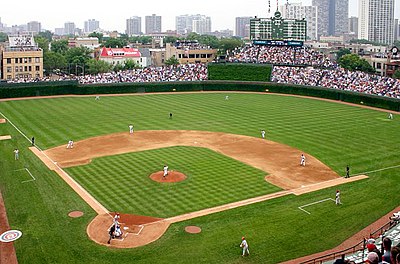
2. Oriole Park at Camden Yards, Baltimore, MD
Even though the Orioles play there, Camden Yards has always been a great place to watch a ballgame in. Debuting in 1992, Camden Yards is known for being the first of the many "retro" parks built, and its success inspired nearly every other baseball team to get their own brand new stadium. A unique feature of this park is the incorporation of an old building, the B & O Warehouse, into its design, as the warehouse serves as the backdrop for the right field bleachers. The park also features a great view of downtown Baltimore, although that has been altered to the building of two new skyscrapers which impair that view. (image from ballparksofbaseball.com).

1. Fenway Park, Boston, MA
I'm not a huge fan of the Red Sox, but I am a huge fan of its ballpark. In fact, if there is one stadium I want to attend a ballgame at, it would be this one. Built in 1912, Fenway Park is the oldest park still in use by a Major League team. The most famous feature of Fenway is the "Green Monster" the 37 foot high fence in left field. Another thing that makes Fenway unique is its wacky dimensions, as the left field fence is only 310 feet away, while the fence in right center is 380 ft away. The dimensions, lack of foul territory, and weird angles off the Green monster and the angular center field fence make games at Fenway an adventure for outfielders, and add a unique factor to games that aren't seen at other games. Another feature exclusive to Fenway is the hand operated scoreboard that resides at ground level on The Green Monster. Although there was talk of replacing Fenway, Red Sox brass wisely have decided against it, meaning that this great stadium will continue to host the Red Sox and their devoted fans for years to come. (image from ballparksofbaseball.com).

Well, that's the five best, but now it's time to get negative and name the five worst baseball stadiums. Unlike the last list of all current stadiums, this one will contain ballparks that are no longer hosting ballgames, so consider this the five worst baseball stadiums I have seen in my time following baseball.
5. Tropicana Field, Tampa, FL
I'm not sure why the people of Tampa Florida decided to build a dome for a baseball team, but that's what they did. Built in 1986, although not used for Major League Baseball until 1998, Tropicana Field often seems like a dull, lifeless place to watch a ballgame. It's indoors, there's nothing really to set it apart from other stadiums and is painted in drab, lifeless colors. The Rays are hoping for a new stadium soon, hopefully it will be better than this one (image courtesy of projectballpark.org)
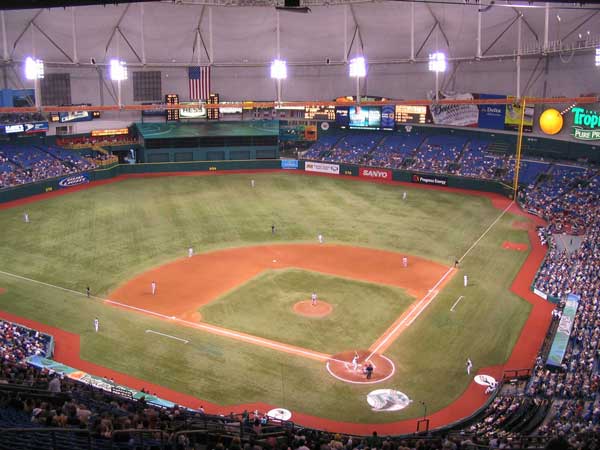
4. Hubert H. Humphrey Metrodome, Minneapolis, MN
The Twins opened up their new ballpark this year, meaning that there will be no more baseball inside of the HHH Metrodome. Personally, I find that to be good news, as I never liked how dark it appeared inside the dome. Not to mention the right field wall, which looked as if it was made of trash bags. On the other hand, the Atlanta Falcons finest moment took place in this building, so I guess I can't completely hate it (image from ballparksofbaseball.com)

3. Veterans Stadium - Philadelphia, PA
The old stadium of the Phillies had all of the charm of razor-wire. The only thing this stadium was known for was its artificial turf, considered to be the worst playing surface in baseball. The park was huge and cavernous, to the point where some seats required binoculars in order to see the action. The Phillies moved to their new ballpark in 2004, and it is a vast improvement over this one (image courtesy of ballparkreviews.com).
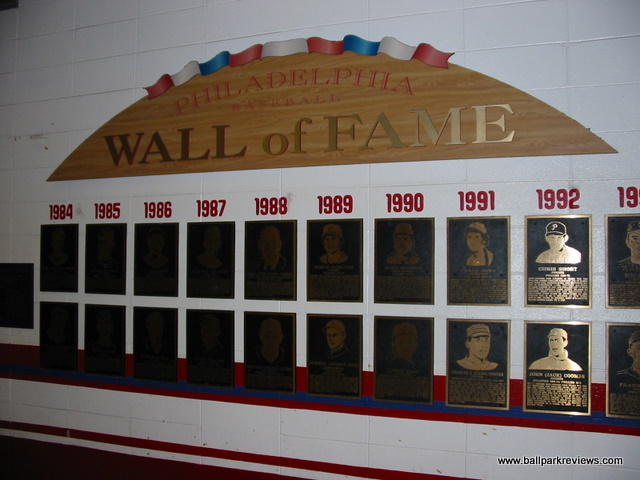
2. Minute Maid Park - Houston, TX
Formerly known as Enron Field, this park probably doesn't deserve to be on a list of worst stadiums, but it's my list, and I must admit that I've never enjoyed the quirks of this stadium. For one thing, why in the world is there a hill and a flagpole in play in centerfield? Also, I've never been a fan of the advertising on the foul poles, and the dimensions are so weird that balls off the wall can be considered home runs, provided they hit over a certain line, as the Braves found out in their 18 inning extra inning marathon in the 2005 NLDS. Actually, that game is probably a large factor in this stadium''s placing on this list (image courtesy of wikipedia.org).

1. Candlestick Park - San Francisco, CA
Candlestick is remembered by many baseball fans for its swirling winds, which made night baseball a challenge to stay warm, even in the summer. Add to that a field far away from even the closest seats, due to its expansive foul territory and outfield walls some 20 feet away from the stands, the chain-link outfield walls, and a drab, lifeless atmosphere, and Candlestick Park is my choice for the worst baseball stadium. It's no coincidence that attendance at Giants games improved dramatically after the Giants moved to AT&T Park (image courtesy of ballparksofbaseball.com).

Well, thanks for reading, and if you have any ideas for future posts, than let me know either by leaving a comment or by sending me a e-mail at KtheC2001@gmail.com.
5. Petco Park - San Diego, CA
The home of the Padres, Petco Park is a fairly new park, having been completed in 2004. What I like about this park is the view of the big buildings of downtown San Diego from home plate, as well as the incorporation of an old warehouse as part of the ballpark, as an old Western Metal Supply building serves as part of the left field wall. Bottom line, this is one of the most attractive stadiums in baseball. (image courtesy of ballparksofbaseball.com)
4. AT&T Park, San Francisco, CA
The home stadium of the Giants is everything that their old stadium, Candlestick Park, isn't, charming, attractive, and what generally seems to be a heck of a place to watch a ballgame. Built on the coast of the San Francisco Bay, this stadium has many unique features, including the "World's Largest Baseball Glove" and a chance for power hitters to hit homeruns in "McCovey's Cove" over the right field fence, an inlet of the San Francisco Bay where many boaters park each night hoping to catch a souvenir. (Image courtesy of mlbraodtrip.com)
3. Wrigley Field, Chicago, IL
The longtime home of the Cubs, Wrigley Field is a landmark in Chicago, home to baseball for almost 100 years. There are quite a few unique qualities in Wrigley Field, from its brick walls covered in ivy to its "rooftop seats" where fans can climb up to the roofs of their apartment buildings and take in all of the action, to its giant green scoreboard in centerfield, one of the few hand controlled scoreboards left in the major leagues. Wrigley Field is often considered the most enjoyable place to watch a ballgame, and for good reason. (image from wikipedia.org)
2. Oriole Park at Camden Yards, Baltimore, MD
Even though the Orioles play there, Camden Yards has always been a great place to watch a ballgame in. Debuting in 1992, Camden Yards is known for being the first of the many "retro" parks built, and its success inspired nearly every other baseball team to get their own brand new stadium. A unique feature of this park is the incorporation of an old building, the B & O Warehouse, into its design, as the warehouse serves as the backdrop for the right field bleachers. The park also features a great view of downtown Baltimore, although that has been altered to the building of two new skyscrapers which impair that view. (image from ballparksofbaseball.com).
1. Fenway Park, Boston, MA
I'm not a huge fan of the Red Sox, but I am a huge fan of its ballpark. In fact, if there is one stadium I want to attend a ballgame at, it would be this one. Built in 1912, Fenway Park is the oldest park still in use by a Major League team. The most famous feature of Fenway is the "Green Monster" the 37 foot high fence in left field. Another thing that makes Fenway unique is its wacky dimensions, as the left field fence is only 310 feet away, while the fence in right center is 380 ft away. The dimensions, lack of foul territory, and weird angles off the Green monster and the angular center field fence make games at Fenway an adventure for outfielders, and add a unique factor to games that aren't seen at other games. Another feature exclusive to Fenway is the hand operated scoreboard that resides at ground level on The Green Monster. Although there was talk of replacing Fenway, Red Sox brass wisely have decided against it, meaning that this great stadium will continue to host the Red Sox and their devoted fans for years to come. (image from ballparksofbaseball.com).
Well, that's the five best, but now it's time to get negative and name the five worst baseball stadiums. Unlike the last list of all current stadiums, this one will contain ballparks that are no longer hosting ballgames, so consider this the five worst baseball stadiums I have seen in my time following baseball.
5. Tropicana Field, Tampa, FL
I'm not sure why the people of Tampa Florida decided to build a dome for a baseball team, but that's what they did. Built in 1986, although not used for Major League Baseball until 1998, Tropicana Field often seems like a dull, lifeless place to watch a ballgame. It's indoors, there's nothing really to set it apart from other stadiums and is painted in drab, lifeless colors. The Rays are hoping for a new stadium soon, hopefully it will be better than this one (image courtesy of projectballpark.org)
4. Hubert H. Humphrey Metrodome, Minneapolis, MN
The Twins opened up their new ballpark this year, meaning that there will be no more baseball inside of the HHH Metrodome. Personally, I find that to be good news, as I never liked how dark it appeared inside the dome. Not to mention the right field wall, which looked as if it was made of trash bags. On the other hand, the Atlanta Falcons finest moment took place in this building, so I guess I can't completely hate it (image from ballparksofbaseball.com)
3. Veterans Stadium - Philadelphia, PA
The old stadium of the Phillies had all of the charm of razor-wire. The only thing this stadium was known for was its artificial turf, considered to be the worst playing surface in baseball. The park was huge and cavernous, to the point where some seats required binoculars in order to see the action. The Phillies moved to their new ballpark in 2004, and it is a vast improvement over this one (image courtesy of ballparkreviews.com).
2. Minute Maid Park - Houston, TX
Formerly known as Enron Field, this park probably doesn't deserve to be on a list of worst stadiums, but it's my list, and I must admit that I've never enjoyed the quirks of this stadium. For one thing, why in the world is there a hill and a flagpole in play in centerfield? Also, I've never been a fan of the advertising on the foul poles, and the dimensions are so weird that balls off the wall can be considered home runs, provided they hit over a certain line, as the Braves found out in their 18 inning extra inning marathon in the 2005 NLDS. Actually, that game is probably a large factor in this stadium''s placing on this list (image courtesy of wikipedia.org).
1. Candlestick Park - San Francisco, CA
Candlestick is remembered by many baseball fans for its swirling winds, which made night baseball a challenge to stay warm, even in the summer. Add to that a field far away from even the closest seats, due to its expansive foul territory and outfield walls some 20 feet away from the stands, the chain-link outfield walls, and a drab, lifeless atmosphere, and Candlestick Park is my choice for the worst baseball stadium. It's no coincidence that attendance at Giants games improved dramatically after the Giants moved to AT&T Park (image courtesy of ballparksofbaseball.com).
Well, thanks for reading, and if you have any ideas for future posts, than let me know either by leaving a comment or by sending me a e-mail at KtheC2001@gmail.com.
Monday, April 5, 2010
The Canon Review 2010 MLB Preview
Normally, The Canon Review does not do previews. After all, it goes against the whole concept of The Canon Review title. However, as I have said before, I'll write about any topic requested by the readers of The Canon Review, and reader Ben W. wanted me to preview the 2010 MLB season, which starts tonight, so preview it I shall. So let's just dive right in, shall we?
AL East (*=Wild Card)
1. New York Yankees
2. Tampa Bay Rays*
3. Boston Red Sox
4. Baltimore Orioles
5. Toronto Blue Jays
I have the Yankees first, although this is going to be a very tough division, as the Yankees, Rays, and Red Sox are arguably three of the top five teams in baseball. The Yankees have a great lineup led by 1B Mark Teixeira, SS Derek Jeter, and 3B Alex Rodriguez. However, it remains to be seen if new CF Curtis Granderson and new DH Nick Johnson can effectively replace the production of former Yankees Johnny Damon and Hideki Matsui. The Yankees pitching should be better with the addition of Javier Vazquez, but he wasn't very effective as a Yankee in 2004, so time will tell. The Rays have a great young lineup, but must get a better year out of CF B.J. Upton. It also remains to be seen if SS Jason Bartlett and RF/2B/Util Ben Zobrist can come close to matching their surprising production from 2009 (My take, Zobrist should be fine, but Bartlett will slip. Pitching wise, the Rays have a chance to be as good as anyone, especially if young pitchers David Price and Wade Davis develop quickly. Plus, with the addition of Rafael Soriano, the Rays bullpen should be more settled than last year. I have the Rays making the playoffs as this year's Wild Card Team.
The Red Sox are a very good team, but I do have questions about their offense, as 2B Dustin Pedroia 1B Kevin Youkilis, and C Victor Martinez are all very good, but the rest of their lineup is a question mark. The Red Sox emphasized defense over offense in the offseason, and while CF Mike Cameron, 3B Adrian Beltre, and SS Marco Scutaro have good gloves, it remains to be seen if their offense will be up to snuff. The Red Sox should have good pitching with Josh Beckett, Jon Lester, and new acquistion John Lackey making for a top-notch starting rotation, but ultimately, I think the Rays and Yankees will be better. If the Red Sox were in any other division, they would be the favorites to win it, but in a stacked division, somebody's got to finish third, and the Red Sox are my choice for that unfortunate distinction. As for the other teams, the Orioles seem to have a plan in place, and good young players, but they are at least a year or two away from contending. The Blue Jays, meanwhile, are starting over, and this will be a rough year, even with star hitters like2B Aaron Hill and RF Adam Lind.
AL Central
1. Minnesota Twins
2. Chicago White Sox
3. Detroit Tigers
4. Cleveland Indians
5. Kansas City Royals
This should be a two-team battle throughout the season. The Twins have the better lineup, led by 2009 MVP C Joe Mauer, 1B Justin Morneau, DH Jason Kubel, and RF Michael Cuddyer, all of which have the potential for 30 HR and 100 RBI seasons. However, their pitching is a question mark, as Scott Baker is the only starter that I would consider above average. If former phenom Fransisco Liriano can regain his pre-injury form, than the Twins will be much better off. Meanwhile, All-Star closer Joe Nathan will miss 2010 for the Twins, although they do have enough talent in their bullpen, so while Nathan will be missed, the Twins should find someone that will be a decent closer (Jon Rauch is the current favorite for that role). The White Sox should have a heck of a rotation, with Jake Peavy, Mark Buehrle, Gavin Floyd, and John Danks all capable of being aces on other teams' staffs. However, their lineup is a bit of a mess. If LF Carlos Quentin can come back from injury, and CF Alexis Rios can start giving a damn again, than the White Sox will have enough power to compete. If not, expect a lot of low scoring games at The Cell this year.
The Tigers nearly won the division last year, but even with star pitcher Justin Verlander and star 1B Miguel Cabrera, there are just too many question marks for me to pick them to win the division. However, the AL Central is pretty weak, so the Tigers could get lucky. I would expect a .500 season though from the Tigers. The Indians are in the same boat as the Tigers, as they have a few good players such as CF Grady Sizemore and RF Shin-Soo Choo, but they also have a lot of questions, particularly with their pitching staff. The Royals, even with 2009 Cy Young Winner Zack Greinke and top closer Joakim Soria, should continue to suck, unless about eight guys have career seasons, the Royals will likely lose at least 95 games. Too bad, because Greinke really is a top-notch talent.
AL West
1. Los Angeles Angels of Anaheim
2. Texas Rangers
3. Seattle Mariners
4. Oakland Athletics
Other than the ridiculously stacked AL East, this might be the most competitive division in baseball, as you can make a case for all four teams to win the division. The Angels, winners of the division for the last three years, and five of the last six, suffered major losses with the departure of free agents 3B Chone Figgins and SP John Lackey. However, the Angles should have the deepest rotation in the division, especially if Ervin Santana bounces back, and have a powerful lineup led by 1B Kendry Morales, CF Torii Hunter, and RF Bobby Abreu. Plus, they added Hideki Matsui from the Yankees to be their new DH, and if 2B Howie Kendrick and 3B Brandon Wood can finally live up to their immense potential, than the Angels could have a very potent offense. The Rangers can hit the ball, and rookie CF Julio Borbon should be an excellent leadoff man for the team, but while the Rangers have pitching talent, most of it is either unproven (Derek Holland, Matt Harrison) or a health rish (Rich Harden). Watch out for prospect Neftali Feliz, who has a 100-mph fastball and should be a key contributor to the Rangers this season, either out of the bullpen or in the rotation. Ultimately, I chose the Angels over the Rangers because while the Rangers have talent, I trust the Angels' players to perform a bit more than I do the Rangers.
The Mariners are a chic pick to win the division this year, according to a lot of people that follow baseball. However, I don't see it. While the Mariners should have great pitching, led by Felix Hernandez and Cliff Lee, two of the top 10 starting pitchers in baseball, the rest of the rotation is a bit of a question mark, and while closer David Aardsma had a great season last year, it remains to be seen if he can do it again. Meanwhile, the Mariners have emphasized defense over offense the past two seasons, and while it did lead the team to a surprising 85 win season last year, it also has left the lineup a bit lacking in power. While Ichiro Suzuki is a top notch leadoff hitter who should bat around .325 this season, the Mariners may not have anyone to drive him, unless they believe that 1B Casey Kotchman will finally develop into a power hitter, that LF Milton Bradley will stay healthy and happy, and that DHs Ken Griffey Jr and Mike Sweeney can turn back the clock five years or so. The Mariners were an 85 win team last year, and even with the addition of Lee, I don't see them winning more than that this year. As for the Athletics, if they get enough hitting, then they might be able to compete. However, they are relying on a lot of question marks in the lineup, like 1B Daric Barton and RF Ryan Sweeney, who have yet to develop the way people thought they should some 3 or 4 years ago. The pitching should be good, especially if Ben Sheets is healthy and Justin Duchscherer is over his physical and mental problems, but the A's probably won't have enough offense to compete.
NL East
1. Philadelphia Phillies
2. Atlanta Braves*
3. New York Mets
4. Florida Marlins
5. Washington Nationals
The Phillies won the World Series in 2008 and went back to the World Series last year, and in the offseason added Roy Halladay, arguably the best pitcher in baseball. Despite trading Cliff Lee, the Phillies are the odds-on favorite to represent the NL in the World Series again. Offensively, the Phillies have oodles of power, led by 2B Chase Utley, 1B Ryan Howard, and RF Jayson Werth. Add to that expected bounce-back seasons from SS Jimmy Rollins and SP Cole Hamels, and the Phillies are loaded. The Braves may have the best rotation in the league, led by young gun Tommy Hanson, Jair Jurrjens, and veteran Tim Hudson, who has looked sharp in spring after recovering from elbow surgery. Offensively, the Braves are led by C Brian McCann, and are hoping from a bounce-back season from 3B Chipper Jones. However, the Braves player everybody is excited about is rookie RF Jason Heyward, who is the most hyped prospect since Alex Rodriguez and is only being compared to guys like Hank Aaron. While expectations may be out of control, it looks as if Heyward, only 20, will at least be a solid right fielder this year, and should only get better in the next few years. I expect a .270 BA and 20+ HR from Heyward this year, which should be enough to help the Braves make the playoffs as a Wild Card team.
The Mets are a mess from the ground up, but still have some talented players in 3B David Wright, SP Johan Santana, and new LF Jason Bay. The Mets battled a lot of injury problems last year, and with CF Carlos Beltran and SS Jose Reyes already on the Disabled List, 2010 may be more of the same. If the Mets are healthy and have their heads on straight, they have enough talent to win 90 games. However, I wouldn't expect the Mets to be any better than a .500 team this year. The Marlins have and MVP Candidate in SS Hanley Ramirez, and two potential aces in Josh Johnson and Ricky Nolasco, but ultimately do not have enough talent to hang with the Phillies and Braves. They should be good, however, and if they get a few breaks, the Marlins could be a team to watch for. The Nationals have two star hitters in 1B Adam Dunn and 3B Ryan Zimmerman, but ultimately are not a very good team. The most interesting thing about the Nationals will be when and if phenom SP Stephen Strasburg is called up to the majors. Expect him up by mid-May, as Strasburg is just too good for the Nats to keep in the minors.
NL Central
1. St. Louis Cardinals
2. Milwaukee Brewers
3. Chicago Cubs
4. Cincinnati Reds
5. Houston Astros
6. Pittsburgh Pirates
Other than the Cardinals, I really don't like the chances of any team in this division. The Cardinals have the top hitter in the game in 1B Albert Pujols and the two best pitchers in the division in Chris Carpenter and Adam Wainwright. Picking the Cardinals to win this division is the easiest choice in this baseball preview, even if some people believe the Brewers or Reds might win. The Brewers should be a decent team, as 1B Prince Fielder and LF Ryan Braun are top-notch hitters, and the staff, led by Yovani Gallardo, should at least be decent, if not as good as the Cardinals and Cubs. Speaking of Chicago, if Carlos Zambrano has his head on straight, and if Ted Lilly recovers from injury, the Cubs have the makings of a very good pitching staff. Their offense might be a different story, as too many players are either a little old (1B Derrek Lee), coming off of bad seasons (C Geovany Soto), or both (LF Alfonso Soriano). The Cubs look like a mediocre team to me.
Some people are high on the Reds' chances this year, but I am not one of them. Their pitching is promising, but I'd like it a little more if Edison Volquez wasn't out for the season. Their hitting could be decent, provided that RF Jay Bruce recovers from an off season and 1B Joey Votto is a successful as he was last year. The Astros are poorly built team, although they have a few good players such as RF Hunter Pence, 1B Lance Berkman, and starting pitchers Roy Oswalt and Wandy Rodriguez. Unfortunately, there's not a lot of help around them, and Berkman's going to start the season on the DL. The Pirates have had 17 straight losing seasons, and there is no reason to believe that this year won't be number 18. If things go well, the Pirates might have a winning season in 2011, but they are too inexperience to make any noise this year.
NL West
1. Colorado Rockies
2. Los Angeles Dodgers
3. Arizona Diamondbacks
4. San Francisco Giants
5. San Diego Padres
This division could become a four way battle between the Rockies, Dodgers, Diamondbacks, and Giants. Ultimately, I picked the Rockies because they have the least weaknesses of any team in this division. Their pitching staff, led by ace Ubaldo Jimenez, should be very good, especially if starter Jeff Francis and closer Huston Street can come back from injuries suffered during spring training. Their offense is good, led by SS Troy Tulowitzki and potential superstar CF Carlos Gonzalez. The Dodgers still have a solid lineup, led by their outfield of Manny Ramirez, Matt Kemp, and Andre Ethier. However, their rotation is a mess after Clayton Kershaw and Chad Billingsley, and both of them have questions about their durability. At least they have a top closer in Johnathan Broxton, and if they find a pitcher or two to go with Kershaw and Billingsley, and if 1B James Loney can finally hit for power or C Russell Martin plays like he did in 2007 and 2008 instead of the way he played last year, the Dodgers could make the postseason for the third straight year.
There are some people that feel that this is the year the Diamondbacks' young talent finally lives up to their promise, I am not one of them, but I will say that the team has a couple of stars in RF Justin Upton, 3B Mark Reynolds (despite the strikeouts) and SP Dan Haren. Ultimately, it won't be enough this year. The Giants have excellent pitching, led by two-time Cy Young winner Tim Lincecum and Matt Cain, but other than 3BPablo Sandoval, the Giants lack offense, and unless you believe that CF Aaron Rowand, 1B Aubrey Huff, and SS Edgar Renteria will regain their previous form, Don't hold your breath on that happening this year, though. The Padres have some good young players, like SP Mat Latos, LF Kyle Blanks, and SS Everth Cabrera, but are at least a year away from contending. The only suspense surronding the Padres is if and when they trade star 1B Adrian Gonzalez. I would hope they could keep Gonzalez, a San Diego native, but the small-market Padres might not be able to afford a player of his caliber.
Award Predictions:
AL MVP:
1. Joe Mauer, C, Twins
2. Mark Teixeira, 1B, Yankees
3. Kendry Morales, 1B, Angels
Dark Horse: Nelson Cruz, RF, Rangers
Mauer, who recently signed an 8-year, $184 million extension, was last year's MVP, and his excellent fielding and powerful bat make him the favorite to win the award again and become the first catcher to win 2 MVP Awards since Johnny Bench in 1970 and 1972. Both Teixeira and Morales are powerful first basemen in the prime of their careers, and both should be the top RBI men on contending teams. Since MVP voters love RBIs, that should give both Teixeira and Morales an advantage. Keep an eye on Nelson Cruz, a powerful right fielder for the Texas Rangers. If the Rangers make the playoffs, Cruz will be a large reason why, and he also has the ability to hit 40 home runs this season.
NL MVP:
1. Chase Utley, 2B, Phillies
2. Albert Pujols, 1B, Cardinals
3. Ryan Braun, LF, Brewers
Dark Horse: Justin Upton, RF, Diamondbacks
In recent years, both 1B Ryan Howard and SS Jimmy Rollins have won MVP awards for the Phillies. However, many people believe that Utley has been the largest reason for the Phillies' success over the past few years. Other than Albert Pujols, Utley may be the best hitter in the NL, and I think that 2010 will finally be the year Utley gets his own Most Valuable Player Award. Pujols is a three time MVP winner, and at 30, is still in the prime of his career. Braun is one of the best hitters in the game, and has the potential to hit 40-45 home runs this season. Upton might be the most talented player in baseball, and at 22, is just starting to put it all together. The sky's the limit for Upton, and if the Diamondbacks sneak into the playoffs, Upton will be a large reason why.
AL Cy Young Award:
1. Felix Hernandez, SP, Mariners
2. C.C. Sabathia, SP, Yankees
3. Zack Greinke, SP, Royals
Dark Horse: Brett Anderson, SP, Athletics
Hernandez is an elite pitcher playing his home games in a pitchers park with the game's best defense behind him. Even if the Mariners don't score enough for King Felix, Hernandez has the stuff and should dominate the league in 2010. Sabathia is an ace pitcher playing for the best team in the league, so he should have a high win total to go along with his usual high strikeout total and low ERA. If so, Sabathia could nab his second Cy Young Award. Greinke was the best pitcher in the American League last year, and there's no reason to believe that he won't have an excellent season in 2010. Keep an eye on Anderson, an immensely talented 22-year-old who many experts believe will have a breakout season in 2010.
NL Cy Young
1. Roy Halladay, SP, Phillies
2. Tim Lincecum, SP, Giants
3. Chris Carpenter, SP, Cardinals
Dark Horse: Ubaldo Jimenez, SP, Rockies
Halladay has a lot of factors going for him. For one, he'll be on the best team in the NL instead of a mediocre Blue Jays squad. Also, he'll be pitching in the National League, which is much easier for pitchers. Halladay is likely to win at least 20 games this year, and some feel he could get 25 wins. That might be a little much, but Halladay is my pick for Cy Young Winner. Lincecum has won the last two, so it would be stupid to discount him. As long as he's healthy, Lincecum should be a Cy Young contender for the next decade or so. Carpenter also is a former Cy Young Winner, and pitched well enough to win last year. As long as he's healthy, Carpenter is one of the best pitchers in the game. Jimenez has electric stuff and while Coors Field is still a hitter's park, the effects are not as extreme as they were a decade ago, making it possible for Jimenez to put together a Cy Young caliber season for the Rocks.
AL Rookie of the Year:
1. Wade Davis, SP, Rays
2. Scott Sizemore, 2B, Tigers
3. Brian Matusz, SP, Orioles
Dark Horses: Lou Marson/Carlos Santana, C, Indians
Davis is expected to be the Rays fifth starter for now, but has the stuff and command to be a key starter for Tampa Bay this year. Don't be surprised if Davis wins 15 for the Rays and puts up an ERA around 3.50. Sizemore will start at second base for the Tigers, and has a solid glove and pop in his bat. While fellow rookie CF Austin Jackson may be getting more headlines for the Tigers, Sizemore is considered more ready to excel at the major league level. Matusz is one of the top pitching prospects in the AL, and impressed many in his few starts last year for the Orioles. If the Orioles score enough runs, Matusz could have a very good rookie year. Marson will start at catcher for the Indians, but many people feel that Santana has more potential and is the better hitter of the two. If Marson struggles, look for Santana to be called up from the minors. However, Marson has enough talent to contend for the Rookie of the Year Award himself, so it should be interesting to see what happens in Cleveland.
NL Rookie of the Year:
1. Jason Heyward, RF, Braves
2. Alcides Escobar, SS, Brewers
3. Stephen Strasburg, SP, Nationals
Dark Horse: Pedro Alvarez, 3B/1B, Pirates
Heyward has been talked about in terms usually revered for Chuck Norris (i.e. "Jason Heyward will win Rookie of the Year twice" or "Jason Heyward covers more ground than grass"). In fact, it is widely believed that while the Boogeyman may check under his bed for Chuck Norris, Chuck Norris checks under his bed for Jason Heyward. While Heyward has been incredibly hyped, he should be good enough to deliver on at least some of it, as the Braves have wisely decided to start him in right field this season. Escobar may not be able to cover more ground than grass, but he is a solid player and will be the Brewers' everyday shortstop. Strasburg will start the season in the minors due to financial reasons, but he should be back by May and much like last year's ROY, Chris Coughlin, Strasburg very well could win the award despite spending a month or so in the minors. Alvarez might be the Pirates best hitter other than CF Andrew McCutheon, but his glove needs work and like Strasburg, the Pirates may have kept him in the minors due to financial reasons. There's no doubt that Alvarez can rake, though, and he could be in the Pirates lineup before you know it.
World Series Prediction: Phillies over Yankees in 6
Like last year, these two teams are clearly the class of their respective leagues, although the Red Sox, Rays, Angels, Cardinals and Braves might disagree. But in my mind, at least, we will see a repeat of last year's World Series, only this year the Phillies, led by new acquistion Roy Halladay and new closer Ryan Madson, should have the pitching to shut down the Yankees' bats. Add that to the Phillies' potent offense, and Philadelphia will celebrate their second World Series title in three years.
Well, that was long, but hopefully it was at least a decent preview for the 2010 season. It should be an exciting season, even if you are a Royals fan, because at least you have Zack Greinke pitching every fifth day. Thanks for reading, and let me know your thoughts on the 2010 MLB season if you any.
AL East (*=Wild Card)
1. New York Yankees
2. Tampa Bay Rays*
3. Boston Red Sox
4. Baltimore Orioles
5. Toronto Blue Jays
I have the Yankees first, although this is going to be a very tough division, as the Yankees, Rays, and Red Sox are arguably three of the top five teams in baseball. The Yankees have a great lineup led by 1B Mark Teixeira, SS Derek Jeter, and 3B Alex Rodriguez. However, it remains to be seen if new CF Curtis Granderson and new DH Nick Johnson can effectively replace the production of former Yankees Johnny Damon and Hideki Matsui. The Yankees pitching should be better with the addition of Javier Vazquez, but he wasn't very effective as a Yankee in 2004, so time will tell. The Rays have a great young lineup, but must get a better year out of CF B.J. Upton. It also remains to be seen if SS Jason Bartlett and RF/2B/Util Ben Zobrist can come close to matching their surprising production from 2009 (My take, Zobrist should be fine, but Bartlett will slip. Pitching wise, the Rays have a chance to be as good as anyone, especially if young pitchers David Price and Wade Davis develop quickly. Plus, with the addition of Rafael Soriano, the Rays bullpen should be more settled than last year. I have the Rays making the playoffs as this year's Wild Card Team.
The Red Sox are a very good team, but I do have questions about their offense, as 2B Dustin Pedroia 1B Kevin Youkilis, and C Victor Martinez are all very good, but the rest of their lineup is a question mark. The Red Sox emphasized defense over offense in the offseason, and while CF Mike Cameron, 3B Adrian Beltre, and SS Marco Scutaro have good gloves, it remains to be seen if their offense will be up to snuff. The Red Sox should have good pitching with Josh Beckett, Jon Lester, and new acquistion John Lackey making for a top-notch starting rotation, but ultimately, I think the Rays and Yankees will be better. If the Red Sox were in any other division, they would be the favorites to win it, but in a stacked division, somebody's got to finish third, and the Red Sox are my choice for that unfortunate distinction. As for the other teams, the Orioles seem to have a plan in place, and good young players, but they are at least a year or two away from contending. The Blue Jays, meanwhile, are starting over, and this will be a rough year, even with star hitters like2B Aaron Hill and RF Adam Lind.
AL Central
1. Minnesota Twins
2. Chicago White Sox
3. Detroit Tigers
4. Cleveland Indians
5. Kansas City Royals
This should be a two-team battle throughout the season. The Twins have the better lineup, led by 2009 MVP C Joe Mauer, 1B Justin Morneau, DH Jason Kubel, and RF Michael Cuddyer, all of which have the potential for 30 HR and 100 RBI seasons. However, their pitching is a question mark, as Scott Baker is the only starter that I would consider above average. If former phenom Fransisco Liriano can regain his pre-injury form, than the Twins will be much better off. Meanwhile, All-Star closer Joe Nathan will miss 2010 for the Twins, although they do have enough talent in their bullpen, so while Nathan will be missed, the Twins should find someone that will be a decent closer (Jon Rauch is the current favorite for that role). The White Sox should have a heck of a rotation, with Jake Peavy, Mark Buehrle, Gavin Floyd, and John Danks all capable of being aces on other teams' staffs. However, their lineup is a bit of a mess. If LF Carlos Quentin can come back from injury, and CF Alexis Rios can start giving a damn again, than the White Sox will have enough power to compete. If not, expect a lot of low scoring games at The Cell this year.
The Tigers nearly won the division last year, but even with star pitcher Justin Verlander and star 1B Miguel Cabrera, there are just too many question marks for me to pick them to win the division. However, the AL Central is pretty weak, so the Tigers could get lucky. I would expect a .500 season though from the Tigers. The Indians are in the same boat as the Tigers, as they have a few good players such as CF Grady Sizemore and RF Shin-Soo Choo, but they also have a lot of questions, particularly with their pitching staff. The Royals, even with 2009 Cy Young Winner Zack Greinke and top closer Joakim Soria, should continue to suck, unless about eight guys have career seasons, the Royals will likely lose at least 95 games. Too bad, because Greinke really is a top-notch talent.
AL West
1. Los Angeles Angels of Anaheim
2. Texas Rangers
3. Seattle Mariners
4. Oakland Athletics
Other than the ridiculously stacked AL East, this might be the most competitive division in baseball, as you can make a case for all four teams to win the division. The Angels, winners of the division for the last three years, and five of the last six, suffered major losses with the departure of free agents 3B Chone Figgins and SP John Lackey. However, the Angles should have the deepest rotation in the division, especially if Ervin Santana bounces back, and have a powerful lineup led by 1B Kendry Morales, CF Torii Hunter, and RF Bobby Abreu. Plus, they added Hideki Matsui from the Yankees to be their new DH, and if 2B Howie Kendrick and 3B Brandon Wood can finally live up to their immense potential, than the Angels could have a very potent offense. The Rangers can hit the ball, and rookie CF Julio Borbon should be an excellent leadoff man for the team, but while the Rangers have pitching talent, most of it is either unproven (Derek Holland, Matt Harrison) or a health rish (Rich Harden). Watch out for prospect Neftali Feliz, who has a 100-mph fastball and should be a key contributor to the Rangers this season, either out of the bullpen or in the rotation. Ultimately, I chose the Angels over the Rangers because while the Rangers have talent, I trust the Angels' players to perform a bit more than I do the Rangers.
The Mariners are a chic pick to win the division this year, according to a lot of people that follow baseball. However, I don't see it. While the Mariners should have great pitching, led by Felix Hernandez and Cliff Lee, two of the top 10 starting pitchers in baseball, the rest of the rotation is a bit of a question mark, and while closer David Aardsma had a great season last year, it remains to be seen if he can do it again. Meanwhile, the Mariners have emphasized defense over offense the past two seasons, and while it did lead the team to a surprising 85 win season last year, it also has left the lineup a bit lacking in power. While Ichiro Suzuki is a top notch leadoff hitter who should bat around .325 this season, the Mariners may not have anyone to drive him, unless they believe that 1B Casey Kotchman will finally develop into a power hitter, that LF Milton Bradley will stay healthy and happy, and that DHs Ken Griffey Jr and Mike Sweeney can turn back the clock five years or so. The Mariners were an 85 win team last year, and even with the addition of Lee, I don't see them winning more than that this year. As for the Athletics, if they get enough hitting, then they might be able to compete. However, they are relying on a lot of question marks in the lineup, like 1B Daric Barton and RF Ryan Sweeney, who have yet to develop the way people thought they should some 3 or 4 years ago. The pitching should be good, especially if Ben Sheets is healthy and Justin Duchscherer is over his physical and mental problems, but the A's probably won't have enough offense to compete.
NL East
1. Philadelphia Phillies
2. Atlanta Braves*
3. New York Mets
4. Florida Marlins
5. Washington Nationals
The Phillies won the World Series in 2008 and went back to the World Series last year, and in the offseason added Roy Halladay, arguably the best pitcher in baseball. Despite trading Cliff Lee, the Phillies are the odds-on favorite to represent the NL in the World Series again. Offensively, the Phillies have oodles of power, led by 2B Chase Utley, 1B Ryan Howard, and RF Jayson Werth. Add to that expected bounce-back seasons from SS Jimmy Rollins and SP Cole Hamels, and the Phillies are loaded. The Braves may have the best rotation in the league, led by young gun Tommy Hanson, Jair Jurrjens, and veteran Tim Hudson, who has looked sharp in spring after recovering from elbow surgery. Offensively, the Braves are led by C Brian McCann, and are hoping from a bounce-back season from 3B Chipper Jones. However, the Braves player everybody is excited about is rookie RF Jason Heyward, who is the most hyped prospect since Alex Rodriguez and is only being compared to guys like Hank Aaron. While expectations may be out of control, it looks as if Heyward, only 20, will at least be a solid right fielder this year, and should only get better in the next few years. I expect a .270 BA and 20+ HR from Heyward this year, which should be enough to help the Braves make the playoffs as a Wild Card team.
The Mets are a mess from the ground up, but still have some talented players in 3B David Wright, SP Johan Santana, and new LF Jason Bay. The Mets battled a lot of injury problems last year, and with CF Carlos Beltran and SS Jose Reyes already on the Disabled List, 2010 may be more of the same. If the Mets are healthy and have their heads on straight, they have enough talent to win 90 games. However, I wouldn't expect the Mets to be any better than a .500 team this year. The Marlins have and MVP Candidate in SS Hanley Ramirez, and two potential aces in Josh Johnson and Ricky Nolasco, but ultimately do not have enough talent to hang with the Phillies and Braves. They should be good, however, and if they get a few breaks, the Marlins could be a team to watch for. The Nationals have two star hitters in 1B Adam Dunn and 3B Ryan Zimmerman, but ultimately are not a very good team. The most interesting thing about the Nationals will be when and if phenom SP Stephen Strasburg is called up to the majors. Expect him up by mid-May, as Strasburg is just too good for the Nats to keep in the minors.
NL Central
1. St. Louis Cardinals
2. Milwaukee Brewers
3. Chicago Cubs
4. Cincinnati Reds
5. Houston Astros
6. Pittsburgh Pirates
Other than the Cardinals, I really don't like the chances of any team in this division. The Cardinals have the top hitter in the game in 1B Albert Pujols and the two best pitchers in the division in Chris Carpenter and Adam Wainwright. Picking the Cardinals to win this division is the easiest choice in this baseball preview, even if some people believe the Brewers or Reds might win. The Brewers should be a decent team, as 1B Prince Fielder and LF Ryan Braun are top-notch hitters, and the staff, led by Yovani Gallardo, should at least be decent, if not as good as the Cardinals and Cubs. Speaking of Chicago, if Carlos Zambrano has his head on straight, and if Ted Lilly recovers from injury, the Cubs have the makings of a very good pitching staff. Their offense might be a different story, as too many players are either a little old (1B Derrek Lee), coming off of bad seasons (C Geovany Soto), or both (LF Alfonso Soriano). The Cubs look like a mediocre team to me.
Some people are high on the Reds' chances this year, but I am not one of them. Their pitching is promising, but I'd like it a little more if Edison Volquez wasn't out for the season. Their hitting could be decent, provided that RF Jay Bruce recovers from an off season and 1B Joey Votto is a successful as he was last year. The Astros are poorly built team, although they have a few good players such as RF Hunter Pence, 1B Lance Berkman, and starting pitchers Roy Oswalt and Wandy Rodriguez. Unfortunately, there's not a lot of help around them, and Berkman's going to start the season on the DL. The Pirates have had 17 straight losing seasons, and there is no reason to believe that this year won't be number 18. If things go well, the Pirates might have a winning season in 2011, but they are too inexperience to make any noise this year.
NL West
1. Colorado Rockies
2. Los Angeles Dodgers
3. Arizona Diamondbacks
4. San Francisco Giants
5. San Diego Padres
This division could become a four way battle between the Rockies, Dodgers, Diamondbacks, and Giants. Ultimately, I picked the Rockies because they have the least weaknesses of any team in this division. Their pitching staff, led by ace Ubaldo Jimenez, should be very good, especially if starter Jeff Francis and closer Huston Street can come back from injuries suffered during spring training. Their offense is good, led by SS Troy Tulowitzki and potential superstar CF Carlos Gonzalez. The Dodgers still have a solid lineup, led by their outfield of Manny Ramirez, Matt Kemp, and Andre Ethier. However, their rotation is a mess after Clayton Kershaw and Chad Billingsley, and both of them have questions about their durability. At least they have a top closer in Johnathan Broxton, and if they find a pitcher or two to go with Kershaw and Billingsley, and if 1B James Loney can finally hit for power or C Russell Martin plays like he did in 2007 and 2008 instead of the way he played last year, the Dodgers could make the postseason for the third straight year.
There are some people that feel that this is the year the Diamondbacks' young talent finally lives up to their promise, I am not one of them, but I will say that the team has a couple of stars in RF Justin Upton, 3B Mark Reynolds (despite the strikeouts) and SP Dan Haren. Ultimately, it won't be enough this year. The Giants have excellent pitching, led by two-time Cy Young winner Tim Lincecum and Matt Cain, but other than 3BPablo Sandoval, the Giants lack offense, and unless you believe that CF Aaron Rowand, 1B Aubrey Huff, and SS Edgar Renteria will regain their previous form, Don't hold your breath on that happening this year, though. The Padres have some good young players, like SP Mat Latos, LF Kyle Blanks, and SS Everth Cabrera, but are at least a year away from contending. The only suspense surronding the Padres is if and when they trade star 1B Adrian Gonzalez. I would hope they could keep Gonzalez, a San Diego native, but the small-market Padres might not be able to afford a player of his caliber.
Award Predictions:
AL MVP:
1. Joe Mauer, C, Twins
2. Mark Teixeira, 1B, Yankees
3. Kendry Morales, 1B, Angels
Dark Horse: Nelson Cruz, RF, Rangers
Mauer, who recently signed an 8-year, $184 million extension, was last year's MVP, and his excellent fielding and powerful bat make him the favorite to win the award again and become the first catcher to win 2 MVP Awards since Johnny Bench in 1970 and 1972. Both Teixeira and Morales are powerful first basemen in the prime of their careers, and both should be the top RBI men on contending teams. Since MVP voters love RBIs, that should give both Teixeira and Morales an advantage. Keep an eye on Nelson Cruz, a powerful right fielder for the Texas Rangers. If the Rangers make the playoffs, Cruz will be a large reason why, and he also has the ability to hit 40 home runs this season.
NL MVP:
1. Chase Utley, 2B, Phillies
2. Albert Pujols, 1B, Cardinals
3. Ryan Braun, LF, Brewers
Dark Horse: Justin Upton, RF, Diamondbacks
In recent years, both 1B Ryan Howard and SS Jimmy Rollins have won MVP awards for the Phillies. However, many people believe that Utley has been the largest reason for the Phillies' success over the past few years. Other than Albert Pujols, Utley may be the best hitter in the NL, and I think that 2010 will finally be the year Utley gets his own Most Valuable Player Award. Pujols is a three time MVP winner, and at 30, is still in the prime of his career. Braun is one of the best hitters in the game, and has the potential to hit 40-45 home runs this season. Upton might be the most talented player in baseball, and at 22, is just starting to put it all together. The sky's the limit for Upton, and if the Diamondbacks sneak into the playoffs, Upton will be a large reason why.
AL Cy Young Award:
1. Felix Hernandez, SP, Mariners
2. C.C. Sabathia, SP, Yankees
3. Zack Greinke, SP, Royals
Dark Horse: Brett Anderson, SP, Athletics
Hernandez is an elite pitcher playing his home games in a pitchers park with the game's best defense behind him. Even if the Mariners don't score enough for King Felix, Hernandez has the stuff and should dominate the league in 2010. Sabathia is an ace pitcher playing for the best team in the league, so he should have a high win total to go along with his usual high strikeout total and low ERA. If so, Sabathia could nab his second Cy Young Award. Greinke was the best pitcher in the American League last year, and there's no reason to believe that he won't have an excellent season in 2010. Keep an eye on Anderson, an immensely talented 22-year-old who many experts believe will have a breakout season in 2010.
NL Cy Young
1. Roy Halladay, SP, Phillies
2. Tim Lincecum, SP, Giants
3. Chris Carpenter, SP, Cardinals
Dark Horse: Ubaldo Jimenez, SP, Rockies
Halladay has a lot of factors going for him. For one, he'll be on the best team in the NL instead of a mediocre Blue Jays squad. Also, he'll be pitching in the National League, which is much easier for pitchers. Halladay is likely to win at least 20 games this year, and some feel he could get 25 wins. That might be a little much, but Halladay is my pick for Cy Young Winner. Lincecum has won the last two, so it would be stupid to discount him. As long as he's healthy, Lincecum should be a Cy Young contender for the next decade or so. Carpenter also is a former Cy Young Winner, and pitched well enough to win last year. As long as he's healthy, Carpenter is one of the best pitchers in the game. Jimenez has electric stuff and while Coors Field is still a hitter's park, the effects are not as extreme as they were a decade ago, making it possible for Jimenez to put together a Cy Young caliber season for the Rocks.
AL Rookie of the Year:
1. Wade Davis, SP, Rays
2. Scott Sizemore, 2B, Tigers
3. Brian Matusz, SP, Orioles
Dark Horses: Lou Marson/Carlos Santana, C, Indians
Davis is expected to be the Rays fifth starter for now, but has the stuff and command to be a key starter for Tampa Bay this year. Don't be surprised if Davis wins 15 for the Rays and puts up an ERA around 3.50. Sizemore will start at second base for the Tigers, and has a solid glove and pop in his bat. While fellow rookie CF Austin Jackson may be getting more headlines for the Tigers, Sizemore is considered more ready to excel at the major league level. Matusz is one of the top pitching prospects in the AL, and impressed many in his few starts last year for the Orioles. If the Orioles score enough runs, Matusz could have a very good rookie year. Marson will start at catcher for the Indians, but many people feel that Santana has more potential and is the better hitter of the two. If Marson struggles, look for Santana to be called up from the minors. However, Marson has enough talent to contend for the Rookie of the Year Award himself, so it should be interesting to see what happens in Cleveland.
NL Rookie of the Year:
1. Jason Heyward, RF, Braves
2. Alcides Escobar, SS, Brewers
3. Stephen Strasburg, SP, Nationals
Dark Horse: Pedro Alvarez, 3B/1B, Pirates
Heyward has been talked about in terms usually revered for Chuck Norris (i.e. "Jason Heyward will win Rookie of the Year twice" or "Jason Heyward covers more ground than grass"). In fact, it is widely believed that while the Boogeyman may check under his bed for Chuck Norris, Chuck Norris checks under his bed for Jason Heyward. While Heyward has been incredibly hyped, he should be good enough to deliver on at least some of it, as the Braves have wisely decided to start him in right field this season. Escobar may not be able to cover more ground than grass, but he is a solid player and will be the Brewers' everyday shortstop. Strasburg will start the season in the minors due to financial reasons, but he should be back by May and much like last year's ROY, Chris Coughlin, Strasburg very well could win the award despite spending a month or so in the minors. Alvarez might be the Pirates best hitter other than CF Andrew McCutheon, but his glove needs work and like Strasburg, the Pirates may have kept him in the minors due to financial reasons. There's no doubt that Alvarez can rake, though, and he could be in the Pirates lineup before you know it.
World Series Prediction: Phillies over Yankees in 6
Like last year, these two teams are clearly the class of their respective leagues, although the Red Sox, Rays, Angels, Cardinals and Braves might disagree. But in my mind, at least, we will see a repeat of last year's World Series, only this year the Phillies, led by new acquistion Roy Halladay and new closer Ryan Madson, should have the pitching to shut down the Yankees' bats. Add that to the Phillies' potent offense, and Philadelphia will celebrate their second World Series title in three years.
Well, that was long, but hopefully it was at least a decent preview for the 2010 season. It should be an exciting season, even if you are a Royals fan, because at least you have Zack Greinke pitching every fifth day. Thanks for reading, and let me know your thoughts on the 2010 MLB season if you any.
Subscribe to:
Posts (Atom)