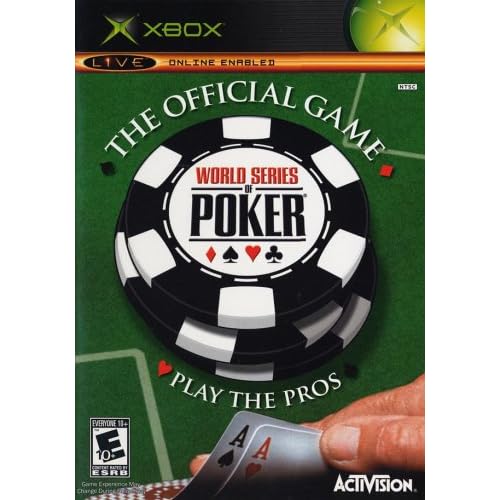
Over the past few days, I have found myself playing a lot of the 2005 game World Series of Poker for the XBOX. It is the best first-person shooting game I have ever played. Well, not really. Like you might have guessed from its name, World Series of Poker is a poker game that features the logos of the World Series of Poker and some poker professionals from the World Poker Tour. Other than Chris Ferguson, I don't know who any of the pros are, but I guess they had to be pretty successful to get into the game. Or maybe they paid somebody, what do I know? Here is the cover for the game, courtesy of amazon.com:
In World Series of Poker, the game offers four different games of poker to play. There's the most well known, Texas Hold 'Em, as well as Seven Card Stud, Omaha, and Razz. Both Seven Card Stud and Omaha also have hi-lo split versions, where the lowest and highest hands split the pot. Even though I only knew of Texas Hold 'Em when I first started playing the game, the other games are not too hard to pick up. However, the instruction book and the game itself wasn't too helpful in explaining the rules. So basically you're either left to figure it out on the fly or look up the rules somewhere on the internet. The graphics are nothing to write home about, but since it is just a poker game, graphics aren't really the most important factor. I will say that the characters look rather normal, and you can clearly see everything that is going on. The game provides commentary from poker announcer Lon McEachern, but I think he says only eight phrases throughout the game, and the commentary gets rather repetitive after the third hand or so.
The game offers a career mode where you create your own player and get 10,000 dollars each year to participate in various events, depending on the game, the type of bet (no-limit, pot limit, limit bets) and the amount of cash it takes to play each game. Of course, the big event is the World Series of Poker. Although it's a rather simple career mode, I have found it to be quite enjoyable. The game also offers different poker chips for achievements on the game, such as winning tournaments, eliminating pros in a showdown, getting certain hands and also for the amount of money you win throughout your career. You can't really do anything with the chips, so it's basically like the achievements on an XBox 360 game.
The game itself moves pretty fast, so you don't waste a lot of time watching the CPU players making their decisions, unlike the World Series of Poker game for the XBox 360, which takes forever to play just one hand. The AI players range from extremely aggressive to extremely conservative, although most of the players seem to lean towards the former. This makes things rather frustrating at times, especially when they'll go all in with a crappy hand like a 7-2 or something. Of course with my luck, they'll end up getting three more sevens or something, but I digress. I will say that they are rather predictable, so an experienced poker player will be able to pick up on each player's betting tendencies early in the game. One rather annoying thing about the game is that the CPU likes to rub it in when they win, and since most characters only have about 6 or 7 lines of dialogue, you hear the same things over and over again. One guy kept saying "Trying to knock down a dinosaur" after dang near each bet he made. Not only is it a dumb thing to say, but the constant repetition finally caused me to turn the sound down and listen to some music. Luckily, the game offers the use of custom soundtracks, so you can just listen to the music stored on your XBox is the sound gets too annoying. The game also has online play available, but since I don't feel like renewing my XBox live account, I won't be playing it online anytime soon. From what I remember, it's not too bad, but a little slow and if the host leaves the table, the game automatically ends instead of the game finding another host, which kind of sucks.
Overall, World Series of Poker is just a basic cookie-cutter poker game, but it still is quite enjoyable to play, in least in my view. There are a couple of weaknesses, but overall the game moves quickly and should provide anyone wanting to play some poker a good time. I'll give the game a 6.5 out of 10. Well, thanks for reading, and if you have any ideas for future reviews, or thoughts about this and previous reviews, than feel free to leave a comment or send me an e-mail at KtheC2001@gmail.com. Now, here's a video of a lucky poker hand for Chris Ferguson:
Wednesday, August 18, 2010
Brett Favre is BACK! I think, and more fun with YouTube reccomendations
Well boys and girls, it seems as if our national crisis is over. Brett Favre is in Minnesota right now and all sings are pointing to Favre coming back for a 93rd season in the NFL. Personally I'm disappointed, as I thought Favre would drag the suspense out one more week before coming back. But Favre's back and his return can only mean one thing, that football season has officially begun. I'm so excited that I can't think straight, so I'm going to watch a few videos that YouTube tells me to watch and share my thoughts about them.
Video 1: Brett Favre's First Completion
Actually, this wasn't a recommendation, I just wanted to see a Brett Favre video. This video is of a young Brett Favre in 1992 playing against the Tampa Bay Buccaneers, who at this time were still wearing their hideous orange and white uniforms. In this clip, Favre rolls out to the right and throws, but his pass is tipped by defensive end Ray Seals. Favre, ever the competitor, is undaunted by this turn of events, and proceeds to catch the live ball himself. This doesn't go well for Mr. Favre, as he is quickly tackled for a loss. So, yes, Brett Favre's first completed pass was to himself. Also, even as a youngster, the announcers are quick to point out the competivness of Brett Favre. If he pulled this same play this year, I'm sure whoever is announcing will have an on-air orgasm explaining how Brett Favre 'just likes to have fun out there' Especially if those idiots on the ESPN Monday Night Football crew call the game. I don't think there's a football player those guys don't love, especially Jon Gruden, who gushes over quarterbacks ad nauseum. But I digress.
Video 2: Bobby Heenan unveils Narcissist Lex Luger
Well, this was rather interesting. I believe after watching this video that not only is the Narcissist in love with himself, but Bobby Heenan is in love with the Narciassist. The whole video is five minutes of Luger posing in front of a mirror while Heenan prods him on by saying things such as 'Don't tease us Lex, show us', and "oh, are you ever put together". Finally, Luger stops posing to drop some knowledge on us, telling us that all the other wrestlers will bow down on their knees before him, and that he is the "most mesamorphically, magnificent physical specimen" Luger threatens Heenan's former charge Mr. Perfect some and that's all there is to it. After the interview, Heenan says that this is the "highlight of my career". I'm 99.9% sure that Heenan would not say the same about this moment today. Anyway, the Narcissist made such an impact that he was repacked a mere six months later as Lex Luger, the All-American.
Video 3: ESPN MLB Commercial
I believe that this commercial is from 2007, but I'm not 100% sure. Anyway, it's just a basic commercial which describes how much you love baseball or something like that. I wouldn't think that I needed to be told how and why I came to love baseball, but by golly ESPN does that for me anyway. Maybe I'm just tired, but I did not care much for this commercial. Perhaps you will like it more.
Video 4: The Price is Right: Temptation Goof from 1983:
In this clip of a Price is Right episode from back in the day, a woman is playing a game called Temptation, where she must select a number from the prices of four items to guess the correct price of a new car. It's hard to believe that the price of a new car could be less than 10,000 dollars, but here we are. The person can either take the four prizes and walk away, or try to play for the car. If they win the car, they also get the other prizes, if not they win nothing. Usually they play for the car. The prizes are a $350 dollar space heater, some luggage, an electronic blood pressure reader, and a touchtone telephone which must have been a big deal at this time, because it was valued at $550 dollars. I wouldn't pay more than five dollars for that phone today. Anyway, the lady chooses her numbers, and gets the first three right without a problem. But as Bob Barker pushes the button to reveal the fourth number, the door won't drop. Bob tries and tries, but the blasted thing won't work. Bob explains to the lady that she will have to wait until the next day. The lady then tries to push the button and what do you know? It works and she won the car. To be honest, I think they made up a malfunction just to build up suspense, but hey, that's showbuisness for you. I wonder what happened to all of those prizes?
Well, I think I'll stop for now. Tommorrow I will try to have two posts on the Canon Review, but I'm not promising anything. I will promise that soon justice is coming to The Canon Review, and by justice I mean TNA's Hardcore Justice 2010. I can feel your excitement coming from your various internet connections. Remember, if you have any ideas for future reviews, or comments on this post, then send them to me either by e-mail at KtheC2001@gmail.com or by leaving a comment on the blog.
Labels:
Bobby Heenan,
Brett Favre,
commercial,
ESPN,
Lex Luger,
The Price is Right,
YouTube
Tuesday, August 17, 2010
The Pro Football Hall of Fame's Worst of the Best: The Worst Hall of Famers by Position
Last weekend, the Pro Football Hall of Fame inducted their newest members into the Hall. Which got me thinking a little bit about which players would be considered the worst of the best, the lowest of the elite, the players that make you wonder how he got in and another similar player is on the outside looking in. Well, a week later, I finally decided to get around to it and list who I think are the worst Hall of Famers by position. Were all of these men good football players? Sure, but nevertheless, their inductions range from questionable to downright dumbfounding. So, without further adieu, here are the most mortal of the immortals, the worst Pro Football Hall of Famers by position, as well as players on the outside looking in who perhaps should be in instead.
Quarterback: Joe Namath, 1965-1977, Inducted 1985
Namath is best known for leading his New York Jets to victory in Super Bowl III after guaranteeing a win against the heavily favored Baltimore Colts. While that is one of the greatest moments in NFL history, it shouldn't be enough to get into the Hall. Looking at Namath's numbers, one wonders just how a quarterback with his numbers could get in. Namath threw more interceptions than touchdowns (220-173) and only threw more touchdown than interceptions in two of his thirteen seasons. His completion percentage (50.1) and quarterback rating (65.5) are downright pedestrian. Namath defenders will say that it was a different game, and those statistics were low for all quarterbacks. Well, maybe so, but over the course of Namath's career (65-77), Namath ranks 33rd in completion percentage and 28th in quarterback rating amongst quarterbacks with over 1000 attempts. Namath ranks behind such legends as Randy Johnson, Bill Munson, and Bob Berry. Bottom line, Namath got in thanks more to the perception that he was a great quarterback rather than reality.
If Namath is in, then why not:
Kenny Stabler? Stabler and Namath are similar in many aspects. Both men led their teams to a Super Bowl win (Stabler in Super Bowl XI). Both men won MVP awards (Namath in 1968, Stabler in 1974). Both men threw more interceptions than touchdowns (222 INTs, 194 TDs for Stabler). Both men quarterbacked at the University of Alabama under Bear Bryant and both men had reputations for scoring both on and off the field. However, Stabler had the better numbers, as he completed 59.8 percent of his passes and finished his career with a quarterback rating of 75.3. While Namath finished his career with a losing record in games he started, Stabler put together a record of 96-49-1 as a starter. Yes Stabler had better teams around him, but Stabler deserves some credit, as he lead his teams on 26 game winning drives late in the game (Namath had 16, btw). Yet after all these years, Stabler is still on the outside looking in.
Running Back: Paul Hornung, 1957-62, 1964-66, Inducted 1986
Hornung is remember as being a key member of the Vince Lombardi era Green Bay Packers of the 1960s, and acquired the nickname 'The Golden Boy' due to his accomplishments at Notre Dame and with the Packers. However, while Hornung was considered a threat to score whenever he handled the ball and not only played running back, but also served as the placekicker for a few years, he seemed to be a jack of all trades but a master of none. In his nine years with the team, Hornung only received 100 or more touches in only four seasons. He never gained more than 1000 yards from scrimmage in a season, and was named to only two Pro Bowl teams in his career. Yes Hornung has 62 career touchdowns and led the NFL in scoring three straight seasons (1959-61). But I have a hard time putting somebody in the Hall of Fame when he was only the second best running back on his team (Jim Taylor got most of the carries for the Packers, btw).
If Hornung is in, then why not:
Timmy Brown? Brown played for three different teams, primarily for the Philadelphia Eagles, from 1959-1968. To the best of my knowledge, nobody has ever made an argument that Timmy Brown should be in the Hall of Fame. But Brown, drafted in the 27th round in 1959 by the Packers, was actually quite a similar player to Hornung. A three time Pro Bowler, Brown finished his career with more touchdowns than Hornung (64 to 62), more rushing yards (3,862 to 3,711 in nearly the same amount of carries), more receptions (235 to 130) and more yards from scrimmage (7,261 to 5,191). While Hornung helped his club on special teams by kicking field goals, Brown was a special teams maven in his own right, returning five kickoffs and a punt for a touchdown. In 1963, Brown set a record (since broken) by gaining 2,425 all-purpose yards. Yet since Brown toiled away for a mediocre Philadelphia Eagles team, he is hardly remembered today, while Hornung is due to his time with the Packers. I guess that's the way the cookie crumbles.
Wide Receiver: Lynn Swann, 1974-82, Inducted 2001
There may not be a more controversial selection to the Pro Football Hall of Fame than that of Lynn Swann. Swann's induction seems primarily based on his reputation of making spectacular catches, such as the catches he made in Super Bowl X in winning the Super Bowl MVP. Swann's detractors say that his stats weren't that of an elite receiver (336 career catches, no seasons with 1,000 or more receiving yards) and that Swann was nothing more than a beneficiary of playing for such a great team in the Pittsburgh Steelers. Swann's defenders would have you believe that his stats are so low only because the Steelers were a running team first, and only used Swann when a big play was needed. Personally, I feel Swann was a good player but he wasn't even the best wide receiver on his team (John Stallworth, also a Hall of Famer), so, like Hornung, I have a hard time accepting that Swann is a Hall of Famer.
If Swann is in, then why not:
Cliff Branch? During Swann's career, Branch had more catches (413 to 336), more yards (7,257 to 5,462) and more touchdown receptions (59 to 51). Branch was a four-time Pro Bowler and three times was a first team All-Pro, compared to Swann's three Pro Bowls and one All-Pro selection. Branch had 2 seasons of over 1,000 yards receiving, Swann had none. Branch led the NFL in receiving yards in 1974, and in touchdowns in 1974 and 1976. Swann led the NFL in touchdowns only once, in 1975. Swann was a member of four Super Bowl winning teams, but Branch was a member of three such teams himself. Of the two, I'd say Branch had the better career, but since Swann had a big performance on a big stage and was more outgoing than Branch, he's the one in the Hall of Fame.
Offensive Lineman: Bob St. Clair, 1953-1963, Inducted 1990
I'll be honest, this was the hardest position to find a 'worst' for. St. Clair was a very good player for a number of years with the San Francisco 49ers, making five Pro Bowls and allegedly blocking 10 kicks during the 1956 season. The 6'9" St. Clair was a towering presence over his opponents and blocked for fellow Hall of Famers Y.A. Tittle, Joe Perry, Hugh McElhenny and John Henry Johnson. But somebody's got to be here, and St. Clair's lack of a single consensus All-Pro selection puts him on the list.
If St. Clair is in, then why not:
Jerry Kramer? In 1969, the NFL named Kramer one of the two guards on it's all 50th Anniversary Team. Of the players named on that team, Kramer is the only one not to be inducted into the Hall of Fame. Not only was Kramer a key player on the Green Bay Packers' dynasty of the 1960s, the five time All-Pro also served as a placekicker for a couple of seasons for the team, and he threw perhaps the most famous block in the history of the NFL that allowed Bart Starr to score the winning touchdown in the Ice Bowl. The only reason that I can think of as to why the Hall has yet to induct Kramer is that 10 of his Packers teammates are already in, and one more may be too much. To that I say hogwash. After all, Lynn Swann was inducted even though he had 10 or so teammates in the Hall already, and not to belabor the point, but Kramer was a much better player at his position than Swann was.
Defensive Lineman: Dan Hampton, 1979-1990, Inducted 2002
Hampton was a big part of the Super Bowl Champion 1985 Chicago Bears and was named to four Pro Bowl teams during his 12 year career. But for a supposedly dominant defensive lineman, Hampton seems to fall a little short of his reputation. Yes, he was named to four Pro Bowls and 1 consensus All-Pro team, but men such as Bob Baumhower, Fred Smealers, and Joe Klecko, and those guys aren't going to be in the Hall anytime soon. Was Hampton a great player, yes, but there are better lineman than him that are not in the Hall of Fame.
If Hampton is in, then why not:
Richard Dent? It was Dent and not Dan Hampton that was the most destructive force on the legendary Bears defense of the 1980s. Dent is sixth all time in sacks with 137.5, and like Hampton, Dent played in four Pro Bowl and was named an NFL All-Pro once. For years, Dent has been a Hall of Fame finalist, but every year Dent is passed over in favor of lesser candidates such as Fred Dean, Derrick Thomas and Andre Tippett. Eventually, you have to figure that the MVP of Super Bowl XX will join Hampton in the Hall, but until that day comes, we are left to wonder just why Dent has been passed over again and again.
Linebacker: Andre Tippett, 1982-1988, 1990-93, Inducted 2008
During a four year stretch for 1984-1987, Tippett was the best outside linebacker in the NFL not named Lawrence Taylor. In those four seasons, Tippett recorded 57 sacks and was named to the other Pro Bowl after each of those seasons. In his other seven seasons, Tippett was a decent linebacker, but hardly a gamechanger. Yes, Tippett had a spectacular four year run, but so did DE Mark Gastineau and OLB Pat Swilling, and neither one of those players have been mentioned for Hall of Fame consideration.
If Tippett is in, then why not:
Kevin Greene? Greene, like Tippett, was a tremendous pass rusher from the Outside Linebacker position. Greene, like Tippett, played in five Pro Bowls and was named to two All-Pro teams. Unlike Tippett, Greene was more consistent, putting up 10 seasons with 10 or more sacks. Greene's 160 sacks is the third most in NFL history, and yet he has not even been on the final ballot in his five years of eligibility. Tippett did not get in until his ninth year of eligibility, so maybe there's hope for Greene just yet.
Defensive Back: Dick Lebeau, 1959-1972, Inducted 2010
Lebeau is the most recent induction on the list, and his 62 interceptions give him a strong case for his induction. However, there are a couple of factors to consider. One, Lebeau played nearly his entire career opposite Dick "Night Train" Lane and Lem Barney, two Hall of Fame cornerbacks in their own right. Therefore, Lebeau had a chance to pick more passes off because quarterbacks would rather throw at him than his teammate. Two, Lebeau only made three Pro Bowl, and never was selected a consensus All-Pro. Third, Lebeau gained momentum for his induction largely due to his role as the defensive coordinator of the Pittsburgh Steelers and as the innovator of the zone blitz, which is all well and good but should not be considered into inducting Lebeau the player. I'm happy that Lebeau was inducted after such a long wait, but one must wonder if he would have been inducted if not for his second career.
If Lebeau is in, then why not:
Johnny Robinson? Robinson, a 12-year pro for the Kansas City Chiefs from 1960-1971, was a Hall of Fame finalist six times during the 1980s, but is no longer on the ballot and now must be considered by the Veteran's Committee. He should be. Robinson played in seven Pro Bowls, and was named to the first team AFL and NFL teams six times during his career. Robinson finished his career with 57 interceptions, twice had 10 interceptions in a season, and was named to the NFL's All Decade team of the 1960s. Robinson is probably the greatest defensive back in the history of the AFL, and deserves a spot in the Hall of Fame.
Head Coach: Bud Grant, 1967-1983, 1985, Inducted 1994
Grant coached the Minnesota Vikings for his entire NFL head coaching career, leading them to 12 playoff appearances, 11 division titles, and four Super Bowl appearances during his tenure in Minnesota. However, Grant failed to win a Super Bowl and even one of his team's appearances, and often the games were over by the end of the first half. Yes, the Vikings had a remarkable run, but it seems that a team as talented as they were would at least win one Super Bowl.
If Grant is in, then why not:
Dan Reeves. Like Grant, Reeves took a team to the Super Bowl four times, including three trips in four years. Like Grant, Reeves never coached a team to a Super Bowl victory and often the games were over by halftime. Unlike Grant, Reeves didn't coach teams exactly bursting with talent. Yes, his Broncos teams of the 1980s had John Elway at quarterback, but the rest of the team was primarily league-average talent at best, with a few solid players such as Karl Mecklenberg and Dennis Smith thrown in there. Reeves also led the 1998 Falcons to a 14-2 record and a NFC Title, and I doubt that any non-Falcon fan today could name more than five starters from that team. Yes, Grant has the better record, (158-96-5 to 190-165-2), but Reeves has the better playoff record (11-9 to 10-12) and was able to do more with less than most coaches to ever coach in the game.
Well, that's it, the worst Pro Football Hall of Famers by position. To be fair, all of the men mentioned were fine players, and I'm not asking that they be voted out of the Hall of Fame or anything drastic like that. It's just that there's got to be a player that just barely meets the specifications of what a Hall of Famer should be, and I was just interested in discussing just who that is. If you happen to agree or disagree with my selections, than feel free to express your opinions on this topic. If you have any comments on this post, or ideas for future posts, than send me them either by leaving a comment or by e-mail at kthec2001@gmail.com.
Quarterback: Joe Namath, 1965-1977, Inducted 1985
Namath is best known for leading his New York Jets to victory in Super Bowl III after guaranteeing a win against the heavily favored Baltimore Colts. While that is one of the greatest moments in NFL history, it shouldn't be enough to get into the Hall. Looking at Namath's numbers, one wonders just how a quarterback with his numbers could get in. Namath threw more interceptions than touchdowns (220-173) and only threw more touchdown than interceptions in two of his thirteen seasons. His completion percentage (50.1) and quarterback rating (65.5) are downright pedestrian. Namath defenders will say that it was a different game, and those statistics were low for all quarterbacks. Well, maybe so, but over the course of Namath's career (65-77), Namath ranks 33rd in completion percentage and 28th in quarterback rating amongst quarterbacks with over 1000 attempts. Namath ranks behind such legends as Randy Johnson, Bill Munson, and Bob Berry. Bottom line, Namath got in thanks more to the perception that he was a great quarterback rather than reality.
If Namath is in, then why not:
Kenny Stabler? Stabler and Namath are similar in many aspects. Both men led their teams to a Super Bowl win (Stabler in Super Bowl XI). Both men won MVP awards (Namath in 1968, Stabler in 1974). Both men threw more interceptions than touchdowns (222 INTs, 194 TDs for Stabler). Both men quarterbacked at the University of Alabama under Bear Bryant and both men had reputations for scoring both on and off the field. However, Stabler had the better numbers, as he completed 59.8 percent of his passes and finished his career with a quarterback rating of 75.3. While Namath finished his career with a losing record in games he started, Stabler put together a record of 96-49-1 as a starter. Yes Stabler had better teams around him, but Stabler deserves some credit, as he lead his teams on 26 game winning drives late in the game (Namath had 16, btw). Yet after all these years, Stabler is still on the outside looking in.
Running Back: Paul Hornung, 1957-62, 1964-66, Inducted 1986
Hornung is remember as being a key member of the Vince Lombardi era Green Bay Packers of the 1960s, and acquired the nickname 'The Golden Boy' due to his accomplishments at Notre Dame and with the Packers. However, while Hornung was considered a threat to score whenever he handled the ball and not only played running back, but also served as the placekicker for a few years, he seemed to be a jack of all trades but a master of none. In his nine years with the team, Hornung only received 100 or more touches in only four seasons. He never gained more than 1000 yards from scrimmage in a season, and was named to only two Pro Bowl teams in his career. Yes Hornung has 62 career touchdowns and led the NFL in scoring three straight seasons (1959-61). But I have a hard time putting somebody in the Hall of Fame when he was only the second best running back on his team (Jim Taylor got most of the carries for the Packers, btw).
If Hornung is in, then why not:
Timmy Brown? Brown played for three different teams, primarily for the Philadelphia Eagles, from 1959-1968. To the best of my knowledge, nobody has ever made an argument that Timmy Brown should be in the Hall of Fame. But Brown, drafted in the 27th round in 1959 by the Packers, was actually quite a similar player to Hornung. A three time Pro Bowler, Brown finished his career with more touchdowns than Hornung (64 to 62), more rushing yards (3,862 to 3,711 in nearly the same amount of carries), more receptions (235 to 130) and more yards from scrimmage (7,261 to 5,191). While Hornung helped his club on special teams by kicking field goals, Brown was a special teams maven in his own right, returning five kickoffs and a punt for a touchdown. In 1963, Brown set a record (since broken) by gaining 2,425 all-purpose yards. Yet since Brown toiled away for a mediocre Philadelphia Eagles team, he is hardly remembered today, while Hornung is due to his time with the Packers. I guess that's the way the cookie crumbles.
Wide Receiver: Lynn Swann, 1974-82, Inducted 2001
There may not be a more controversial selection to the Pro Football Hall of Fame than that of Lynn Swann. Swann's induction seems primarily based on his reputation of making spectacular catches, such as the catches he made in Super Bowl X in winning the Super Bowl MVP. Swann's detractors say that his stats weren't that of an elite receiver (336 career catches, no seasons with 1,000 or more receiving yards) and that Swann was nothing more than a beneficiary of playing for such a great team in the Pittsburgh Steelers. Swann's defenders would have you believe that his stats are so low only because the Steelers were a running team first, and only used Swann when a big play was needed. Personally, I feel Swann was a good player but he wasn't even the best wide receiver on his team (John Stallworth, also a Hall of Famer), so, like Hornung, I have a hard time accepting that Swann is a Hall of Famer.
If Swann is in, then why not:
Cliff Branch? During Swann's career, Branch had more catches (413 to 336), more yards (7,257 to 5,462) and more touchdown receptions (59 to 51). Branch was a four-time Pro Bowler and three times was a first team All-Pro, compared to Swann's three Pro Bowls and one All-Pro selection. Branch had 2 seasons of over 1,000 yards receiving, Swann had none. Branch led the NFL in receiving yards in 1974, and in touchdowns in 1974 and 1976. Swann led the NFL in touchdowns only once, in 1975. Swann was a member of four Super Bowl winning teams, but Branch was a member of three such teams himself. Of the two, I'd say Branch had the better career, but since Swann had a big performance on a big stage and was more outgoing than Branch, he's the one in the Hall of Fame.
Offensive Lineman: Bob St. Clair, 1953-1963, Inducted 1990
I'll be honest, this was the hardest position to find a 'worst' for. St. Clair was a very good player for a number of years with the San Francisco 49ers, making five Pro Bowls and allegedly blocking 10 kicks during the 1956 season. The 6'9" St. Clair was a towering presence over his opponents and blocked for fellow Hall of Famers Y.A. Tittle, Joe Perry, Hugh McElhenny and John Henry Johnson. But somebody's got to be here, and St. Clair's lack of a single consensus All-Pro selection puts him on the list.
If St. Clair is in, then why not:
Jerry Kramer? In 1969, the NFL named Kramer one of the two guards on it's all 50th Anniversary Team. Of the players named on that team, Kramer is the only one not to be inducted into the Hall of Fame. Not only was Kramer a key player on the Green Bay Packers' dynasty of the 1960s, the five time All-Pro also served as a placekicker for a couple of seasons for the team, and he threw perhaps the most famous block in the history of the NFL that allowed Bart Starr to score the winning touchdown in the Ice Bowl. The only reason that I can think of as to why the Hall has yet to induct Kramer is that 10 of his Packers teammates are already in, and one more may be too much. To that I say hogwash. After all, Lynn Swann was inducted even though he had 10 or so teammates in the Hall already, and not to belabor the point, but Kramer was a much better player at his position than Swann was.
Defensive Lineman: Dan Hampton, 1979-1990, Inducted 2002
Hampton was a big part of the Super Bowl Champion 1985 Chicago Bears and was named to four Pro Bowl teams during his 12 year career. But for a supposedly dominant defensive lineman, Hampton seems to fall a little short of his reputation. Yes, he was named to four Pro Bowls and 1 consensus All-Pro team, but men such as Bob Baumhower, Fred Smealers, and Joe Klecko, and those guys aren't going to be in the Hall anytime soon. Was Hampton a great player, yes, but there are better lineman than him that are not in the Hall of Fame.
If Hampton is in, then why not:
Richard Dent? It was Dent and not Dan Hampton that was the most destructive force on the legendary Bears defense of the 1980s. Dent is sixth all time in sacks with 137.5, and like Hampton, Dent played in four Pro Bowl and was named an NFL All-Pro once. For years, Dent has been a Hall of Fame finalist, but every year Dent is passed over in favor of lesser candidates such as Fred Dean, Derrick Thomas and Andre Tippett. Eventually, you have to figure that the MVP of Super Bowl XX will join Hampton in the Hall, but until that day comes, we are left to wonder just why Dent has been passed over again and again.
Linebacker: Andre Tippett, 1982-1988, 1990-93, Inducted 2008
During a four year stretch for 1984-1987, Tippett was the best outside linebacker in the NFL not named Lawrence Taylor. In those four seasons, Tippett recorded 57 sacks and was named to the other Pro Bowl after each of those seasons. In his other seven seasons, Tippett was a decent linebacker, but hardly a gamechanger. Yes, Tippett had a spectacular four year run, but so did DE Mark Gastineau and OLB Pat Swilling, and neither one of those players have been mentioned for Hall of Fame consideration.
If Tippett is in, then why not:
Kevin Greene? Greene, like Tippett, was a tremendous pass rusher from the Outside Linebacker position. Greene, like Tippett, played in five Pro Bowls and was named to two All-Pro teams. Unlike Tippett, Greene was more consistent, putting up 10 seasons with 10 or more sacks. Greene's 160 sacks is the third most in NFL history, and yet he has not even been on the final ballot in his five years of eligibility. Tippett did not get in until his ninth year of eligibility, so maybe there's hope for Greene just yet.
Defensive Back: Dick Lebeau, 1959-1972, Inducted 2010
Lebeau is the most recent induction on the list, and his 62 interceptions give him a strong case for his induction. However, there are a couple of factors to consider. One, Lebeau played nearly his entire career opposite Dick "Night Train" Lane and Lem Barney, two Hall of Fame cornerbacks in their own right. Therefore, Lebeau had a chance to pick more passes off because quarterbacks would rather throw at him than his teammate. Two, Lebeau only made three Pro Bowl, and never was selected a consensus All-Pro. Third, Lebeau gained momentum for his induction largely due to his role as the defensive coordinator of the Pittsburgh Steelers and as the innovator of the zone blitz, which is all well and good but should not be considered into inducting Lebeau the player. I'm happy that Lebeau was inducted after such a long wait, but one must wonder if he would have been inducted if not for his second career.
If Lebeau is in, then why not:
Johnny Robinson? Robinson, a 12-year pro for the Kansas City Chiefs from 1960-1971, was a Hall of Fame finalist six times during the 1980s, but is no longer on the ballot and now must be considered by the Veteran's Committee. He should be. Robinson played in seven Pro Bowls, and was named to the first team AFL and NFL teams six times during his career. Robinson finished his career with 57 interceptions, twice had 10 interceptions in a season, and was named to the NFL's All Decade team of the 1960s. Robinson is probably the greatest defensive back in the history of the AFL, and deserves a spot in the Hall of Fame.
Head Coach: Bud Grant, 1967-1983, 1985, Inducted 1994
Grant coached the Minnesota Vikings for his entire NFL head coaching career, leading them to 12 playoff appearances, 11 division titles, and four Super Bowl appearances during his tenure in Minnesota. However, Grant failed to win a Super Bowl and even one of his team's appearances, and often the games were over by the end of the first half. Yes, the Vikings had a remarkable run, but it seems that a team as talented as they were would at least win one Super Bowl.
If Grant is in, then why not:
Dan Reeves. Like Grant, Reeves took a team to the Super Bowl four times, including three trips in four years. Like Grant, Reeves never coached a team to a Super Bowl victory and often the games were over by halftime. Unlike Grant, Reeves didn't coach teams exactly bursting with talent. Yes, his Broncos teams of the 1980s had John Elway at quarterback, but the rest of the team was primarily league-average talent at best, with a few solid players such as Karl Mecklenberg and Dennis Smith thrown in there. Reeves also led the 1998 Falcons to a 14-2 record and a NFC Title, and I doubt that any non-Falcon fan today could name more than five starters from that team. Yes, Grant has the better record, (158-96-5 to 190-165-2), but Reeves has the better playoff record (11-9 to 10-12) and was able to do more with less than most coaches to ever coach in the game.
Well, that's it, the worst Pro Football Hall of Famers by position. To be fair, all of the men mentioned were fine players, and I'm not asking that they be voted out of the Hall of Fame or anything drastic like that. It's just that there's got to be a player that just barely meets the specifications of what a Hall of Famer should be, and I was just interested in discussing just who that is. If you happen to agree or disagree with my selections, than feel free to express your opinions on this topic. If you have any comments on this post, or ideas for future posts, than send me them either by leaving a comment or by e-mail at kthec2001@gmail.com.
Thursday, August 12, 2010
Canon Book Review: Harry Potter and the Sorcerer's Stone
This review idea comes from Canon Review reader Maggie W., who is a big fan of J.K. Rowling's Harry Potter series and wanted me to read and review the first book of the series, Harry Potter and the Sorcerer's Stone. Before I read this book, I must admit that I had very little knowledge of Harry Potter and his world. Sure, I heard the names Harry Potter and Voldemort and Quidditch and the like, but my knowledge on the subject was sparse. To be honest, I just had no interest in the whole Harry Potter saga. For all I knew they all flew around on brooms and turned each other into frogs, which, actually, wasn't too far from the truth. However, that's only really part of the story. In Harry Potter and the Sorcerer's Stone, Harry Potter in the beginning is just a poorly treated kid who lives with his aunt and uncle who are his only living relatives. He sleeps in a closet, gets treated like dirt by his aunt and uncle and is constantly picked on by his spoiled cousin and his posse. One day, a letter is addressed to Harry that will change his life forever, as he learns that he is a wizard, like his parents, and is taken to Hogwarts school to learn the skills to become a great wizard. However, Hogwarts proves to have its own hurdles to climb for the young Potter. A few notes about this book, and I am warning you in advance that there are SPOILERS ahead:
- There are two different titles to this book, which is kind of strange. The original book was titled Harry Potter and the Philosopher's Stone, but for reasons beyond me, it was changed to Harry Potter and the Sorcerer's Stone when the book was first sold in America. Anyway, just to clear up any confusion, I'm going to keep referring to this book with the Sorcerer's Stone title, because that's what my copy of the book says.
- The Harry Potter saga, so to speak, has taken some criticism from religious types for promoting witchcraft and for having Satanic undertones. To that I say hogwash. The idea that Harry and his friends could be seen as some sort of Satanic cult was the furthest thing from my mind after finishing the book. This book is a fantasy story, full of magic and wizards and other things beyond the realm of possibility, not a Wicca guidebook or some sort of religious text. But I guess some people just think that anything that doesn't fit their strict, buttoned-down philosophy just has to be evil. Go figure.
- Harry's life before discovering his magic skills really sucks hard. He lives in a closer under the stairs and is treated as an afterthought by his aunt and uncle, the Dursleys. Interestingly enough, the Dursleys are portrayed as the type of people who would complain about a book like Harry Potter being evil and what not, as the Dursleys are the ultimate conservative family unit, looking down at anything different. Their son Dudley actually reminded me of a couple of people I knew, as he's a big spoiled brat who bullies people, including his doting parents, to get what he wants. Then again, if I had the misfortune of being named Dudley Dursley, I'd be a miserable person to be around as well. Anyway, back to Potter, whose life sucks because he lives in a closet and the only things he had are things Dudley can't use anymore. Even though the Dursleys seem to treat Potter as a third-class citizen, they take extreme measures to ensure that Harry never learns of his magic skills (which are only significant enough to nearly destroy the baddest wizard of them all, Voldemort, after he fails to kill a then two-year old Harry). You would think they would have been happy to rid themselves of Harry for nine months out of the year, but due to their fear of the unknown, the Dursleys go to great extremes to keep Harry from receiving his acceptance letter to Hogwarts.
- One problem I have with the story, and it may be just me being picky, but I wonder why it took the main villian in the story, whose name I won't mention so as not to spoil to story, so long to come up with a plan to steal the Sorcerere's Stone in order to free Voldemort. I mean, it took him until the last week of school to finally decide to go after the stone. Surely he could have come up with a way to get past the various protection devices to get the stone in less than nine months. Or maybe not, I don't know. I will say that Rowling did a great job of concealing that character's main intentions, as the story led you to believe that it was another person trying to steal the stone, so the reveal came as a huge surprise to me.
- Rowling mixes in a lot of familiar aspects of the common concept of wizardry, such as wearing robes, using magic wands, and flying on broomsticks, but she also throws in a few original ideas of her own in there. One of them is the sport of Quidditch, which as best as I could tell is a bizzare mixture of soccer, basketball, and dodgeball played on brooms in mid air. The person with the hardest job in Quidditch has to be the goalkeeper, who must defend three different goals at different heights against four other people, all the while trying to dodge two heavy balls hit by the game's 'beaters'. The beaters can't score, but they do get to hit the crap out of heavy balls with clubs, so that would probably be pretty fun. Harry eventually joins his house's Quidditch team as a seeker, whose lone purpose is to catch a small, elusive golden ball called the snitch, which only seekers can touch. Catching the snitch not only scores 150 points (regular goals are worth 10 points) but also ends the game. Seekers are usually the fastest players on the teams, however, they also are the person most likely to take a severe beating in the game due to the importance of catching the snitch. Well, I guess the game makes sense to them, because I could barely make heads or tails of what was going on during the Quidditch parts of the book. Seems like it would be mass chaos in mid-air and one hard game to officiate.
- One of the things that I think made this story so popular is that, even though this is a school and land of wizards and magic, the characters are all relatable in some way. There's the know-it-all overachiever (Hermoine), the rich snob who bullies those he considers 'under' him (Draco), the clumsy, but likable oaf (Neville), and the extremely strict teacher that all the students hate (Snape). Rowling does a great job of making these seemingly larger-than-life characters seem like regular people, making the story easily accessible to both kids and adults reading the book.
Overall, I'm surprised to say that this was quite an entertaining read. It is an engaging story that kept me interested from beginning to end. It's not very long, so one can read it in a few hours. Even though it's considered a kids book, Harry Potter and the Sorcerer's Stone is a book that can be enjoyed by all readers from 8 to 800. I'll give the book a 7.3 out of 10. Well, thanks for reading, and if you have any comments about this or previous posts, or ideas for future reviews or posts, than share them either by leaving a comment or by sending me an e-mail at KtheC2001@gmail.com.
Wednesday, August 11, 2010
Canon Video Game Review: Ultimate Basketball (NES)
Sorry for the lack of activity the past couple of days, as I overdosed on Jon Voight movies and spent two days searching for Jon Voight's car. Anyway, today's review is of the first basketball video game that I ever owned and played, Ultimate Basketball. Released in 1990 for the Nintendo Entertainment System, Ultimate Basketball was developed and published by American Sammy, which produced various other games for the Nintendo and Super Nintendo over the years, including Jimmy Houston's Bass Tournament U.S.A. I remember playing Ultimate Basketball as a kid, but I also remember not liking it too much. I still have the cartridge around somewhere, but my NES doesn't work, so I must play on an emulator instead. Here's the cover for the game, courtesy of allgame.com:
Well, you can definitely tell that it's a basketball game. Anyway, in Ultimate Basketball, you can play either an exhibition game or a tournament. The game features seven fictional teams with fictional players, each team having different strengths and weaknesses. What they are, I don't know, since they all seem to play the same style of basketball, full-court press on defense and constantly driving to the hoop on offense. The graphics are not anything groundbreaking, and the players look and move like cro-magnon cavemen, but the game does have a horizontal view of the court and you can usually tell what's going on. There are certain plays, such as a dunk, three-pointer and free throw, that will change the view into a close up view of the action going on. When going up for a dunk, there's a meter that shows up, and you have to hit the shoot button at the right time or otherwise, you will miss. The controls are rather straightforward, although you have to hit the jump button twice to shoot, and there's not a button to steal the ball, as steals seem to happen at random. The music in the game is neither memorable or annoying, it's just there. The sound effects are mostly realistic for a basketball game, except the sound of a missed shot sounds nothing like a ball hitting the rim. Instead, it sound like the sound of a small hammer hitting a piece of scrap metal, if that makes any sense.
After playing the game, I suddenly remember why I didn't like this game in the first place. For one, passing the ball inbounds is nearly impossible, as the cpu opponent will steal it if you throw the ball to anyone that is not directly in front of you. It doesn't matter if you throw the ball to the left or the right, the ball will magically appear in the CPUs hands, and he'll go in for the easy dunk unless he misses. Speaking of which, there are way too many times where the cpu will go for the dunk, and the close-up animation will show up, and the computer won't even try for the dunk, instead just floating by the rim. Wouldn't it be more realistic if there was an animation of the player missing the dunk?
From there, it gets worse. Apparently, the CPU has an incredible ability to steal the ball. All he has to do is run up behind the player, get relatively close to him and poof! the ball is in his hands. Even if you're on a fast break, the computer will catch up with you nearly every time. However, if you try to do the same, you more than likely will either fail or get called for a foul. Actually, I got called for a lot of fouls on both ends, as apparently breathing on an opposing player will cause a file. The worst call happened when I had just inbounded the ball and was called for a charge, and all of a sudden, the cpu starts shooting free throws. I guess they changed the rules of basketball while I wasn't looking. Another rule change for this game is that jumpballs don't just occur at the beginning of the game, but rather at the beginning of each quarter. Who knew? One advantage that you have is that 75-foot shots are remarkably easy to make on this game, but that goes for the cpu as well. Even on the easiest level, the CPU' defense is sharp to the point of being unrealistic, while your non-controlled players seem to enjoy standing on the half court line and watching the other team go to the rim. Frustrating does not begin to describe this game. It's like being in a home run derby with Albert Pujols, and you have to use a wiffleball bat.
Overall, I must say that I do not like this game. Sure, there a couple of neat effects, like the dunk closeup shot and mini-game that goes along with it, and the game has decent graphics for an Nintendo basketball game. But the degree of difficulty and the cheapness of the A.I. is such that it makes the game completely unenjoyable, and not worth playing much more than one game. I'll give it a 2.09583 out of 10. Well, thanks for reading, and if you any ideas for future posts, or thoughts about this post, than either leave a comment on the blog or send them to me at e-mail at KtheC2001@gmail.com
Labels:
basketball,
cheating,
Jon Voight's Car,
nes,
Sammy,
Ultimate Basketball,
video game
Monday, August 9, 2010
Canon Movie Review: U-Turn
The Canon Review's weekend of Jon Voight concludes with the 1997 Oliver Stone film U-Turn. Based off of a novel written by John Ridley title Stray Dogs, the movie has a big-time cast, starring Sean Penn, Nick Nolte, Jennifer Lopez, Billy Bob Thornton, Voight, Claire Danes, and Joaquin Phoenix. U-Turn tells the story of a drifter named Bobby Cooper (Penn), who is on his way to Las Vegas to pay a debt off, has to take a U-Turn after the radiator hose in his car bursts and finds himself in the town of Superior, Arizona. After that Bobby's day goes from bad to worse, as he has difficulties with the town's mehanic Darrell (Thornton) a beautiful woman named Grace (Lopez) and her real-estate developer husband Jake McKenna (Nolte), who oddly enough, each wants Penn to kill off their respective spouses. Penn also meets a blind man (Voight) who loves to drink Dr. Pepper and pops up from time to time to offer Bobby advice, and a fickle girl named Jenny (Danes), whose frequent flirting with Bobby leads to problems with her boyfriend Toby N Tucker, aka TNT (Phoenix). No matter how hard Bobby tries, he just can't seem to get out of Superior, and ends up getting deeper and deeper in a web of lies, jealousy, and greed. A few thoughts about the film, and there are SPOILERS ahead:
- Director Oliver Stone is a talented filmmaker, and his talent shows in this film. The cinematography is excellent in this film, and Stone uses different tricks such as flashbacks to add background to the characters and slow-motion shots to add a sense of importance to certain scenes. However, Stone does get a bit too reliant on these and other gimmicks, so to speak, and a lot of it doesn't really add anything to the film at all and just seems as if he's trying to show off.
- As Bobby Cooper, Sean Penn does a wonderful job of playing the role, and manages to get the audience to root for this seemingly lowlife character to succeed in his quest not only to get out of town, but to pay off his debts as well. You almost feel sorry for him seeing his money being destroyed by a shotgun blast from a store owner after a failed robbery attempt from two local thugs, and his constant battle with the mechanic over the bill is something people can relate to, as most of us have been in slightly similar situations before. Penn plays Cooper with such skill that it's hard to imagine anyone else playing the role better. Certainly not Tom Cruise and Bill Paxton, who also were considered for the role. No offense to either men, who are both fine actors in their own right, but I feel like something would have been missing had anyone else other than Penn had played the role.
- Actually, most of the acting in this film is quite top-notch. Billy Bob Thornton does an excellent job playing Darrell the redneck mechanic, making him one of the film's more memorable characters. Jon Voight is a little over-the-top as the blind man who carries a dead dog with him, but the movie in itself was over-the-top, so it fits the film perfectly here. Actually, Voight was almost unrecognizable at first, so kudos to the makeup department for making Voight look like a hapless old blind bum. Voight's Anaconda co-star Jennifer Lopez also turned in a solid performance as Grace McKenna, and did more than just hold her own in her many scenes with Penn. Nick Nolte, however, was just ok as Jake McKenna, as he really just seemed to be going through the motions and didn't give his character a whole lot of depth. Meanwhile, Joaquin Phoenix was hysterical in his portrayal of the high-tempered TNT, nearly stealing the show despite being in the movie no longer than five minutes.
- This movie is shot and directed very well, and is acted very well. However, I must say that I felt the plot was a little bit flat with a few holes in it. There were quite a few moments where you may wonder "What are the chances of that happening?" Also, the story has so many twists and turns that some might end up confused, and the movie has so many false endings that at the end, I just couldn't wait for the makers of the movie to just pick an ending and go with it instead of dragging the film on.
Overall, this seems to be Oliver Stone's attempt at making a scuzzy, Tarantino-esque film. While the acting is strong, and Stone's talent shines through, there are some weaknesses with the plot and a few scenes just wind up going nowhere. It's a good film, probably worth seeing and I wouldn't be surprised if others like this more than I did, but to me it just fell short of being a great film. I'll give U-Turn a 5.920 out of 10. Well, thanks for reading, and if you have any thoughts about this post, or ideas for future reviews, than share those thoughts and ideas either by leaving a comment on the blog or by sending me an e-mail at kthec2001@gmail.com.
Labels:
Jennifer Lopez,
Jon Voight,
movie,
Nick Nolte,
Oliver Stone,
Sean Penn,
Superior AZ,
U-Turn
Sunday, August 8, 2010
Canon Movie Review: Midnight Cowboy
The Canon Review's weekend of Jon Voight continues with the film that made Voight famous, the 1969 classic Midnight Cowboy. Starring Voight and Dustin Hoffman, and directed by John Schlesinger, Midnight Cowboy won three Academy Awards, including best picture and best director. In fact, Midnight Cowboy is the only X rated movie to win the Academy Award for best picture, although by today's standards the movie would be rated R. Midnight Cowboy is about a young man from Texas named Joe Buck (Voight) who goes to New York in the hopes of becoming a high-priced gigolo. While there, he meets a crippled con artist named Enrique "Ratso" Rizzo, who at first cons Buck out of twenty bucks, but eventually gives Buck a place to stay after learning that Buck had nowhere else to go. The two then try to scrape by in the big city, doing whatever it takes to survive and make money and improve their surroundings. A few thoughts about this film (SPOILERS AHEAD):
- The director, Schlesinger, used a lot of flashbacks and fantasy sequences in the film, to the point where there are a couple of times where you're wondering what is real and what is not. Despite that, Schlesinger uses the flashbacks and fantasies to great effect, telling of the background of Joe Buck from his confusing relationship to his grandmother to the relationship he had with a girl named Crazy Annie. The fantasy sequences also give a deeper impression of both Rizzo and Buck's ultimate dreams, Buck's to become a man making his money making love to rich women and Rizzo's desire to leave New York behind and start a new life in Florida, using Buck to accomplish that goal.
- One of the aspects that make this film such a work of art is the soundtrack. From the use of Harry Nilsson's "Everybody Talkin at Me" whenever Buck is featured in a scene either walking around or riding the bus, to the haunting tone of John Barry's score, including his Grammy Award winning "Midnight Cowboy Theme". The soundtrack adds a lot to the film and really helps tell the story being presented.
- Last night I laid into Voight's performance in Anaconda, although to be fair, it wasn't as if he had a whole lot to work with. Well today I have a completly different opinion on Voight's acting in a movie, as he just did a magnificent job playing the naive cowboy Joe Buck. Voight perfectly captures Buck's transformation from a hopeful man ready to make a living for himself in New York to a man willing to do just about anything, except going back to washing dishes, to get by and provide himself and Rizzo with a life outside of a condemned building they currently call home. The experiences that Joe has had in New York changes him greatly, and Voight is able to capture and show all of the little changes of Joe's personality effectively.Voight even gets the Texan accent down perfectly, not bad considering he's a native New Yorker.
- Meanwhile, Hoffman also turns in a strong performance as Ratso Rizzo, a crippled low-rate thief who will do anything, much like a rat, to survive his environment another day. Even though Rizzo is little more than a petty thug, Hoffman is able to humanize him, to make Rizzo a sympathetic and likable character to the audience. A tour de force performance from one of the greatest actors of his time.
- Ultimately, the heart of the story is the strange friendship that develops between Buck and Rizzo, mainly because they realize that one can not survive without the other. Buck is hopelessly naive about life as a hustler in New York City, which Rizzo at least knows a little about, while Rizzo comes to depend on Buck as not only a physical protector of sorts, but also as the one person that can help him escape from be a rat in New York and enjoy a new life in Florida. So, while the story is at first glance a tale of hustlers trying to scam a buck, it's actually a story of despair and loneliness and a friendship between two out-of-place people who have nothing to rely on but each other.
- Sylvia Miles received a Best Supporting Actress nomination for her work in the film, even though she may have been in the movie for three minutes. She plays a rich lady who Buck tries to hustle for a few bucks in exchange for a good time, but Buck's attempt backfires to the extent that he consuls her for daring to ask money for his services and ends up giving her twenty bucks for cab fare. While the scene shows that's it is not going to be as easy as Buck thinks it will be to become a hustler, there's so much going on later in the movie that you somewhat forget about the scene, so it's a mystery why a person in what amounted to a secondary scene was nominated for an Academy Award.
- This was an X rated movie by 1969 standards, although if it came out today it would hardly be shocking to today's audience. Sure, there is nudity, graphic violence and strong language, but those things can be found in nearly every movie out these days. What made it particularly shocking to audiences of this time period was the subject matter being explored, from male prostitution to homosexuality to rape and other controversial subjects that have been in movies for many years since then, but by 1969 standards was highly shocking to see in a film.
- Jon Voight actually wasn't the first choice to play Joe Buck, as other actors such as Lee Majors and Michael Sarrizan were offered the role first, but turned it down. An actor that wanted to play Joe Buck was none other than Elvis Presely, although if he had been in it the film would have to be completely changed and Joe would probably end up singing a few songs. Instead, Elvis did a film called Change of Habit, which bombed, and Midnight Cowboy ended up being an Oscar winning film. I guarantee that doesn't happen if Elvis plays Joe Buck, no disrespect to Elvis.
Overall, Midnight Cowboy is just a great movie. There are a couple of weak spots, the whole party scene and the idea that a cowboy like Buck would actually be invited to an Andy Warhol-style party is a little weak, and the scene just goes on forever before finally something of significance happens. Other than that and a few minor hiccups, I have no complaints about this film. The soundtrack is great, the director did a fantastic job, and Voight and Hoffman turned in performances that few actors and actresses will ever be able to match. I'll give the film an 8.75 out of 10. Well, thanks for reading, and if you have any thoughts about this post or other previous posts, or ideas for future posts, than share them either by leaving a comment or by sending me an e-mail at kthec2001@gmail.com.
Labels:
controversial film,
Dustin Hoffman,
Harry Nilsson,
Joe Buck,
Jon Voight,
Midnight Cowboy,
movie,
Oscar,
Rizzo
Subscribe to:
Posts (Atom)

