This review comes from a suggestion by reader Ben W., who suggested that I watch the 1973 Oscar Winner for Best Picture, The Sting. Directed by George Roy Hill, The Sting stars Robert Redford, Paul Newman, Robert Shaw, Ray Walston, Charles Durning, and Eileen Brennan. Along with the Best Picture Oscar, The Sting also won Oscars for Best Director, Best Original Screenplay, Best Costume Design, Best Art Direction, Best Film Editing, and Best Musical Score. In The Sting, which is set in 1930s Chicago, a pair of drifters named Johnny Hooker (Redford) and Luther Coleman (Robert Earl Jones) inadvertently fleece 11,000 dollars from a crime boss named Doyle Lonnegan (Shaw), and Lonnegan has Coleman killed in retaliation. Just before Luther's death, he tells Johnny to meet a former big-time con man in Henry Gondorff (Newman), and the two come up with a complicated scheme to con Doyle out of a lot of money in retaliation for Luther's death. Along the way, Johnny must also dodge hitmen out to kill him, and a cop named Snyder (Durning) who wants a cut of Johnny's action. A few notes about this film, and there will probably be SPOILERS, so read carefully.
- The first thing that came to my mind when starting this film is how great it looks. From the costume design that was not only sharp but spot-on for that era, to the gritty setting of the streets of 1930s Chicago, to the interiors of the betting house and the amusement park/brothel where Henry is holed up at, the setting and backdrop of The Sting really adds a lot to the movie. Kudos to the art department, cinematographers and costume designer, as they did a top notch job and their work was almost as impressive as the acting of Newman and Redford.
- Speaking of Newman and Redford, each man does an excellent job in their second film together (Butch Cassidy and the Sundance Kid being the first). Newman is entirely convincing as a master of the con, as he plays Gondoff as a cool, collected character who always seems one step ahead of everyone else. However, the main focus of the film revolves around Redford's Johnny Hooker, a skilled con-man in his own right who doesn't have the experience that Gondoff has in pulling off the big con. Redford does an excellent job in portraying Hooker as a multi-dimensional character whom, even though we know he's on the wrong side of the law, we root for anyway due in large part to the compassion he shows for Luther at the beginning of the film and the vulnerability he displays throughout the film. Whereas other actors may have portrayed Johnny as a 'too cool for school' type character, Redford is both able and willing to add humanity to the role, and does an excellent job in doing so.
- While Newman and Redford were both great, perhaps the best acting performance turned in in The Sting was Robert Shaw's portrayal as crime boss Doyle Lonnegan, a cunning and clever man who wants to be seen as a legitimate buisnessman, but is not above cheating at poker or killing to get his way. As Lonnegan, Shaw is perfectly cast as the foil of the con, exuding a sense of menace with every sneer he makes onscreen. Even though he is the mark for this con, Shaw is able to make Lonnegan look like a sharp cookie who is not one to be trifled with. A great performance from a great actor.
- Even though there is a lot going on in the script, with twists and turns in every direction, The Sting is not a muddled mess but rather moves quite smoothly and is relatively easy to follow. A lot of credit for that goes to director George Roy Hill, who does an excellent job of pacing the film and keeping the suspense level high. As director, Hill doesn't use a lot of fancy camera tricks to create the action, but he does use different angles throughout the film to heighten the drama. One scene in particular that is well done is Lonnegan's first entrance into the betting shop, where we are treated to a bird's eye view from a second floor window following Lonnegan and his minions into the building, walking in without noticing that they're being watched. Also of note is the poker game on the train between Lonnegan and Gondorff, which is a great scene not only due to the talents of Shaw and Newman, but the pacing and camera shots which the director used.
- The score of The Sting contains a lot of ragtime music from Scott Joplin, and due to the success of the movie, Joplin's 'The Entertainer' briefly became a hit again. Even though the movie is set in the 1930s and the music was from the 1900s and 1910s, the score actually fits in perfectly with the whole motif of the film, giving the film a breezy feel to it in contrast with the grittiness of the setting. The music also fit in perfectly with the 'cards' that introduced each scene in the movie, which also was a nice touch by Hill.
Overall, there's not really anything negative I can say about The Sting. Sure, a couple of plot points seemed to be a little too convinent, but this is a great film by a great director with great actors. I suggest that if you haven't seen it, then make an effort to see The Sting. Overall, I'd give it a 9.15 out of 10. Well, it's getting late, so I'm going to bed. Hopefully, you've enjoyed this mini blast from the past. Well, thanks for reading, and if you any ideas for future posts, or thoughts about this post, than either leave a comment on the blog or send them to me at e-mail at KtheC2001@gmail.com.
Wednesday, March 16, 2011


Monday, March 14, 2011
Canon Review List-A-Mania: The Top Ten Wrestling Books
Well, as you could probably tell by the title, here is a list of the top ten wrestling books according to The Canon Review. In case you were wondering, the worst wrestling book I've ever read all the way through is Hulk Hogan's first book, which is so full of tall tales and outright lies that it's hard to believe anything the book says. Also, I once read five pages of 'If They Only Knew' by Chyna and couldn't believe how bad it was. As for the top ten wrestling books, well, here they are:
10. Foley is Good: And the Real World is Faker Than Wrestling by Mick Foley
The second of Foley's four autobiographies (note: how many people have written four autobiographies?) Foley is Good chronicles the career of Mick Foley from 1999-2000, a period in which he held the WWF Title three times and main evented Wrestlemania before retiring as an active competitor. While not up to par with Mick Foley's first book, Foley is Good is an entertaining and in-depth book, and Foley's defense of the WWF against groups like the PTC at the end of the book provides a few intriguing items to think about. Plus, Foley isn't nearly as self-righteous as he would come off in his next two books, so that's nice.
9. The Death of WCW by R.D. Reynolds and Bryan Alvarez
A collaberation between the creators of Wrestlecrap.com and Figure Four Weekly, the Death of WCW is an in-depth look at, what else, the death of WCW. This book is both quite informative and humorous at times as it details some of the absurd things going on in WCW over the years, such as paying Lanny Poffo a huge salary even though he only made one appearance in the company. The only problem I have with this book is that a lot of the backstage activities in the book seem to be based more on rumor than fact, as the authors credit very little sources other than interviews with people that may of had a bias. Still, this is an interesting book to read about one of the most fascinating stories in wrestling history.
8. WWE Encyclopedia by Brian Shields and Kevin Sullivan
Yes, there are a few notable omissions in this book, but the WWE Enyclopedia is a very thorough listing of nearly every WWE wrestler, pay-per-view, championships, and everything else WWE. Each wrestler featured, from Beaver Cleavage to The Rock, gets a photo and a description of their WWE tenure. The WWE Encylcopedia is both an informative reference and a blast to flip pages through.
7. Tributes/Tributes II by Dave Meltzer
Ok, so I kind of cheated and put 11 books on this list, but so what? Anyway, both of these books are written by Wrestling Observer founder Dave Meltzer and both books have numerous profiles about wrestlers that had passed away, such as Owen Hart, Andre the Giant, Curt Hennig, and Freddie Blassie. After reading both books, I found that the first book had better editing and more photos, while the second book featured slightly more detailed profiles. However, both books are really well done and are very informative looks at a variety of wrestlers, so I really couldn't pick between the two.
6. Cheating Death, Stealing Life by Eddie Guerrero
Written just before his untimely death in 2005, Cheating Death, Stealing Life is an in-depth and personal look at the life and wrestling career of Eddie Guerrero. Guerrero chronicles his problems with substance abuse, which nearly cost him both his career and his life on a number of occasions, as well as the struggle to 'get clean' and become one of the best wrestlers on the planet. Guerrero pulls no punches in this book, as he is very honest about his struggles and the personal problems he endured over the years. It's a great book, although it is kind of sad that Eddie passed away before it was released.
5. Pure Dynamite: The Price you Pay for Wrestling Stardom by Tom Billington
One of the first wrestling autobiographies to hit the market, Billington, a.k.a. The Dynamite Kid, gives a brutally honest account about his life as a wrestling superstar and the struggles he's gone through after injuries and drug problems left him a broken man. Billington is quite candid in this book, as he blames himself for his actions instead of trying to justify it with excuse after excuse, and is unafraid to call others out if he feels they deserve it. A very good book that I fell has been forgotten about a little over the years.
4. Undisputed: How to Become the World Champion in 1,372 Easy Steps by Chris Jericho
Hey, I just reviewed this book earlier this month, so there isn't a whole lot I can say here that I didn't say earlier, other than that if you are a wrestling fan, then I suggest you read this book as soon as physically and fiscally possible.
3. Hitman: My Real Life in the Cartoon World of Wrestling by Bret Hart
Hitman is probably the most in-depth wrestling autobiography of all time, and Hart writes the entire story in his own words, from his childhood growing up in the crazy Hart family, to wrestling for his father's company, to his rise in WWF, and his fall from grace and medical problems that caused his retirement and nearly cost him his life. Hart writes his book in an honest and frank manner, and doesn't pull any punches when it comes to wrestlers like Bad News Brown, Shawn Michaels, or even his own family members like Bruce Hart. It's a great read, although I did feel that Bret was a little full of himself and his constant attempts to justify his affairs on the road became tiresome after a while. Still, highly recommended reading for all wrestling fans.
2. Have a Nice Day: A Tale of Blood and Sweatsocks by Mick Foley
Perhaps the most famous wrestling book, Have A Nice Day is Mick Foley's first autobiography and was a fixture on the New York Times best selling list in 1999. The book covers everything in Foley's life from his childhood, to training under Dominic DeNucci, to struggling in the territores, to his stints in WCW and ECW and finally his rise in the WWF, culminating in winning the World Title for the first time. Along the way, Foley shows a great sense of humor and a remarkable talent for writing that is only surpassed slightly by his wrestling skills. Yes, Foley's other three books have not come close to the standard of Have a Nice Day, but I can't think of many autobiographies in any subject that come close to the greatness of this book.
1. A Lion's Tale: Around the World in Spandex by Chris Jericho
Ever since getting this book for Christmas back in 2008, I must have read this book five times, as it's just that great. Jericho displays a great sense of humor and a talent for storytelling in this book about his travels all across the world, trying to realize his dream of becoming a wrestling superstar. From Jericho's adventures training at the Hart Brothers Training Camp, to his tales of wrestling in Germany, Mexico, and Japan, to his time in ECW and the highs and lows of working in WCW, A Lion's Tale is a hilarious and yet sincere look at Chris Jericho and his lifelong quest to reach the top of the wrestling world. My favorite wrestling book, and probably one of my five favorite books period.
Well, that's all for this list. If you agree of disagree with any of the selections on this list, then I implore you to share your thoughts by leaving a comment on the blog or by sending me an e-mail at KtheC2001@gmail.com
10. Foley is Good: And the Real World is Faker Than Wrestling by Mick Foley
The second of Foley's four autobiographies (note: how many people have written four autobiographies?) Foley is Good chronicles the career of Mick Foley from 1999-2000, a period in which he held the WWF Title three times and main evented Wrestlemania before retiring as an active competitor. While not up to par with Mick Foley's first book, Foley is Good is an entertaining and in-depth book, and Foley's defense of the WWF against groups like the PTC at the end of the book provides a few intriguing items to think about. Plus, Foley isn't nearly as self-righteous as he would come off in his next two books, so that's nice.
9. The Death of WCW by R.D. Reynolds and Bryan Alvarez
A collaberation between the creators of Wrestlecrap.com and Figure Four Weekly, the Death of WCW is an in-depth look at, what else, the death of WCW. This book is both quite informative and humorous at times as it details some of the absurd things going on in WCW over the years, such as paying Lanny Poffo a huge salary even though he only made one appearance in the company. The only problem I have with this book is that a lot of the backstage activities in the book seem to be based more on rumor than fact, as the authors credit very little sources other than interviews with people that may of had a bias. Still, this is an interesting book to read about one of the most fascinating stories in wrestling history.
8. WWE Encyclopedia by Brian Shields and Kevin Sullivan
Yes, there are a few notable omissions in this book, but the WWE Enyclopedia is a very thorough listing of nearly every WWE wrestler, pay-per-view, championships, and everything else WWE. Each wrestler featured, from Beaver Cleavage to The Rock, gets a photo and a description of their WWE tenure. The WWE Encylcopedia is both an informative reference and a blast to flip pages through.
7. Tributes/Tributes II by Dave Meltzer
Ok, so I kind of cheated and put 11 books on this list, but so what? Anyway, both of these books are written by Wrestling Observer founder Dave Meltzer and both books have numerous profiles about wrestlers that had passed away, such as Owen Hart, Andre the Giant, Curt Hennig, and Freddie Blassie. After reading both books, I found that the first book had better editing and more photos, while the second book featured slightly more detailed profiles. However, both books are really well done and are very informative looks at a variety of wrestlers, so I really couldn't pick between the two.
6. Cheating Death, Stealing Life by Eddie Guerrero
Written just before his untimely death in 2005, Cheating Death, Stealing Life is an in-depth and personal look at the life and wrestling career of Eddie Guerrero. Guerrero chronicles his problems with substance abuse, which nearly cost him both his career and his life on a number of occasions, as well as the struggle to 'get clean' and become one of the best wrestlers on the planet. Guerrero pulls no punches in this book, as he is very honest about his struggles and the personal problems he endured over the years. It's a great book, although it is kind of sad that Eddie passed away before it was released.
5. Pure Dynamite: The Price you Pay for Wrestling Stardom by Tom Billington
One of the first wrestling autobiographies to hit the market, Billington, a.k.a. The Dynamite Kid, gives a brutally honest account about his life as a wrestling superstar and the struggles he's gone through after injuries and drug problems left him a broken man. Billington is quite candid in this book, as he blames himself for his actions instead of trying to justify it with excuse after excuse, and is unafraid to call others out if he feels they deserve it. A very good book that I fell has been forgotten about a little over the years.
4. Undisputed: How to Become the World Champion in 1,372 Easy Steps by Chris Jericho
Hey, I just reviewed this book earlier this month, so there isn't a whole lot I can say here that I didn't say earlier, other than that if you are a wrestling fan, then I suggest you read this book as soon as physically and fiscally possible.
3. Hitman: My Real Life in the Cartoon World of Wrestling by Bret Hart
Hitman is probably the most in-depth wrestling autobiography of all time, and Hart writes the entire story in his own words, from his childhood growing up in the crazy Hart family, to wrestling for his father's company, to his rise in WWF, and his fall from grace and medical problems that caused his retirement and nearly cost him his life. Hart writes his book in an honest and frank manner, and doesn't pull any punches when it comes to wrestlers like Bad News Brown, Shawn Michaels, or even his own family members like Bruce Hart. It's a great read, although I did feel that Bret was a little full of himself and his constant attempts to justify his affairs on the road became tiresome after a while. Still, highly recommended reading for all wrestling fans.
2. Have a Nice Day: A Tale of Blood and Sweatsocks by Mick Foley
Perhaps the most famous wrestling book, Have A Nice Day is Mick Foley's first autobiography and was a fixture on the New York Times best selling list in 1999. The book covers everything in Foley's life from his childhood, to training under Dominic DeNucci, to struggling in the territores, to his stints in WCW and ECW and finally his rise in the WWF, culminating in winning the World Title for the first time. Along the way, Foley shows a great sense of humor and a remarkable talent for writing that is only surpassed slightly by his wrestling skills. Yes, Foley's other three books have not come close to the standard of Have a Nice Day, but I can't think of many autobiographies in any subject that come close to the greatness of this book.
1. A Lion's Tale: Around the World in Spandex by Chris Jericho
Ever since getting this book for Christmas back in 2008, I must have read this book five times, as it's just that great. Jericho displays a great sense of humor and a talent for storytelling in this book about his travels all across the world, trying to realize his dream of becoming a wrestling superstar. From Jericho's adventures training at the Hart Brothers Training Camp, to his tales of wrestling in Germany, Mexico, and Japan, to his time in ECW and the highs and lows of working in WCW, A Lion's Tale is a hilarious and yet sincere look at Chris Jericho and his lifelong quest to reach the top of the wrestling world. My favorite wrestling book, and probably one of my five favorite books period.
Well, that's all for this list. If you agree of disagree with any of the selections on this list, then I implore you to share your thoughts by leaving a comment on the blog or by sending me an e-mail at KtheC2001@gmail.com
Friday, March 11, 2011
Canon Video Game Review: Red Dead Redemption (PS3)
Over the past month or so, I have found myself rather occupied by the 2010 western game for the PlayStation3 (as well as the XBOX 360), Red Dead Redemption. The sequel to Red Dead Revolver, Red Dead Redemption was developed and published by Rockstar Games, and is widely considered one of the best games to be released in 2010. After playing through the game myself, I find it hard to believe that there was another game released in 2010 that was better than Red Dead Redemption.
In Red Dead Redemption, you play as John Marston, a reformed outlaw who has been forced by the government to kill his former running mates in exchange for his family and to clear his name. Marston is sent to the territory of New Austin to kill his former friend Bill Williamson, but instead it is Marston that nearly dies. From there, Marston must rely on help from a wide variety of characters, from a ranch hand's daughter named Bonnie McFarlane, a snake oil salesman, an aging gunslinger now residing in Mexico, and a crazed treasure hunter who is not above digging up corpses in his never-ending search for treasure. The main storyline is quite immense, with 57 missions in all. While there is some variety in the missions, from herding cattle to racing horses, most of the missions usually end with John shooting at a whole bunch of people. It gets kind of repetitive after a while, but at least the missions have more variety than, say, GTA4. Also, there are a few 'stranger' missions, in which Marston encounters a series of random characters and tries to help them out in some way, from giving a sick person medicine to convincing a man not to cheat on his wife. These stranger missions are a nice diversion to the main storyline, and add some variety to the game.
What separates Red Dead Redemption from other western games is all the things that you can do outside of the storyline. Players can wander the great outdoors, from the deserts of Mexico to the forests up north, and hunt down a variety of animals, from wolves to rabbits to bears. Skinning those animals will give your player meat and fur to sell to shops around the area in exchange for money, as will plants that you can pick up along the way. Also, a number of random events can occur during the game, from a person having their horse stolen or having a relative captured and hung by outlaws. If you choose to do so, you can help out these people in need and build up your honor and fame ratings. Although all the random events can be a little annoying at times if you really want to go somewhere, it does break the monotony of the game outside the story. There are also a number of parlor games to play, from poker to blackjack and five finger-fillet, which I wasn't good at at all.
The controls to Red Dead Redemption are rather straightforward and easy to master. Gunfights are quite well done here, and the 'dead-eye' meter allows you to slow down time and pick apart your enemies until the meter runs out. The hand-to-hand combat in this game is a little awkward at best, and the dueling system in this game was a bit confusing at times to me, but overall the game has smooth controls. Graphically, the game is superb, as the old west setting looks spectacular and the character models are nicely rendered. The one problem with the graphics is that you will get glitches from time to time. For example, I was in the middle of the road one time and all of a sudden a chair appears. As for the sound, Red Dead Redemption features one of the best scores I've ever heard from a video game, as the soundtrack is reminiscent of an Enrico Morricone scored western. Also, the sound effects of guns, animals, and trains, etc, as well as the voice acting, are all top notch.
Overall, I have very few bones to pick with this game. Red Dead Redemption is a top-notch game with a variety of activities to do and a great storyline to boot. True, some of the missions can be repetitive, and you may not like a lot of the characters who you're forced to work with (personally, I couldn't stand Nigel, or De Santa, among others) but if you can get past those problems, then you'll invest hours and hours of time into this game and never get bored. This is easily the best western video game of all time, and one of Rockstar's stronger efforts. I'd give Red Dead Redemption a 9.3 out of 10. Well, thanks for reading, and if you any ideas for future posts, or thoughts about this post, than either leave a comment on the blog or send them to me at e-mail at KtheC2001@gmail.com.
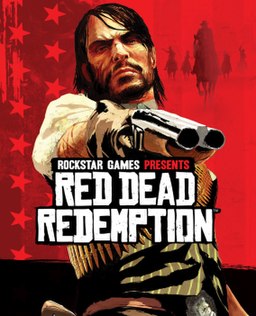 |
| image courtesy of wikipedia.org |
In Red Dead Redemption, you play as John Marston, a reformed outlaw who has been forced by the government to kill his former running mates in exchange for his family and to clear his name. Marston is sent to the territory of New Austin to kill his former friend Bill Williamson, but instead it is Marston that nearly dies. From there, Marston must rely on help from a wide variety of characters, from a ranch hand's daughter named Bonnie McFarlane, a snake oil salesman, an aging gunslinger now residing in Mexico, and a crazed treasure hunter who is not above digging up corpses in his never-ending search for treasure. The main storyline is quite immense, with 57 missions in all. While there is some variety in the missions, from herding cattle to racing horses, most of the missions usually end with John shooting at a whole bunch of people. It gets kind of repetitive after a while, but at least the missions have more variety than, say, GTA4. Also, there are a few 'stranger' missions, in which Marston encounters a series of random characters and tries to help them out in some way, from giving a sick person medicine to convincing a man not to cheat on his wife. These stranger missions are a nice diversion to the main storyline, and add some variety to the game.
What separates Red Dead Redemption from other western games is all the things that you can do outside of the storyline. Players can wander the great outdoors, from the deserts of Mexico to the forests up north, and hunt down a variety of animals, from wolves to rabbits to bears. Skinning those animals will give your player meat and fur to sell to shops around the area in exchange for money, as will plants that you can pick up along the way. Also, a number of random events can occur during the game, from a person having their horse stolen or having a relative captured and hung by outlaws. If you choose to do so, you can help out these people in need and build up your honor and fame ratings. Although all the random events can be a little annoying at times if you really want to go somewhere, it does break the monotony of the game outside the story. There are also a number of parlor games to play, from poker to blackjack and five finger-fillet, which I wasn't good at at all.
The controls to Red Dead Redemption are rather straightforward and easy to master. Gunfights are quite well done here, and the 'dead-eye' meter allows you to slow down time and pick apart your enemies until the meter runs out. The hand-to-hand combat in this game is a little awkward at best, and the dueling system in this game was a bit confusing at times to me, but overall the game has smooth controls. Graphically, the game is superb, as the old west setting looks spectacular and the character models are nicely rendered. The one problem with the graphics is that you will get glitches from time to time. For example, I was in the middle of the road one time and all of a sudden a chair appears. As for the sound, Red Dead Redemption features one of the best scores I've ever heard from a video game, as the soundtrack is reminiscent of an Enrico Morricone scored western. Also, the sound effects of guns, animals, and trains, etc, as well as the voice acting, are all top notch.
Overall, I have very few bones to pick with this game. Red Dead Redemption is a top-notch game with a variety of activities to do and a great storyline to boot. True, some of the missions can be repetitive, and you may not like a lot of the characters who you're forced to work with (personally, I couldn't stand Nigel, or De Santa, among others) but if you can get past those problems, then you'll invest hours and hours of time into this game and never get bored. This is easily the best western video game of all time, and one of Rockstar's stronger efforts. I'd give Red Dead Redemption a 9.3 out of 10. Well, thanks for reading, and if you any ideas for future posts, or thoughts about this post, than either leave a comment on the blog or send them to me at e-mail at KtheC2001@gmail.com.
Wednesday, March 9, 2011
Utah Jazz vs. Houston Rockets, Game 4, 1997 Western Conference Finals, May 25, 1997
For the 250th post at The Canon Review, I decided to do a post much like the first post, in which I watch and review a classic basketball game. Actually, that was the original purpose of this blog, but about a week later I figured I'd get bored with the concept and made it more of a variety blog. Anyway, this game is a classic battle between the Utah Jazz and the Houston Rockets in game 4 of the 1997 Western Conference Finals, and what a battle it was. The game featured five future Hall of Famers, with Karl Malone and John Stockton on the Jazz, and Hakeem Olajuwon, Charles Barkley, and Clyde Drexler on the Rockets. Naturally, in this 95-92 game won by the Rockets, it would not come down to any of these great players, but a role player, as the Rockets' Eddie Johnson sunk a three pointer at the buzzer to give the game to the Rockets. A few notes about this game:
- The first thing I noticed about this game is how ugly the Rockets' uniforms are. During this time, the Rockets were wearing these white pinstriped uniforms with a giant cartoon like logo on the chest and the text done in red and blue. They looked like pajamas, to be honest. The Jazz didn't exactly have the greatest uniforms during this era either, but they looked much sharper than the Rockets' gear, at least. Here's a picture so you can decide for yourself.
- The Rockets seemed to have a rather simple offensive plan. Bring the ball up, throw it in deep to Olajuwon or Barkley in the post, and have them either take a shot if they're single covered or pass back out if the double team came. Not very imaginative, but when you have players like Olajuwon and Barkley, you don't have to overthink to score points. While Barkley and Karl Malone battled for most of the game, Olajuwon had guys like Greg Ostertag and Greg Foster playing him, giving the Rockets a huge advantage, and despite early foul trouble, Hakeem was easily the best player on the Rockets, scoring 27 points, grabbing 10 boards and blocking 4 shots. However, the reason the Jazz hung around and kept this game so close is that the Rockets could not make them pay for double teaming their two star post players. The Jazz would never have the man guarding Drexler double down because that's just asking for trouble, so the Rockets would pass it out to guys like Matt Maloney, Sedale Threatt, and Mario Elie and hope their shots would fall. Well, Maloney and Elie were a combined 3-11 from downtown, and Drexler was 1-4 from three point range himself, as the Rockets missed too many open shots. They did get the big one at the end from Johnson, though.
- The best matchup in this game was the Malone-Barkley duo at the power forward position. At the start, it looked as if Malone would dominate, as he could do whatever he wanted to against Barkley early on. But Malone got into some foul trouble in the first quarter and once he came back in, he didn't seem like the same player he was at the beginning of the game. Malone may have finished with 22 points, but he only went 10-28 shooting from the field and shot a mere two free throws. Barkley may not have been the greatest defender to play the game, but he did a nice job on Malone throughout the game, with a little help from Olajuwon when needed. On the offensive end, Barkley made his presence felt by scoring 20 points and shooting 11-12 from the free throw line. As the game became more and more physical, it was Barkley that held the advantage despite being the smaller man, as he seemed to be the aggressor in this matchup.
- Speaking of matchups, John Stockon of the Jazz was matched up against Matt Maloney for much of the game, and Stockton just owned him. Maloney was particularly flustered by the pick and roll, and he got no help from the interior defenders who couldn't leave Malone to chase after Stockton. On a night where Malone struggled, Stockton picked up the slack with 22 points on 9-12 shooting from the field. However, one thing I did notice was that reverse PG Sedale Threatt seemed to have more success against Stockton in the limited time they were matched up together, which makes me wonder why they didn't give Threatt more playing time. Since Stockton basically owned Maloney throughout the enitre game and series, would it really hurt to give Threatt more of a chance and see if he can do any better. Or maybe the Rockets could have switched Mario Elie on Stockton and have Maloney guard Jeff Hornacek. Just a thought.
- The officiating during this game was not exactly the best in the history of the game. Foul calls were way too inconsistent, as sometimes ticky-tac fouls would be called while full on assaults would go unchecked. Barkley was throwing people all over the place and somehow only got three fouls. Malone got called for two fouls early on that either were questionable or on someone else, and he had to sit down and wasn't the same player afterwards, so the refs definitely had an impact on this game. Both coaches drew technical fouls, and Utah's Jerry Sloan came very close to drawing a second after Foster was smacked hard without a call. Also, this game wasn't the best played game either, as there were a bunch of missed layups. Shandon Anderson of the Jazz missed four in a row during the second quarter, and the two teams didn't exactly remind anyone of the Showtime Lakers.
- Before his game winning shot, Eddie Johnson was 1-4 from the field. But in game three, Johnson came off the bench and scored 31 points, so you've got to think that the Jazz should have considered him a possible option for the winning shot. But on the final inbounds play with 6.2 seconds to go, the Jazz collapsed on Hakeem, not a bad idea, then doubled Drexler in the corner hoping to trap him and force a tough shot. But Drexler kept his cool, passed it to Maloney, who found a wide-open Johnson behind the three-point line, and Johnson promptly nailed the shot. On the possession prior to Johnson's heroics, the Jazz had two shots to take the lead, as Stockton missed an open 18-footer, then Byron Russell missed a contested three from the corner. Interestingly enough, Johnson may not have been in the game had Mario Elie not fouled out with three minutes left, as Johnson wasn't lighting up the scoreboard that night. But when pressed into action, the veteran with the smooth shot came through.
After this game, the Rockets had evened the series at two games apiece. However, the Jazz won the next two games (with Stockton clinching game 6 with a late three pointer) and advanced to the Finals. As it turned out, this was the Rockets' best shot at reaching the Finals again with Olajuwon, as they had an injury-plagued season the next year, then lost in the first round in the playoffs to the Utah Jazz in Clyde Drexler's final season. The Jazz, meanwhile, lost to the Bulls in six games in the 1997 season, then repeated the same feat the next year. Well, thanks for reading, and if you any ideas for future posts, or thoughts about this post, than either leave a comment on the blog or send them to me at e-mail at KtheC2001@gmail.com.
- The first thing I noticed about this game is how ugly the Rockets' uniforms are. During this time, the Rockets were wearing these white pinstriped uniforms with a giant cartoon like logo on the chest and the text done in red and blue. They looked like pajamas, to be honest. The Jazz didn't exactly have the greatest uniforms during this era either, but they looked much sharper than the Rockets' gear, at least. Here's a picture so you can decide for yourself.
 |
| Photo courtesy of sportslogos.net |
- The Rockets seemed to have a rather simple offensive plan. Bring the ball up, throw it in deep to Olajuwon or Barkley in the post, and have them either take a shot if they're single covered or pass back out if the double team came. Not very imaginative, but when you have players like Olajuwon and Barkley, you don't have to overthink to score points. While Barkley and Karl Malone battled for most of the game, Olajuwon had guys like Greg Ostertag and Greg Foster playing him, giving the Rockets a huge advantage, and despite early foul trouble, Hakeem was easily the best player on the Rockets, scoring 27 points, grabbing 10 boards and blocking 4 shots. However, the reason the Jazz hung around and kept this game so close is that the Rockets could not make them pay for double teaming their two star post players. The Jazz would never have the man guarding Drexler double down because that's just asking for trouble, so the Rockets would pass it out to guys like Matt Maloney, Sedale Threatt, and Mario Elie and hope their shots would fall. Well, Maloney and Elie were a combined 3-11 from downtown, and Drexler was 1-4 from three point range himself, as the Rockets missed too many open shots. They did get the big one at the end from Johnson, though.
- The best matchup in this game was the Malone-Barkley duo at the power forward position. At the start, it looked as if Malone would dominate, as he could do whatever he wanted to against Barkley early on. But Malone got into some foul trouble in the first quarter and once he came back in, he didn't seem like the same player he was at the beginning of the game. Malone may have finished with 22 points, but he only went 10-28 shooting from the field and shot a mere two free throws. Barkley may not have been the greatest defender to play the game, but he did a nice job on Malone throughout the game, with a little help from Olajuwon when needed. On the offensive end, Barkley made his presence felt by scoring 20 points and shooting 11-12 from the free throw line. As the game became more and more physical, it was Barkley that held the advantage despite being the smaller man, as he seemed to be the aggressor in this matchup.
- Speaking of matchups, John Stockon of the Jazz was matched up against Matt Maloney for much of the game, and Stockton just owned him. Maloney was particularly flustered by the pick and roll, and he got no help from the interior defenders who couldn't leave Malone to chase after Stockton. On a night where Malone struggled, Stockton picked up the slack with 22 points on 9-12 shooting from the field. However, one thing I did notice was that reverse PG Sedale Threatt seemed to have more success against Stockton in the limited time they were matched up together, which makes me wonder why they didn't give Threatt more playing time. Since Stockton basically owned Maloney throughout the enitre game and series, would it really hurt to give Threatt more of a chance and see if he can do any better. Or maybe the Rockets could have switched Mario Elie on Stockton and have Maloney guard Jeff Hornacek. Just a thought.
- The officiating during this game was not exactly the best in the history of the game. Foul calls were way too inconsistent, as sometimes ticky-tac fouls would be called while full on assaults would go unchecked. Barkley was throwing people all over the place and somehow only got three fouls. Malone got called for two fouls early on that either were questionable or on someone else, and he had to sit down and wasn't the same player afterwards, so the refs definitely had an impact on this game. Both coaches drew technical fouls, and Utah's Jerry Sloan came very close to drawing a second after Foster was smacked hard without a call. Also, this game wasn't the best played game either, as there were a bunch of missed layups. Shandon Anderson of the Jazz missed four in a row during the second quarter, and the two teams didn't exactly remind anyone of the Showtime Lakers.
- Before his game winning shot, Eddie Johnson was 1-4 from the field. But in game three, Johnson came off the bench and scored 31 points, so you've got to think that the Jazz should have considered him a possible option for the winning shot. But on the final inbounds play with 6.2 seconds to go, the Jazz collapsed on Hakeem, not a bad idea, then doubled Drexler in the corner hoping to trap him and force a tough shot. But Drexler kept his cool, passed it to Maloney, who found a wide-open Johnson behind the three-point line, and Johnson promptly nailed the shot. On the possession prior to Johnson's heroics, the Jazz had two shots to take the lead, as Stockton missed an open 18-footer, then Byron Russell missed a contested three from the corner. Interestingly enough, Johnson may not have been in the game had Mario Elie not fouled out with three minutes left, as Johnson wasn't lighting up the scoreboard that night. But when pressed into action, the veteran with the smooth shot came through.
After this game, the Rockets had evened the series at two games apiece. However, the Jazz won the next two games (with Stockton clinching game 6 with a late three pointer) and advanced to the Finals. As it turned out, this was the Rockets' best shot at reaching the Finals again with Olajuwon, as they had an injury-plagued season the next year, then lost in the first round in the playoffs to the Utah Jazz in Clyde Drexler's final season. The Jazz, meanwhile, lost to the Bulls in six games in the 1997 season, then repeated the same feat the next year. Well, thanks for reading, and if you any ideas for future posts, or thoughts about this post, than either leave a comment on the blog or send them to me at e-mail at KtheC2001@gmail.com.
Tuesday, March 8, 2011
A Review of Random 80s Commercials, and an Announcement
Before I delve in to the 249th post on The Canon Review, I have a slight announcement to make. As the two people that read this blog on a regular basis know, earlier in the year I attempted to undertake a project in which I would watch one video from every single entry featured in the WWE Encyclopedia. Well, as of now, that project is on hiatus. The main reason is that I have found the posts to be too long and really kind of dull, plus it takes like eight hours to do one post. So, that's that for now. Now onto some commercials that aired in the 1980s. Why? you ask. Well, I don't know, but after watching the first video featured in this review, I was just inspired to watch more 80s ads.
Commercial One: WSPA "We're the Team" Promo
WSPA is the CBS affiliate in my neck of the woods, and in 1987 the masterminds at WSPA put together this one minute promo for their news team, proclaiming that "We're the Team". The team of what is never quite explained, but whatever. In this ad, the Eyewitness News team works on stories while weatherman Jack Roper brings a pizza for everybody, because I guess he didn't have anything else to do. While this commercial is about as cheesy as that pizza, and the song isn't very good, I actually prefer commercials like this for the news instead of the crap we get today, where they basically tell you that you should be afraid of everything and anything and you'll suffer great hardship if you don't tune in at 5, 5:30, 6, 11, 11:59, and 4:20 a.m. Compared to that, I'd much rather watch a bunch of newscasters trying their hardest to be the team.
Commercial 2: Exxon Commercial from 1989
With gas prices about to go up to $7.95 a gallon, here's a look at a gas station commercial from 1989, where Exxon promises that they have the correct fuel for all the ten million people buying a new car that year. Also, there's a lot of shots of a tiger in this commercial, so one could say that this commercial is running on 'tiger blood'. The most notable part of this ad to me was the lame jingle in it, which goes as follows: 'Turn the Key, Feel Free, Eeeeexxxxxxxoonnn Gasoline'. Of course, Exxon had a whole lot of other troubles in 1989 besides a lame theme.
Commercial 3: 1984 Cool Whip Commercial
This commercial features a family sitting down to eat some pudding when the wise cracking announcer shares his disbelief that the mother is only going to serve plain pudding. He strongly suggests, along with the help of a jingle singer, that she slathers some Cool Whip on it, and her husband and daughter agree. Way to usurp her authority there announcer guy. Another lame jingle is included in this commercial, with the lyrics being 'couldn't they, shouldn't they, wouldn't they love it more with Cool Whip?' Personally, I wouldn't, but to each their own I suppose.
Commercial 4: Commodore 64 Commercial from 1982
Those clever people over at Commodore 64 had a great idea in this commercial. They decided to ask the competion's computers which is the best value to buy based on price and memory, and guess what? Each computer, the IBM, the Apple, and the Radio Shack, all said Commodore 64. Sure, they could have just made a program designed to display the words Commodore 64, but since when have you known advertisers to mislead the audience about a product? To test this theory out, I asked my computer which is the best value on the market. For some reason, the answer that came up was a Digitus 1000, so I think I should rewrite the program. For all I know, the Commodore 64 was the best computer on the market at this time, but I wouldn't trust the claims of this commercial as far as I could throw it. Although, it would be mighty hard to throw a commercial, but I digress.
Well, it's getting late, so I'm going to bed. Hopefully, you've enjoyed this mini blast from the past. Well, thanks for reading, and if you any ideas for future posts, or thoughts about this post, than either leave a comment on the blog or send them to me at e-mail at KtheC2001@gmail.com.
Commercial One: WSPA "We're the Team" Promo
WSPA is the CBS affiliate in my neck of the woods, and in 1987 the masterminds at WSPA put together this one minute promo for their news team, proclaiming that "We're the Team". The team of what is never quite explained, but whatever. In this ad, the Eyewitness News team works on stories while weatherman Jack Roper brings a pizza for everybody, because I guess he didn't have anything else to do. While this commercial is about as cheesy as that pizza, and the song isn't very good, I actually prefer commercials like this for the news instead of the crap we get today, where they basically tell you that you should be afraid of everything and anything and you'll suffer great hardship if you don't tune in at 5, 5:30, 6, 11, 11:59, and 4:20 a.m. Compared to that, I'd much rather watch a bunch of newscasters trying their hardest to be the team.
Commercial 2: Exxon Commercial from 1989
With gas prices about to go up to $7.95 a gallon, here's a look at a gas station commercial from 1989, where Exxon promises that they have the correct fuel for all the ten million people buying a new car that year. Also, there's a lot of shots of a tiger in this commercial, so one could say that this commercial is running on 'tiger blood'. The most notable part of this ad to me was the lame jingle in it, which goes as follows: 'Turn the Key, Feel Free, Eeeeexxxxxxxoonnn Gasoline'. Of course, Exxon had a whole lot of other troubles in 1989 besides a lame theme.
Commercial 3: 1984 Cool Whip Commercial
This commercial features a family sitting down to eat some pudding when the wise cracking announcer shares his disbelief that the mother is only going to serve plain pudding. He strongly suggests, along with the help of a jingle singer, that she slathers some Cool Whip on it, and her husband and daughter agree. Way to usurp her authority there announcer guy. Another lame jingle is included in this commercial, with the lyrics being 'couldn't they, shouldn't they, wouldn't they love it more with Cool Whip?' Personally, I wouldn't, but to each their own I suppose.
Commercial 4: Commodore 64 Commercial from 1982
Those clever people over at Commodore 64 had a great idea in this commercial. They decided to ask the competion's computers which is the best value to buy based on price and memory, and guess what? Each computer, the IBM, the Apple, and the Radio Shack, all said Commodore 64. Sure, they could have just made a program designed to display the words Commodore 64, but since when have you known advertisers to mislead the audience about a product? To test this theory out, I asked my computer which is the best value on the market. For some reason, the answer that came up was a Digitus 1000, so I think I should rewrite the program. For all I know, the Commodore 64 was the best computer on the market at this time, but I wouldn't trust the claims of this commercial as far as I could throw it. Although, it would be mighty hard to throw a commercial, but I digress.
Well, it's getting late, so I'm going to bed. Hopefully, you've enjoyed this mini blast from the past. Well, thanks for reading, and if you any ideas for future posts, or thoughts about this post, than either leave a comment on the blog or send them to me at e-mail at KtheC2001@gmail.com.
Saturday, March 5, 2011
Canon Magazine Review: Pro Wrestling Illustrated, August 2000
Here is a review of a magazine I, or somebody else, purchased for my reading enjoyment some 10 years ago, the August 2000 issue of Pro Wrestling Illustrated. This issue is apparently a Special Collector's Issue, whatever that means, and covers 'Y2K's Greatest Cards'. Those cards being Wrestlemania 2000, WCW Uncensored 2000, and ECW Living Dangerously 2000. If those were 2000's greatest cards, then 2000 must have been a lot worse than I remembered. Anyway, here's the cover of the issue, courtesy of the PWI website:

The magazine starts with publisher Stu Saks offering his opinion about the return of Eric Bischoff to a power position of WCW, just two months after Bischoff told a reporter that it would take 'more than an act of congress and less than an act of God' for WCW to reinstall him as head booker. In hindsight, they either should have just given Bischoff full power or find somebody else instead of going with the failed Bischoff-Russo regime. Up next is the letters section, and a common theme in the letters is how much WCW sucks. Other letters praised Jerry Lawler for his commentary, Balls Mahoney for his hardcore wrestling skills, and another letter called for the NWA Title to be recognized as an official world title. At the time, the NWA Title was held by Naoya Ogawa, not exactly a household name today. Although he did beat Gary Goodridge at Pride 6, so at least he had shoot fighting credibility. Following the letters, we get more columns, including ringside with Will Welsh, in which he writes about Bischoff, the surprising track record of ECW's Judge Jeff Jones, and Chris Jericho's call for Hulk Hogan to retire on his website. Dave Lenker follows with his column, where he implores Bret Hart to retire for good (which he would) and talks about Jake Roberts's 'performance' in Beyond the Mat. It's been a while since I've seen that film, but Jake the Snake doesn't come off too well,
More columns follow, as Brandi Mankiewicz berates readers and slams Hulk Hogan just like everyone else was around this time for not stepping back and letting the young stars shine. Meanwhile, Frank Krewda gets all nostalgic and wishes wrestling would turn back the clock some, bringing back such concepts as monthly title defenses, a clear line between good vs. evil where pimps are not celebrated, and referees who actually withold the rules instead of looking like clueless putzes, much like the referees in ECW.
The magazine's cover story is next, about the greatest cards of 2000 or something like that. Up first is a recap of WCW Uncensored 2000, which the article damns with faint praise by saying it was at least better than Uncensored 1995. I'd disagree with that, but then that would probably mean that I'd have to go back and watch both shows to compare them, and I'd rather not. The main event of Uncensored 2000 was the same as Uncensored 1999, a mess of a match between Hulk Hogan and Ric Flair, this one being a strap match. Even the recaper seemed bored by this show, and it's their job over at PWI to overhype everything. According to the article, the best moment was a move similar to one seen in ECW years before, in which the Wall chokeslammed Crowbar off a scaffold.
Up next is Wrestlemania 2000, which only cost $34.95 on PPV. Now a days, it cost 40 dollars to buy WWE Coal Miner's Glove or whatever gimmick match they push there PPVs around these days, but I digress. Wrestlemania 2000 was built around the main event in which a McMahon was in every corner, with Vince McMahon representing The Rock, Stephanie in Triple-H's corner, Shane with the Big Show, and Linda in Mick Foley's corner. The match ended in a shocking development when Linda McMahon somehow landed on top of Triple-H and the ref counted to three, making her the first female WWE World Champion. Actually, Vince turned on The Rock, then after the match The Rock destroyed everybody and gave Stephanie a People's Elbow. Also on the card, Kurt Angle lost two titles without being pinned (the Intercontental and European to Chris Benoit and Chris Jericho, respectively), Pete Rose took a stinkface from Rikishi, and the three way ladder match between the Hardys, the Dudleys, and Edge and Christian stole the show. Here are highlights from that match, set to Chris Benoit's WCW theme for some reason:
The last of the big three supercards to be profiled was ECW's Living Dangerously 2000, which I remember for two reasons. One was the Dusty Rhodes vs. Steve Corino match that was an entertaining brawl full of blood, and the other was New Jack and Grimes' fall off a scaffold in which Grimes nearly killed New Jack by landing on his head. Other than that, the main event was Super Crazy vs. Rhino for the television title, which drew high praise from the magazine despite the lack of star power in the match, and a three team tag match was featured in which the Impact Players won the tag titles from Mike Awesome and Raven and Masato Tanaka and Tommy Dreamer. Plus, Joey Styles and Cyrus played some Hardcore Revolution on the air, which I'm sure sucked.
After a color section featuring pictures from the three previously mentioned supercards, there's a quick article about the 2000 Super 8 Tournament hosted by ECWA. Christopher Daniels won the eight man tournament by defeating the 'Black Nature Boy' Scoot Andrews in the finals. I always thought Andrews would make it further in wrestling, but he just never got his big break and retired in 2005. An interview with Rob Van Dam follows, and Van Dam talks at length about his injury suffered before his feud with Mike Awesome over the ECW Title, as well as his experiences in WCW and the WWF and he discusses what ECW must do in order to take the next step. It seems hard to believe now, but around this time ECW was being talked about as a company that could one day challenge the WWF and surpass WCW by the end of 2000. Of course, ECW ran out of money and closed up shop in 2001, but at the time the future looked bright. Anyway, Van Dam also talks about training with The Sheik and his endorsement of marijuana. Unlike most PWI interviews, this one actually seems legit and is still an interesting read today, as RVD is quite outspoken on a variety of topics.
The last major article is a list of the top 12 Supercard matches in Wrestling history according to PWI. Want to know the list? Well here it is:
1. Randy Savage vs. Ricky Steamboat, Wrestlemania 3
2. Bruno Sammartino vs. Pedro Morales, Shea Stadium, 9/30/72
3. Razor Ramon vs. Shawn Michaels, Wrestlemania 10
4. Hulk Hogan vs. Andre the Giant, Wrestlemania 3
5. Ric Flair vs. Harley Race, Starrcade 83
6. Rob Van Dam vs. Jerry Lynn, Living Dangerously 99
7. Kerry Von Erich vs. Ric Flair, David Von Erich Memorial Parade of Champions, 05/06/84
8. Antonio Inoki vs. Ric Flair, Collision in Korea, 4/29/95
9. Bruno Sammartino vs. Larry Zbyszko, Showdown at Shea, 8/9/80
10. Bret Hart vs. Owen Hart, Summerslam 1994
11. Undertaker vs. Mankind, King of the Ring 1998
12. Ricky Steamboat vs. Ric Flair, Chi-Town Rumble 1989
I've seen every match on this list except for number 2, and of those 12, only numbers 1, 3, 10, and 12 would probably make my list, while 5, 6, 7, and 11 were decent matches and the rest weren't very good. Anyway, this seems like a topic that I might revisit in the near future. The magazine finishes with a few columns. Media watch reveals that the WWF will soon be moving Monday Night Raw to TNN and also discusses Beyond the Mat. Meanwhile, Dave Rosenbaum wonders just what WCW can do to dig themselves out of their hole and also wonders if WCW is going the way of exctinction. As it turns out, Rosenbaum was right on that point. Harry Burkett writes about the Impact Players and wonders why they must antagonize everybody they come across. Well, it's because Lance Storm is a jerk, I guess. The Japan and Mexico reports follow. In Japan, the Super J Cup 2000 is about to take place while in All-Japan, Jun Akiyama finally pinned Mitsuharu Misawa in a singles match. Meanwhile in Mexico, Abismo Negro won the fourth annual AAA Rey de Reyes tournament by disqualification, and Perro Aguayo is in the midst of wrapping up his career, although like any good wrestler, Aguayo would eventually come back to the ring. Finally, the monthly rankings follow, with The Rock ranked at number one this month while the Dudleys top the tag ranks, and there's an advertisement for ECW Hardcore Revolution on the back cover, which just serves to remind me how bad that game is.
Overall, this wasn't too bad of an issue, thanks in large part to the RVD interview. I do have to question the decision to cover WCW Uncensored at such length, but then again I don't think they had any other choice, as Super Brawl was even worse that year. Overall, I'd give it a 5.85 out of 10. Well, thanks for reading a review of me reading, and if you have any thoughts about this or other posts, or ideas for future reviews, than share them either by leaving a comment or by e-mail at kthec2001@gmail.com.

The magazine starts with publisher Stu Saks offering his opinion about the return of Eric Bischoff to a power position of WCW, just two months after Bischoff told a reporter that it would take 'more than an act of congress and less than an act of God' for WCW to reinstall him as head booker. In hindsight, they either should have just given Bischoff full power or find somebody else instead of going with the failed Bischoff-Russo regime. Up next is the letters section, and a common theme in the letters is how much WCW sucks. Other letters praised Jerry Lawler for his commentary, Balls Mahoney for his hardcore wrestling skills, and another letter called for the NWA Title to be recognized as an official world title. At the time, the NWA Title was held by Naoya Ogawa, not exactly a household name today. Although he did beat Gary Goodridge at Pride 6, so at least he had shoot fighting credibility. Following the letters, we get more columns, including ringside with Will Welsh, in which he writes about Bischoff, the surprising track record of ECW's Judge Jeff Jones, and Chris Jericho's call for Hulk Hogan to retire on his website. Dave Lenker follows with his column, where he implores Bret Hart to retire for good (which he would) and talks about Jake Roberts's 'performance' in Beyond the Mat. It's been a while since I've seen that film, but Jake the Snake doesn't come off too well,
More columns follow, as Brandi Mankiewicz berates readers and slams Hulk Hogan just like everyone else was around this time for not stepping back and letting the young stars shine. Meanwhile, Frank Krewda gets all nostalgic and wishes wrestling would turn back the clock some, bringing back such concepts as monthly title defenses, a clear line between good vs. evil where pimps are not celebrated, and referees who actually withold the rules instead of looking like clueless putzes, much like the referees in ECW.
The magazine's cover story is next, about the greatest cards of 2000 or something like that. Up first is a recap of WCW Uncensored 2000, which the article damns with faint praise by saying it was at least better than Uncensored 1995. I'd disagree with that, but then that would probably mean that I'd have to go back and watch both shows to compare them, and I'd rather not. The main event of Uncensored 2000 was the same as Uncensored 1999, a mess of a match between Hulk Hogan and Ric Flair, this one being a strap match. Even the recaper seemed bored by this show, and it's their job over at PWI to overhype everything. According to the article, the best moment was a move similar to one seen in ECW years before, in which the Wall chokeslammed Crowbar off a scaffold.
Up next is Wrestlemania 2000, which only cost $34.95 on PPV. Now a days, it cost 40 dollars to buy WWE Coal Miner's Glove or whatever gimmick match they push there PPVs around these days, but I digress. Wrestlemania 2000 was built around the main event in which a McMahon was in every corner, with Vince McMahon representing The Rock, Stephanie in Triple-H's corner, Shane with the Big Show, and Linda in Mick Foley's corner. The match ended in a shocking development when Linda McMahon somehow landed on top of Triple-H and the ref counted to three, making her the first female WWE World Champion. Actually, Vince turned on The Rock, then after the match The Rock destroyed everybody and gave Stephanie a People's Elbow. Also on the card, Kurt Angle lost two titles without being pinned (the Intercontental and European to Chris Benoit and Chris Jericho, respectively), Pete Rose took a stinkface from Rikishi, and the three way ladder match between the Hardys, the Dudleys, and Edge and Christian stole the show. Here are highlights from that match, set to Chris Benoit's WCW theme for some reason:
The last of the big three supercards to be profiled was ECW's Living Dangerously 2000, which I remember for two reasons. One was the Dusty Rhodes vs. Steve Corino match that was an entertaining brawl full of blood, and the other was New Jack and Grimes' fall off a scaffold in which Grimes nearly killed New Jack by landing on his head. Other than that, the main event was Super Crazy vs. Rhino for the television title, which drew high praise from the magazine despite the lack of star power in the match, and a three team tag match was featured in which the Impact Players won the tag titles from Mike Awesome and Raven and Masato Tanaka and Tommy Dreamer. Plus, Joey Styles and Cyrus played some Hardcore Revolution on the air, which I'm sure sucked.
After a color section featuring pictures from the three previously mentioned supercards, there's a quick article about the 2000 Super 8 Tournament hosted by ECWA. Christopher Daniels won the eight man tournament by defeating the 'Black Nature Boy' Scoot Andrews in the finals. I always thought Andrews would make it further in wrestling, but he just never got his big break and retired in 2005. An interview with Rob Van Dam follows, and Van Dam talks at length about his injury suffered before his feud with Mike Awesome over the ECW Title, as well as his experiences in WCW and the WWF and he discusses what ECW must do in order to take the next step. It seems hard to believe now, but around this time ECW was being talked about as a company that could one day challenge the WWF and surpass WCW by the end of 2000. Of course, ECW ran out of money and closed up shop in 2001, but at the time the future looked bright. Anyway, Van Dam also talks about training with The Sheik and his endorsement of marijuana. Unlike most PWI interviews, this one actually seems legit and is still an interesting read today, as RVD is quite outspoken on a variety of topics.
The last major article is a list of the top 12 Supercard matches in Wrestling history according to PWI. Want to know the list? Well here it is:
1. Randy Savage vs. Ricky Steamboat, Wrestlemania 3
2. Bruno Sammartino vs. Pedro Morales, Shea Stadium, 9/30/72
3. Razor Ramon vs. Shawn Michaels, Wrestlemania 10
4. Hulk Hogan vs. Andre the Giant, Wrestlemania 3
5. Ric Flair vs. Harley Race, Starrcade 83
6. Rob Van Dam vs. Jerry Lynn, Living Dangerously 99
7. Kerry Von Erich vs. Ric Flair, David Von Erich Memorial Parade of Champions, 05/06/84
8. Antonio Inoki vs. Ric Flair, Collision in Korea, 4/29/95
9. Bruno Sammartino vs. Larry Zbyszko, Showdown at Shea, 8/9/80
10. Bret Hart vs. Owen Hart, Summerslam 1994
11. Undertaker vs. Mankind, King of the Ring 1998
12. Ricky Steamboat vs. Ric Flair, Chi-Town Rumble 1989
I've seen every match on this list except for number 2, and of those 12, only numbers 1, 3, 10, and 12 would probably make my list, while 5, 6, 7, and 11 were decent matches and the rest weren't very good. Anyway, this seems like a topic that I might revisit in the near future. The magazine finishes with a few columns. Media watch reveals that the WWF will soon be moving Monday Night Raw to TNN and also discusses Beyond the Mat. Meanwhile, Dave Rosenbaum wonders just what WCW can do to dig themselves out of their hole and also wonders if WCW is going the way of exctinction. As it turns out, Rosenbaum was right on that point. Harry Burkett writes about the Impact Players and wonders why they must antagonize everybody they come across. Well, it's because Lance Storm is a jerk, I guess. The Japan and Mexico reports follow. In Japan, the Super J Cup 2000 is about to take place while in All-Japan, Jun Akiyama finally pinned Mitsuharu Misawa in a singles match. Meanwhile in Mexico, Abismo Negro won the fourth annual AAA Rey de Reyes tournament by disqualification, and Perro Aguayo is in the midst of wrapping up his career, although like any good wrestler, Aguayo would eventually come back to the ring. Finally, the monthly rankings follow, with The Rock ranked at number one this month while the Dudleys top the tag ranks, and there's an advertisement for ECW Hardcore Revolution on the back cover, which just serves to remind me how bad that game is.
Overall, this wasn't too bad of an issue, thanks in large part to the RVD interview. I do have to question the decision to cover WCW Uncensored at such length, but then again I don't think they had any other choice, as Super Brawl was even worse that year. Overall, I'd give it a 5.85 out of 10. Well, thanks for reading a review of me reading, and if you have any thoughts about this or other posts, or ideas for future reviews, than share them either by leaving a comment or by e-mail at kthec2001@gmail.com.
Tuesday, March 1, 2011
Canon Book Review: Undisputed: How to Become the World Champion in 1,372 Easy Steps
Last week, I picked up Dancing With the Stars contestant Chris Jericho's second book, Undisputed: How to Become the World Champion in 1,372 Easy Steps. Jericho's first autobiography, A Lion's Tale, is regarded as one of the best wrestling books ever written (I'd say it's the best, but that's just my opinion), and many people were eagerly waiting for his second book to drop. Undisputed picks up where A Lion Tale's ends, with Jericho making his debut promo for the WWF in 1999. From there, Jericho details his first run in the WWE, as well as the trials and tribulations of making it in the music business with his band Fozzy and his foray into acting.

While Jericho came into the WWE with a lot of fanfare, things didn't go to well for Y2J when he first arrived. Jericho details the struggles he had with adapting to the WWE style and the politics of the WWE locker room. Jericho also had a feud with Chyna that wasn't exactly a career highlight for him, and even got vehemently berated by Vince McMahon, who said that Jericho wasn't worth the paper his contract was written on. Eventually, Jericho would adapt and become one of the biggest superstars in the industry. In Undisputed, Jericho details some of the classic matches he had with superstars such as Shawn Michaels, Chris Benoit, The Rock, John Cena, Hulk Hogan, and Triple-H, among others. Jericho also delves into the backstage shenanigans of the WWE locker room, including his complicated relationship with WWE head Vince McMahon and his backstage fight with Goldberg in 2003 (in which Goldberg comes across as a bit of a wimp).
The other part of the book is about Jericho's metal band, Fozzy, which actually started out as a joke before rising to semi-prominence in the world of heavy metal. Fozzy's evolution from a gimmicky cover band to a legitimate metal band with their own material is covered in great length in Undisputed. In many ways, Fozzy's tribulations are quite similar to the same problems that Jericho had when he first became a wrestler, as Fozzy would sometimes play a gig in front of sparse audiences that didn't exactly have the warmest reception for Fozzy. But Fozzy did have their share of highlights, including stealing the show in front of 25,000 people at a metal festival in Germany and opening for such bands as Motorhead. I've heard some criticism over all the focus on his music career instead of his wrestling career in this book, but personally I found all the tales of Fozzy and the music industry quite entertaining, and it didn't take away from the book at all.
Readers of A Lion's Tale will know that Jericho has a great sense of humor, and that humor is on full display here in Undisputed. There are many, many instances where I laughed at some of the crazy stories presented here in this book, and it helps that Jericho is not someone who takes themselves seriously. Also, much like his fellow wrestler Mick Foley (who has never beaten Jericho in a wrestling match, as Jericho points out many times in this book), Jericho is not afraid to drop a name or two, and the book details all sorts of celebrity encounters Jericho had. From meeting big-time stars such as Wayne Gretzky (who called him Jeff Jericho) and Bruce Willis, to talking about ring ropes with Jon Lovitz and punching former pitcher Scott Erickson in the face, Jericho recounts each of these encounters with a sense of amusement. Jericho's attempts to break into Hollywood are also recounted here, including his appearance as a contestant of Celebrity Duets, where he was the first voted off. Hopefully, that's not an omen for his upcoming Dancing with the Stars stint.
While most of the book is filled with humor, Jericho also delves into some of the personal struggles he's gone through over the years, including his drunk driving arrest and the deaths of his mom and his close personal friends Eddie Guerrero and Chris Benoit. Jericho devotes an entire chapter to his mother in the book and it's a very poignant part of the book. He also devotes an entire chapter to the Benoit murder-suicide and how he dealt with the feelings of such a shocking event. While Jericho was one of Benoit's best friends and a man who considered Benoit a mentor, he also paints a realistic picture of Chris Benoit the man, who was a little eccentric at best. It's a very interesting and revealing look at the feelings Jericho was dealing with after the unspeakable tragedy committed by one of his best friends.
Overall, Undisputed is a worthy successor to A Lion's Tale and will probably go down as one of the best wrestling autobiographies out there along with Foley's Have A Nice Day and Bret Hart's Hitman: A Life in Tights. If you are a fan of wrestling and looking for something to read, I suggest you pick up this book as soon as possible. I'd give it a 9.25 out of 10. Well, thanks for reading, and if you any ideas for future posts, or thoughts about this post, than either leave a comment on the blog or send them to me at e-mail at KtheC2001@gmail.com.

While Jericho came into the WWE with a lot of fanfare, things didn't go to well for Y2J when he first arrived. Jericho details the struggles he had with adapting to the WWE style and the politics of the WWE locker room. Jericho also had a feud with Chyna that wasn't exactly a career highlight for him, and even got vehemently berated by Vince McMahon, who said that Jericho wasn't worth the paper his contract was written on. Eventually, Jericho would adapt and become one of the biggest superstars in the industry. In Undisputed, Jericho details some of the classic matches he had with superstars such as Shawn Michaels, Chris Benoit, The Rock, John Cena, Hulk Hogan, and Triple-H, among others. Jericho also delves into the backstage shenanigans of the WWE locker room, including his complicated relationship with WWE head Vince McMahon and his backstage fight with Goldberg in 2003 (in which Goldberg comes across as a bit of a wimp).
The other part of the book is about Jericho's metal band, Fozzy, which actually started out as a joke before rising to semi-prominence in the world of heavy metal. Fozzy's evolution from a gimmicky cover band to a legitimate metal band with their own material is covered in great length in Undisputed. In many ways, Fozzy's tribulations are quite similar to the same problems that Jericho had when he first became a wrestler, as Fozzy would sometimes play a gig in front of sparse audiences that didn't exactly have the warmest reception for Fozzy. But Fozzy did have their share of highlights, including stealing the show in front of 25,000 people at a metal festival in Germany and opening for such bands as Motorhead. I've heard some criticism over all the focus on his music career instead of his wrestling career in this book, but personally I found all the tales of Fozzy and the music industry quite entertaining, and it didn't take away from the book at all.
Readers of A Lion's Tale will know that Jericho has a great sense of humor, and that humor is on full display here in Undisputed. There are many, many instances where I laughed at some of the crazy stories presented here in this book, and it helps that Jericho is not someone who takes themselves seriously. Also, much like his fellow wrestler Mick Foley (who has never beaten Jericho in a wrestling match, as Jericho points out many times in this book), Jericho is not afraid to drop a name or two, and the book details all sorts of celebrity encounters Jericho had. From meeting big-time stars such as Wayne Gretzky (who called him Jeff Jericho) and Bruce Willis, to talking about ring ropes with Jon Lovitz and punching former pitcher Scott Erickson in the face, Jericho recounts each of these encounters with a sense of amusement. Jericho's attempts to break into Hollywood are also recounted here, including his appearance as a contestant of Celebrity Duets, where he was the first voted off. Hopefully, that's not an omen for his upcoming Dancing with the Stars stint.
While most of the book is filled with humor, Jericho also delves into some of the personal struggles he's gone through over the years, including his drunk driving arrest and the deaths of his mom and his close personal friends Eddie Guerrero and Chris Benoit. Jericho devotes an entire chapter to his mother in the book and it's a very poignant part of the book. He also devotes an entire chapter to the Benoit murder-suicide and how he dealt with the feelings of such a shocking event. While Jericho was one of Benoit's best friends and a man who considered Benoit a mentor, he also paints a realistic picture of Chris Benoit the man, who was a little eccentric at best. It's a very interesting and revealing look at the feelings Jericho was dealing with after the unspeakable tragedy committed by one of his best friends.
Overall, Undisputed is a worthy successor to A Lion's Tale and will probably go down as one of the best wrestling autobiographies out there along with Foley's Have A Nice Day and Bret Hart's Hitman: A Life in Tights. If you are a fan of wrestling and looking for something to read, I suggest you pick up this book as soon as possible. I'd give it a 9.25 out of 10. Well, thanks for reading, and if you any ideas for future posts, or thoughts about this post, than either leave a comment on the blog or send them to me at e-mail at KtheC2001@gmail.com.
Subscribe to:
Posts (Atom)